

The Role of Screens in Member Retention: 2026 Guide

Digital screens are the most underused retention tool in fitness centers and country clubs today. The role of screens in member retention goes far beyond displaying a class schedule. Strategically deployed digital displays create continuous communication touchpoints that reinforce belonging, motivate behavior, and reduce the annual member departure rate of approximately 28% that American gyms face. That figure represents real revenue walking out the door every year. Screens, when managed correctly, give you a direct line to every member on the floor, in the lobby, and at the point of sale.
How do screens enhance member engagement and reduce attrition?
Member engagement through screens works because screens are always on. A staff member can only speak to one person at a time. A well-placed screen speaks to every member who walks past it, every hour the facility is open.
The most direct engagement mechanism is real-time workout data. Displaying heart rate zones, personal stats, and leaderboards during workouts gives members a reason to push harder and come back tomorrow. Attendance improves when members can see their own effort reflected on screen. That visibility creates accountability, and accountability creates habit.

Member spotlights are a high-return tactic that most operators underuse. Featuring members with photos, goals, and progress transforms them into community advocates. A member who sees their own face on your screen tells three friends about your club. That emotional connection is difficult to replicate through any other channel.
Community content compounds the effect. Attendance streaks, group challenges, and unified messaging across all screens build a shared identity. Members who feel part of something larger than a monthly fee are far less likely to cancel.
Real-time leaderboards motivate competitive members and create natural social interaction on the floor.
Member spotlights build emotional loyalty and generate word-of-mouth referrals.
Challenge countdowns keep members focused on a goal beyond their next session.
Unified announcements across all screens prevent the “I didn’t know about that” cancellation conversation.
Pro Tip: Rotate member spotlights weekly, not monthly. Frequent recognition keeps more members engaged and gives your content team a reliable publishing rhythm.
What are the best practices for screen content strategy?
Content strategy is where most clubs fail. They install screens, fill them with promotions, and wonder why members stop looking up. The fix is a clear content ratio and a zone-based placement plan.
The 80/20 content rule is the standard: at least 80% of screen time goes to informational, motivational, or community content, and no more than 20% goes to promotions. Promotional content above that threshold causes member disengagement. Members begin to tune out screens the same way they tune out billboards, and once that habit forms, it is hard to reverse.
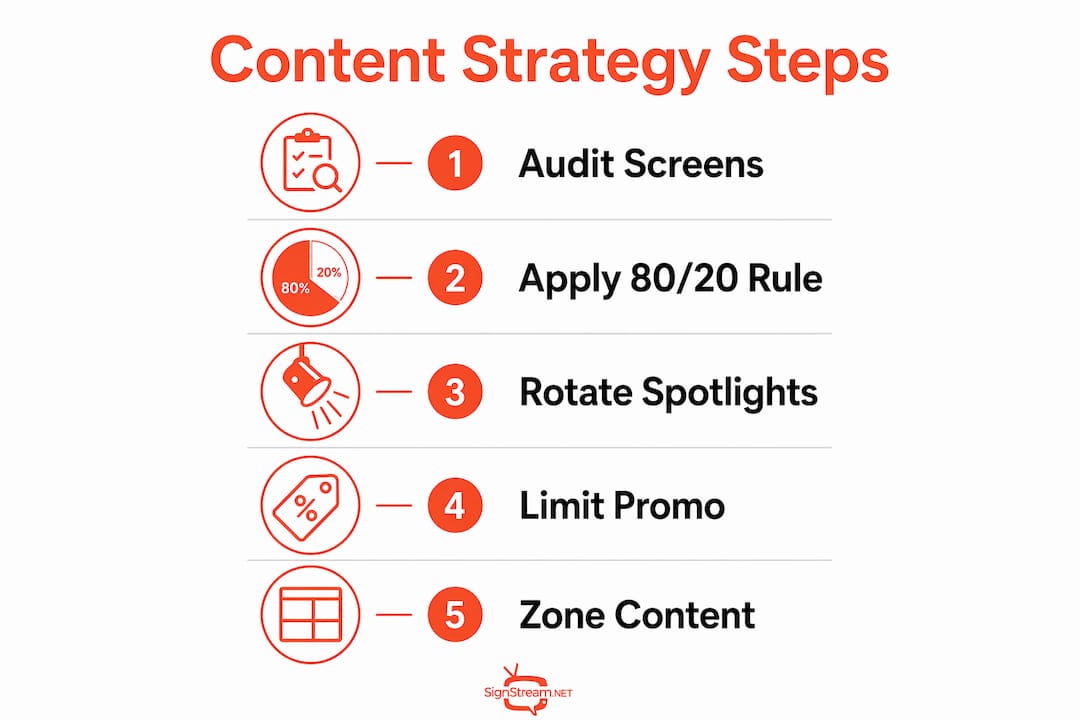
Zone-based content placement is the second pillar of a strong strategy. Cardio floors, lobbies, and retail areas each require different content to match what members are doing in that space. A member on a treadmill wants entertainment and motivation. A member in the lobby wants schedules and announcements. A member near the pro shop responds to product-focused content.
Here is a practical content planning framework for club managers:
Audit your current screen content. List every content type running on each screen and calculate the promotional percentage. Most clubs discover they are running 50% or more promotional content.
Map content to zones. Assign content categories to each screen location based on member behavior in that area.
Build a content calendar. Schedule updates at least weekly. Stale content is the fastest way to train members to ignore your screens.
Vary format and orientation. Portrait-mode screens outperform landscape for member spotlights and leaderboards. Landscape works better for entertainment and class schedules.
Collect feedback. Ask front desk staff what members comment on. That qualitative data is your fastest signal for what content is working.
Pro Tip: Avoid the “billboard effect” by limiting any single promotional message to no more than two consecutive screen slots. Variety keeps eyes on your screens.
Zone | Primary content type | Secondary content |
Lobby | Class schedules, announcements | Member spotlights |
Cardio floor | Motivational content, leaderboards | Entertainment feeds |
Retail area | Product promotions, high-margin offers | Event highlights |
Group fitness room | Workout instructions, challenge countdowns | Community recognition |
What hardware specs does reliable screen operation require?
The best content strategy fails on bad hardware. This is the part of the conversation that club managers often skip, and it costs them significantly in the first year of operation.
Consumer TVs fail after 4–6 hours of daily use in gym environments. They are not built for the heat, humidity, or continuous operation that a fitness facility demands. Commercial-grade screens, such as the Samsung QMR Series, are rated for 24/7 use and include cooling systems designed for high-traffic spaces. The upfront cost difference pays for itself by avoiding early replacement cycles.
Screen orientation and placement matter more than screen size. Portrait-mode placement is more effective for member-facing content like spotlights and leaderboards than a larger landscape screen in the wrong position. Put the right format in the right place before you spend money on bigger panels.
Network connectivity is the most overlooked hardware decision. Hardwired Ethernet connections prevent the “black screen” failures that happen when Wi-Fi bandwidth gets overloaded by members streaming on their phones. Cat6 cabling is the industry standard for reliable content delivery. A screen showing a black rectangle does more damage to member perception than no screen at all.
Brightness is also a factor in high-traffic areas. Screens near windows or in brightly lit lobbies need higher nit ratings to remain readable. A screen that washes out in afternoon sunlight is invisible to the members you are trying to reach.
How can club managers apply screen strategies to maximize retention?
Practical application starts with an honest audit. Walk your facility with a notepad and assess every screen: what is playing, who can see it, and whether the content matches what that member needs at that moment. Most managers find significant gaps between what they intended and what is actually running.
Use multi-zone screen strategies to tailor content without multiplying your workload. A platform that lets you update multiple screens from one device means your team spends minutes, not hours, keeping content current. That efficiency directly supports retention because fresh content keeps members engaged.
Integrate screen content with your other communication channels. If your app sends a push notification about a new class, your lobby screen should reflect the same message that day. Consistent messaging across channels reinforces the communication and makes your club feel organized and attentive. Members notice when a facility communicates well.
Set retention metrics before you launch any screen campaign. Track class attendance, front desk check-ins, and renewal rates as baseline figures.
Personalize where possible. Use member data to feature relevant content, such as displaying beginner tips in areas frequented by new members.
Review screen analytics monthly. Platforms that offer performance data let you see which content drives the most engagement and adjust accordingly.
Connect screens to social media feeds. Pulling in real member posts and tagged content adds authenticity that produced content cannot replicate.
Treat screens as a club communication tool, not a decoration. Every screen should have a defined purpose and a defined audience.
Key Takeaways
Digital screens are a direct retention tool when content strategy, hardware quality, and zone-based placement work together to keep members engaged, recognized, and informed.
Point | Details |
Apply the 80/20 content rule | Keep promotional content below 20% to prevent member disengagement and screen fatigue. |
Use commercial-grade hardware | Consumer TVs fail quickly in gym environments; invest in screens rated for continuous operation. |
Zone your content by member context | Cardio floors, lobbies, and retail areas each need different content to match member behavior. |
Prioritize member recognition | Featuring members on screens builds emotional loyalty and reduces attrition more than any promotion. |
Hardwire your network connection | Cat6 Ethernet prevents black-screen failures that damage member perception and trust. |
Screens are a silent staff member, and most clubs waste them
After working with fitness and country club operators across the country, the pattern I see most often is this: a club invests in screens, fills them with promotional content, and then wonders why members still churn at the same rate. The screens are not the problem. The strategy is.
A screen running the wrong content is worse than no screen. It trains members to look away. Once that habit forms, you have lost the channel entirely. The clubs that get this right treat their screens the way a good manager treats a new hire: they give them a clear role, a defined schedule, and regular feedback.
The psychological impact of member recognition is something I cannot overstate. I have seen clubs where a simple weekly member spotlight, just a photo and a short caption, generated more positive front desk comments than any promotional campaign. Members want to feel seen. Screens are the most scalable way to deliver that feeling at scale across your entire facility.
The other mistake I see constantly is underinvestment in infrastructure. A club will spend thousands on content and then run it over a consumer TV on Wi-Fi. The content never loads reliably, the screen goes black during peak hours, and the whole program gets blamed for failing. Invest in the hardware and the network first. The content strategy only works if the delivery is reliable.
My honest recommendation: start with one zone, get the content and hardware right, measure the impact on attendance and renewals, and then expand. Screens are not a one-time installation. They are an ongoing communication program that rewards consistent attention.
— DKS
How Signstream helps clubs turn screens into retention tools
Signstream is built for exactly the kind of multi-zone, always-on screen management that fitness centers and country clubs need. You can update every screen in your facility from any device, in real time, without needing a technical team to make it happen.
Signstream clients, including elite sports clubs, have reported a 25% rise in class attendance after implementation. The platform supports unlimited screens at no extra charge, making it practical to deploy content across every zone in your facility. You can review how the platform works remotely to see how content management fits into your existing operations. When you are ready to compare options, the pricing plans are designed to fit facilities of every size without burning a hole in the budget.
FAQ
What is the role of screens in member retention?
Screens act as continuous communication touchpoints that motivate members, build community, and reduce the sense of detachment that leads to cancellation. Facilities that use screens strategically report measurable improvements in attendance and renewal rates.
How much promotional content should club screens show?
The 80/20 rule applies: no more than 20% of screen time should carry promotional content. Exceeding that threshold causes members to disengage and stop paying attention to screens entirely.
Do I need commercial-grade screens for my gym or club?
Yes. Consumer TVs are rated for 4–6 hours of daily use and fail quickly in gym environments. Commercial-grade screens with proper cooling systems are built for continuous operation and prevent costly early replacements.
What is the best network setup for digital signage?
Hardwired Ethernet, specifically Cat6 cabling, is the industry standard for reliable digital signage. Wi-Fi connections in busy facilities frequently overload and cause black-screen failures during peak hours.
How does member recognition on screens reduce attrition?
Featuring members with their photos, goals, and progress builds emotional connection and turns members into community advocates. That sense of belonging is one of the strongest predictors of long-term membership retention.
Recommended
Comments