

How Screens Shape and Drive Purchase Decisions

Screens are the single most powerful conversion tool in modern retail, shaping purchase decisions through both conscious reasoning and subconscious emotional triggers. The role of screens in influencing purchase decisions goes far beyond displaying a price or product image. Research shows that 97% of retail information is processed subconsciously, meaning most buying impulses begin before a shopper consciously registers them. For business owners and marketing professionals, this is the defining insight: screens do not just inform buyers, they activate them. Understanding how different screen types, content strategies, and timing variables affect shopper psychology gives you a measurable edge in driving conversion.
How do different screen types influence purchase intent?
The device a shopper uses changes how they think and what they buy. Touchscreens increase emotional, heuristic purchase intentions while desktops increase analytic, reflective intentions. This maps directly onto what psychologists call System 1 and System 2 thinking.
System 1 vs. System 2 buying
System 1 is fast, emotional, and instinct-driven. System 2 is slow, deliberate, and logic-based. Touchscreens, with their tactile immediacy, engage System 1. That is why hedonic products like clothing, snacks, and beauty items sell well through mobile and tablet interfaces. Desktops engage System 2, making them the preferred channel for considered purchases like electronics, software, or financial products.
In-store digital signage operates differently from both. It works through peripheral processing, catching shoppers in a low-attention state and planting purchase cues they do not consciously evaluate. A well-placed screen near a product display does not need to persuade. It simply needs to remind.
Here is how each screen type maps to buying behavior:
Touchscreens (mobile and tablet): Trigger impulse and emotionally driven purchases. Best for hedonic, lower-cost, or lifestyle products.
Desktop screens: Promote research-based, higher-consideration purchases. Best for complex or high-value goods.
In-store digital displays: Exploit peripheral attention to create subconscious purchase drivers. Best for promotions, new products, and brand reinforcement.
Livestream commerce screens: Combine social pressure with heuristic cues to drive fast, emotionally charged buying decisions.
Pro Tip: Match your screen content to the device your customer is most likely using at each stage of their buying journey. Emotional creative performs on mobile; detailed specs and reviews convert better on desktop.
What does neuroscience reveal about screens’ subconscious impact?
The brain science behind screen-driven buying is more specific than most marketers realize. Peripheral processing in retail environments allows screens to trigger needs that shoppers did not know they had. This is not accidental. In-store digital ads drive an average 8.1% conversion rate lift, with optimal conditions pushing that figure to 20–25%.
“Screens placed at the right location, at the right time, with the right message do not just inform shoppers. They create the reason to buy.”
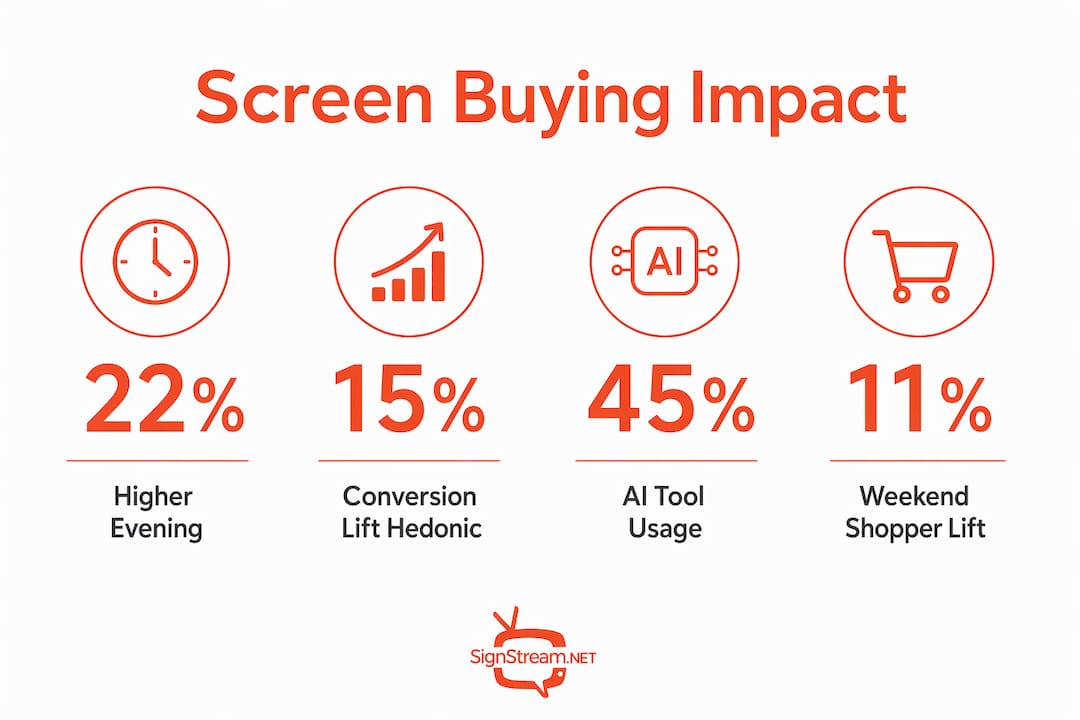
Timing is a variable most businesses ignore entirely. Late-day and evening shoppers are 22.1% more responsive to digital screen content, and weekend shoppers are 11.7% more influenced than weekday visitors. The reason is cognitive depletion. As the day progresses, shoppers exhaust their decision-making capacity and become more susceptible to visual cues and emotional prompts. A screen running a well-timed promotion at 5:00 PM on a Friday hits a psychologically primed audience.
Product type also determines conversion lift. Hedonic products see a 15.4% higher conversion rate from digital signage. Popular brands yield a 16.7% lift. New items or flavors generate a 24.7% lift, the highest of any category. These numbers confirm that novelty and emotional appeal are the strongest levers a screen can pull.
How do interactive visuals and AI tools improve buyer confidence?
Interactive product displays change the psychology of online and in-store shopping by reducing perceived risk. 360-degree product views and zoom features increase purchase intentions, particularly for higher-value goods where buyers need confidence before committing. Contextual imagery, showing a product in a real-life setting rather than on a white background, helps shoppers visualize ownership and reduces hesitation.

AI is reshaping the research phase of buying at a significant scale. 45% of consumers now use AI tools during the buying process, with 41% using AI for product research, 33% for interpreting reviews, and 31% for finding deals. This means a growing share of purchase decisions are shaped before the shopper ever reaches your screen. The screen then serves as the final confirmation point, not the starting one.
Livestream vs. marketplace: two different psychological routes
Livestream commerce and conventional online marketplaces activate buying through completely different mechanisms. Livestream commerce relies on heuristic, cue-driven buying under social pressure, where scarcity signals, host enthusiasm, and live audience reactions push fast decisions. Marketplaces, by contrast, use confidence-mediated routes where reviews, ratings, and detailed specs build trust over time.
Commerce format | Primary psychological route | Best content type |
Livestream commerce | Heuristic, impulse-driven | Social proof, scarcity, live demos |
Online marketplace | Confidence-mediated, analytic | Reviews, specs, comparison tools |
In-store digital display | Peripheral, subconscious | Promotions, new products, brand cues |
Mobile touchscreen | Emotional, System 1 | Lifestyle imagery, short-form video |
Pro Tip: Simplicity converts. Reducing friction in how shoppers compare and evaluate products builds more confidence than adding features. If your screen experience feels complicated, it is costing you sales.
What strategies help business owners use screens more effectively?
Translating neuroscience into practice requires a structured approach. The digital influence on consumer behavior is strongest when content aligns with shopper mindset, location, and timing. Here are the strategies that deliver measurable results:
Time your content to peak susceptibility. Schedule emotionally driven promotions for late afternoon and weekends, when cognitive depletion makes shoppers more receptive to visual cues. Run informational or comparison content earlier in the day when analytical thinking is sharper.
Match content type to product category. Use lifestyle imagery and short-form video for hedonic products. Use detailed specs, reviews, and interactive features for high-consideration purchases. The visual presentation strategy should reflect the cognitive route your product requires.
Deploy social proof at the point of decision. Testimonials, star ratings, and user-generated content displayed on screens near the product or checkout area activate confidence-based buying. This works across in-store displays, mobile screens, and marketplace listings.
Integrate AI research touchpoints into your screen strategy. Since nearly half of shoppers now use AI before they arrive at your screen, your content needs to answer the questions AI already raised. Address common objections, highlight differentiators, and confirm value clearly.
Use screens as gateways to immersive experiences. Live shopping and spatial content create dual pathways for brand interaction that static signage cannot replicate. Brands that treat screens as entry points to deeper engagement, rather than endpoints, build stronger purchase intent over time.
Understanding digital optimization for business leaders is increasingly about aligning screen content with the specific psychological state of your shopper at each moment in their path to purchase.
Key Takeaways
Screens drive purchase decisions by activating both subconscious peripheral processing and deliberate analytical thinking, and the most effective screen strategies align content type, timing, and device to the specific psychological state of the shopper.
Point | Details |
Screen type determines thinking mode | Touchscreens trigger impulse buying; desktops support research-based decisions. |
Timing amplifies screen impact | Late-day and weekend shoppers are significantly more responsive to digital screen content. |
Subconscious processing dominates | 97% of retail information is processed subconsciously, making peripheral screen placement critical. |
AI shapes pre-screen decisions | 45% of consumers use AI before buying, so screen content must address questions AI already raised. |
Simplicity outperforms complexity | Reducing friction in digital experiences builds buyer confidence and increases conversion rates. |
Screens have become the storefront, not just the sign
I have watched businesses spend heavily on screen hardware and then fill those screens with the same static content they used in printed flyers. That is the wrong mental model entirely. A screen is not a digital poster. It is a psychological trigger point, and treating it as anything less wastes the investment.
What the research confirms, and what I have seen play out in practice, is that the businesses winning with screens are the ones thinking about when and where as much as what. Putting the right message in front of a cognitively depleted shopper at 5:30 PM on a Saturday is a fundamentally different act than running the same content at 9:00 AM on a Tuesday. Most businesses do not make that distinction.
The shift toward AI-assisted pre-shopping also changes the game in a way that has not fully landed yet. If nearly half your customers have already researched your product through an AI tool before walking through your door or landing on your page, your screen content needs to be the confirmation, not the introduction. Screens that answer the question the shopper already asked convert at a higher rate than screens that try to start the conversation from scratch.
The future belongs to businesses that treat their screens as active participants in the shopper’s decision process, not passive displays waiting to be noticed.
— DKS
How Signstream helps you put screen science to work
Signstream is built for business owners who want to act on what the research shows, without needing a technical team to do it.

With Signstream’s digital signage platform, you can update content across unlimited screens instantly from any device, schedule promotions to run at peak conversion windows, and track performance through built-in analytics. Clients including elite sports clubs, restaurants, and retailers have reported a 25% rise in engagement after implementation. Signstream’s ad exchange marketplace also lets you cross-promote in other local businesses and generate revenue from your own screens. If you are ready to turn your screens into active purchase drivers, explore in-store promotion strategies or see how Signstream can work for your specific environment.
FAQ
How do screens influence purchase decisions?
Screens influence purchase decisions by activating both subconscious peripheral processing and deliberate analytical thinking. In-store digital ads drive an average 8.1% conversion lift, with optimal conditions reaching 20–25%.
What screen type is best for driving impulse purchases?
Touchscreens are the most effective for impulse purchases because they engage emotional, heuristic System 1 thinking. Mobile and tablet interfaces work best for hedonic products like clothing, food, and beauty items.
When are shoppers most responsive to screen advertising?
Late-day and evening shoppers are 22.1% more responsive to digital screen content, and weekend shoppers are 11.7% more influenced than weekday visitors, due to cognitive depletion reducing analytical resistance.
How does AI affect screen-based purchase decisions?
45% of consumers now use AI tools during the buying process for research, reviews, and deal-finding. Screen content must address the questions AI already raised to serve as an effective confirmation point.
Does interactive content on screens improve conversion rates?
Interactive displays like 360-degree product views and contextual lifestyle imagery increase purchase intentions, particularly for higher-value goods where buyers need confidence before committing.
Recommended
Comments