

How Screen Partnerships Work Between Businesses

Screen partnerships are defined as formal collaborations where two or more businesses share digital signage networks to grow their combined reach, revenue, and customer engagement. Understanding how screen partnerships work between businesses gives you a real advantage: you get access to new audiences without paying for new advertising channels. Signstream clients, including elite sports clubs and retailers, have reported a 25% rise in class attendance after implementing shared screen networks. The core mechanic is simple. One business provides screen real estate; the other provides content, customers, or cash. Both sides win.
How screen partnerships work between businesses
A screen partnership is built on mutual value exchange. Business A has screens in a high-traffic location. Business B has an offer that audience wants to see. Together, they create a media channel that neither could build as efficiently alone. The industry term for this model is a co-marketing media network, though “screen partnership” captures the practical reality for most business owners.

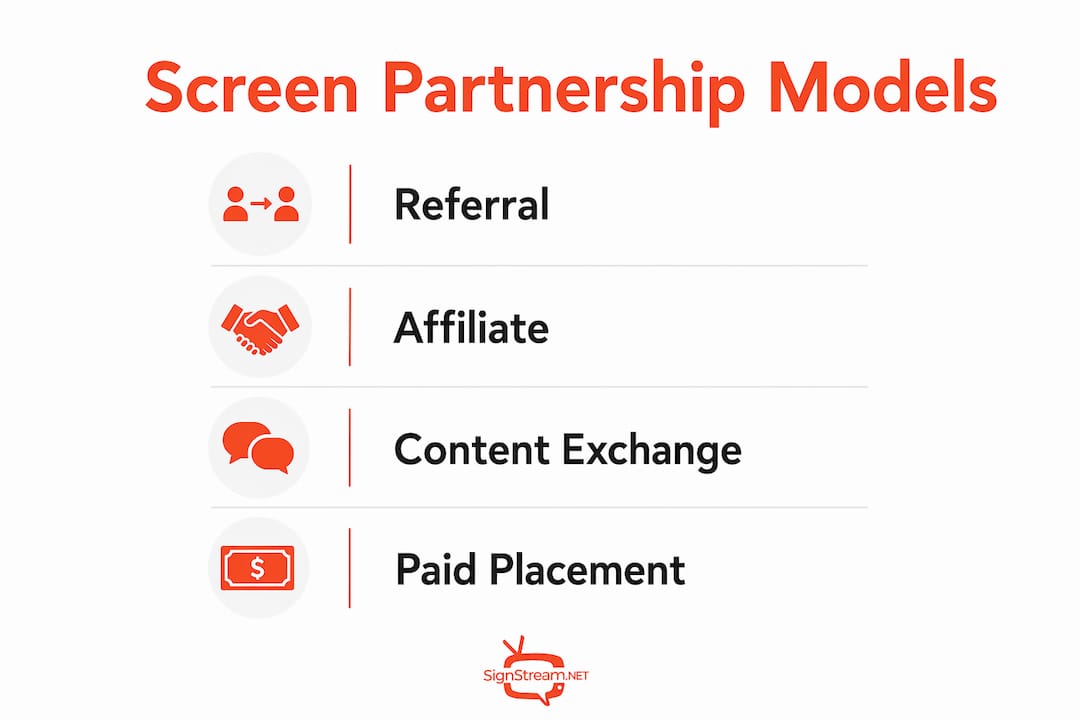
The structure of these partnerships follows three common models. Referral partnerships typically involve commissions of 5–10%, with affiliate models earning only on tracked sales. That low upfront cost makes them the most accessible entry point for businesses new to collaboration. A second model is the content exchange, where both parties trade screen time without cash changing hands. The third is a paid placement model, where one business buys screen time on another’s network at a fixed rate.
Partnership model | Revenue mechanism | Best for |
Referral | 5–10% commission on referred sales | Service businesses with overlapping audiences |
Affiliate | Commission on tracked conversions only | Retailers and e-commerce with measurable sales |
Content exchange | No cash, mutual screen time | Local businesses with complementary offers |
Paid placement | Fixed rate per screen or time slot | Brands seeking guaranteed visibility |
Pro Tip: Start with a content exchange before moving to a commission model. It builds trust and proves the audience overlap before money enters the equation.
A structured partnership proposal must explicitly detail shared objectives, revenue splits, responsibilities, and exit criteria. Skipping any of these four elements creates disputes later. Define who owns the customer relationship, who handles content updates, and what happens if either party wants to exit.
How do you initiate and secure a screen partnership?
Warm introductions outperform cold outreach every time. A referral from a shared contact carries more credibility than any email you write yourself. Before you reach out to a potential partner, identify the mutual connection or the shared customer base that makes the partnership logical.
When you do reach out directly, keep proposals under 150 words and focus entirely on partner value, not your company story. Most outreach fails because the sender leads with their own brand history. The partner does not care about your founding story. They care about what they gain.
A strong outreach message covers five points:
The shared audience. Name the specific customer segment both businesses serve.
The mutual benefit. State what each party gains in concrete terms (more foot traffic, new leads, screen revenue).
The ask. Propose a specific, low-commitment first step such as a 30-day pilot.
The mechanics. Briefly explain how content will be managed and who controls what.
The exit. Confirm that either party can walk away without penalty after the pilot.
Pro Tip: Frame your pitch around the phrase “better together.” Show the partner what your combined audiences look like, not what your business does alone.
The Signstream affiliate program gives businesses a ready-made structure for this kind of outreach. You can invite local partners to display content on your screens and earn from the arrangement without building a custom agreement from scratch.
What does ongoing management of a screen partnership look like?
Partnerships fail most often because of neglected management, not flawed deal structures. Once the agreement is signed, the real work begins. You need a regular operating rhythm to keep both sides engaged and accountable.
Effective ongoing management covers four areas:
Shared metrics. Track qualified pipeline progression and revenue milestones, not just impressions or screen views. Vanity metrics distract both parties from what actually matters: revenue and customer outcomes.
Review cadence. Schedule monthly check-ins for the first quarter, then move to quarterly reviews once the partnership is stable. Use each review to assess content performance, audience response, and revenue attribution.
Tiered rewards. Milestone incentives keep partner sales teams focused on revenue, not just lead volume. A tiered reward structure, where partners earn more as they hit higher revenue thresholds, outperforms flat commission models for long-term engagement.
Communication channels. Agree on a single channel for operational updates, whether that is a shared Slack workspace, a weekly email summary, or a project management tool. Mixed communication channels create confusion and slow down issue resolution.
Ecosystem collaboration with aligned incentives improves revenue streams and resilience by linking partners across development and supply chains. That principle applies directly to screen networks: when both businesses have skin in the game, content quality and audience engagement both rise.
The multi-venue screen network guide covers performance review best practices in detail, including how to set content schedules and measure audience impact across multiple locations.
What are the most common challenges in screen partnerships?
Cultural and operational misalignment is the leading cause of screen partnership failure. Two businesses can have compatible audiences and still clash on content standards, update frequency, or brand tone. These conflicts surface quickly when one partner updates screens daily and the other updates monthly.
“The ‘courtship’ phase, including cultural and operational soft assessments via pilot projects, is critical and often overlooked. Businesses that skip this step commit to full-scale partnerships before they know whether the relationship actually works.”
Running a pilot project before signing a long-term agreement is the most reliable way to test compatibility. A 30-day pilot costs almost nothing and reveals operational friction that no proposal document will surface. Pay attention to how quickly the partner responds to content change requests and whether their audience actually engages with your material.
Three other challenges appear regularly:
Unclear customer ownership. Define before launch who handles customer support, lead routing, and troubleshooting. Ambiguity here creates a poor customer experience that reflects badly on both brands.
Misaligned content standards. Agree on resolution, format, and update frequency in writing. A gym and a café may both want to reach the same 25-to-40-year-old professional, but their content styles will differ significantly.
Evaluating the wrong dimensions. Assess partnerships on technical investment, operational strain, and brand control, not just revenue potential. A high-revenue partnership that drains your team’s time or dilutes your brand is not a good deal.
The community digital signage ecosystem model addresses many of these challenges by giving businesses a shared infrastructure with clear content rules and performance visibility built in.
Key Takeaways
Screen partnerships succeed when both parties agree on structure, manage the relationship actively, and measure outcomes that connect directly to revenue.
Point | Details |
Define the model first | Choose referral, affiliate, content exchange, or paid placement before drafting any agreement. |
Write a complete proposal | Include objectives, revenue splits, responsibilities, and exit criteria in every partnership document. |
Run a pilot before committing | A 30-day pilot reveals operational and cultural fit that no contract can predict. |
Manage actively, not passively | Partnerships fail from neglect; schedule regular reviews and track qualified pipeline, not vanity metrics. |
Align on customer ownership | Define support, lead routing, and troubleshooting responsibilities before the partnership goes live. |
Why partner fit matters more than partner size
The biggest mistake I see business owners make is chasing the largest possible partner instead of the most compatible one. A screen partnership with a business that has ten times your foot traffic sounds great on paper. In practice, if their content standards, update cadence, and customer expectations do not match yours, the partnership creates friction for both teams and a confusing experience for customers.
I have watched well-structured agreements collapse within 90 days because neither party ran a proper pilot. The numbers looked right. The audiences overlapped. But the operational reality was that one partner updated content weekly and the other updated it twice a year. That gap alone killed the relationship.
The partnerships that actually deliver, the ones where both businesses grow their revenue and their customer engagement, share one trait: both sides treat the arrangement as an ongoing commitment, not a set-and-forget deal. You need a champion on each side who owns the relationship and shows up to every review. Without that, even the best agreement becomes a dormant document.
Screen partnerships done right are genuinely one of the most cost-effective ways to grow your customer reach. The business partnership principles that apply to traditional collaborations apply here too: clarity, consistency, and mutual accountability are what separate the partnerships that last from the ones that quietly fade out.
— DKS
Signstream makes screen partnerships practical
Signstream’s digital signage platform gives you the infrastructure to run screen partnerships without technical complexity. You can update content across unlimited screens from any device, invite partner businesses to display their offers on your network, and track performance through built-in analytics.
The ad display network lets you monetize your screens by accepting paid placements from local businesses, turning your existing screen real estate into a revenue channel. Signstream also supports white-label deployments for businesses that want to offer branded screen networks to their own partners. Whether you are a gym, a restaurant, or a retail group, Signstream gives you the tools to build, manage, and grow screen partnerships that deliver real results.
FAQ
What is a screen partnership between businesses?
A screen partnership is a formal collaboration where two or more businesses share digital signage networks to reach each other’s customers and generate mutual revenue. Both parties agree on content rights, revenue splits, and operational responsibilities before going live.
How do referral and affiliate screen partnerships differ?
Referral partnerships pay a commission of 5–10% on referred sales, while affiliate models pay only on tracked conversions. Referral models suit service businesses; affiliate models work best where sales are directly measurable.
How long should a screen partnership pilot run?
A 30-day pilot is the standard starting point. It gives both businesses enough time to test content performance, operational compatibility, and audience response before committing to a longer agreement.
What metrics should you track in a screen partnership?
Track qualified pipeline progression and revenue milestones, not just impressions or screen views. Vanity metrics like raw view counts do not tell you whether the partnership is generating real business value.
How does Signstream support screen partnerships?
Signstream provides a digital signage platform where businesses can manage content across unlimited screens, accept paid placements from partner businesses, and track performance through analytics. The ad exchange marketplace makes cross-promotion between local businesses straightforward and measurable.
Recommended
Comments