

Launch Screen Network Sponsorships in 4 Weeks for Operators

Yes, screen network sponsorships can reliably generate revenue and boost engagement, and they work best when you treat your screens as media inventory, not just internal announcements. Start by auditing what you already have (screen count, dayparts, foot traffic) and pick one pilot package, like a single sponsor slot for four weeks, before building anything more complex. Aim for measurable outcomes: incremental revenue, higher attendance or footfall, and trackable responses like QR scans, not vague “brand exposure.”
TL;DR:
Most sponsorship revenue comes from ongoing partnerships that aim for measurable outcomes like increased foot traffic or QR code responses, not just brand impressions.
Operators should start with a simple pilot package, such as a four-week sponsorship with a single sponsor slot, and use actual data to set prices based on estimated impressions and demand.
Technical setup must support remote scheduling, real-time creative swaps, fallback content, and programmatic access to maximize efficiency and revenue opportunities.
Sponsors value metrics like impressions, engagement responses, and footfall lift more than vague brand exposure, making transparent reporting crucial for renewal.
Small operators can succeed with sponsorships by focusing on local businesses, running short pilots, and using simple, measurable packages to build trust and expand gradually.
Table of Contents
What Are Screen Network Sponsorships?
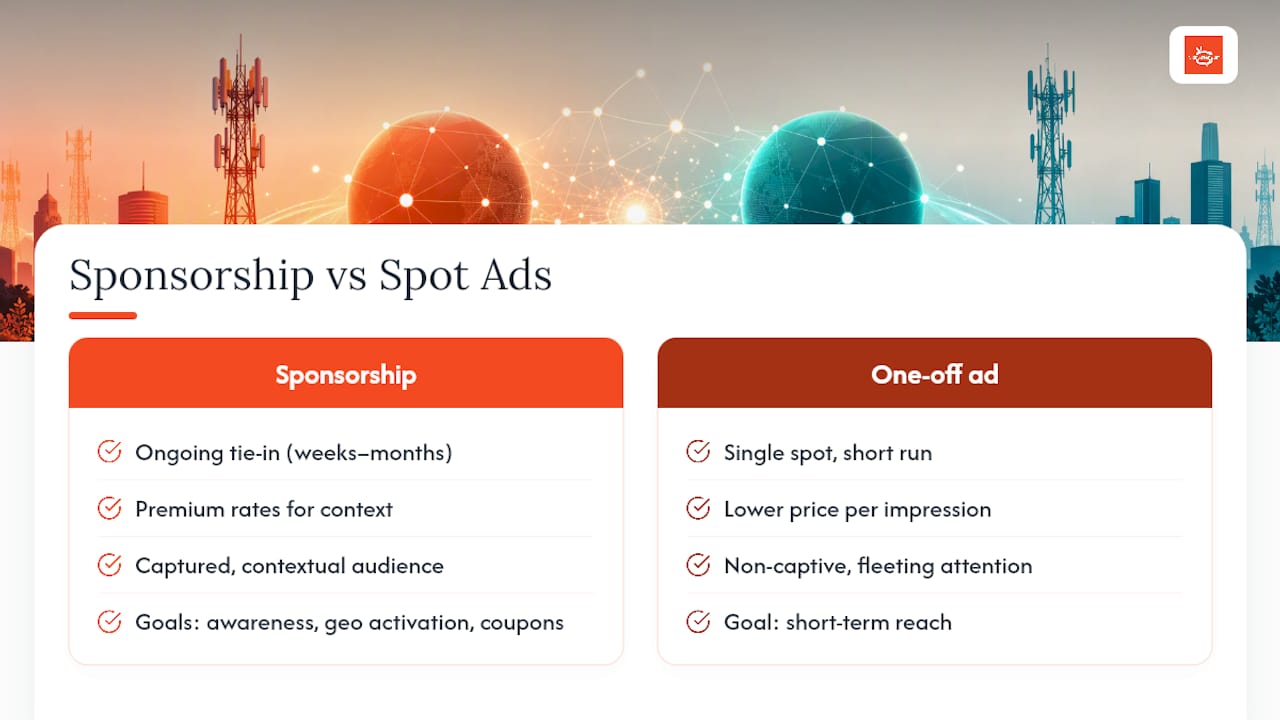
A sponsorship is different from a one-off ad buy. A sponsor pays for an ongoing association, like “presented by,” a branded segment, or exclusive category rights across your network, while a short-run ad is a single spot that rotates with others and disappears after a few days. Sponsors pay more for that ongoing tie-in because it builds recognition over weeks or months instead of one impression at a time.
Screens earn premium sponsorship rates because attention is captive and contextual, and learning more about audience targeting explained can boost your digital marketing results. A gym member waiting for a treadmill, a diner scanning a menu board, or an office employee glancing at a lobby screen is a captured audience in a specific mindset, which is worth more to advertisers than a scroll-past social ad. Sponsors buying screen space usually want one of three things: local brand awareness, a geographically targeted activation tied to a specific venue, or a direct response mechanism like a coupon code or QR offer. Screens can satisfy all three at once, which is rare in advertising.
Sponsorship Models and Inventory You Can Sell
Not every sponsor wants the same product, so operators typically sell a mix of formats depending on their audience size and sales capacity.
Direct sponsorships: exclusive category rights, event or class tie-ins (“This Spin Class Sponsored By…”), and daypart buys where a sponsor owns the morning or evening rotation.
Programmatic access: connecting your network to a supply-side platform (SSP) opens your inventory to demand-side platforms (DSPs), letting outside advertisers bid on unsold slots automatically. One screen network that added inventory to Broadsign’s SSP reached 35 integrated demand partners, turning idle screen time into real-time programmatic revenue.
Bundled local packages: geo-targeted deals across multiple locations, useful for franchises selling one sponsor across ten sites instead of negotiating ten separate deals.
Add-ons: interactivity, dynamic QR offers, and monthly measurement reports, which sponsors increasingly expect as standard rather than extra.
High-end examples show where this can go. LG’s multi-year partnership with the Boston Red Sox combined display technology with in-venue activations at Fenway Park, a model smaller operator can scale down for a single flagship location.
How to Price and Package Sponsorships
Four pricing structures dominate the category: fixed weekly or monthly packages, time-block pricing (daypart exclusivity), CPM-equivalent rates based on estimated impressions, and revenue share tied to actual sponsor-driven sales or sign-ups.
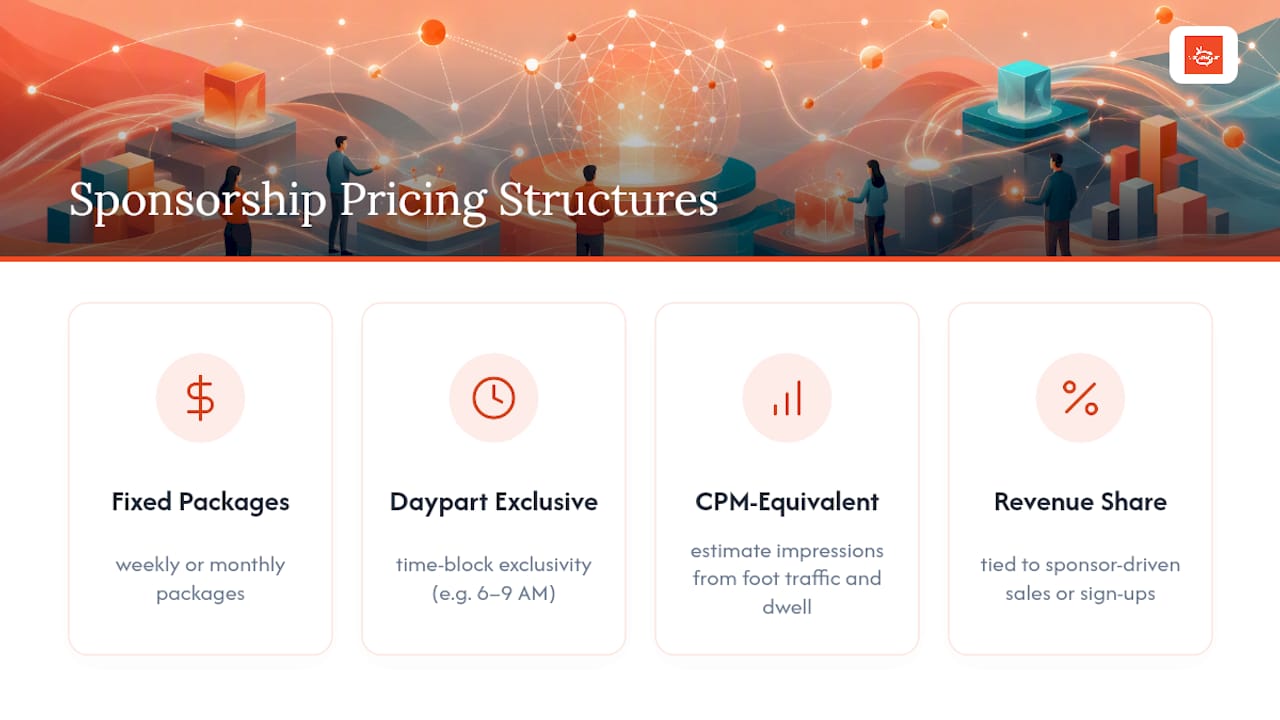
To estimate a CPM-equivalent rate, multiply average daily foot traffic by dwell time near the screen, then extrapolate a monthly impression count. A gym with a moderate daily visitor count and a screen near the front desk might generate several thousand monthly impressions, giving you a defensible baseline to compare against typical out-of-home CPM ranges.
A sample package might look like this: daypart exclusivity (6 to 9 AM), a four-week run, weekly creative rotation, and a one-page measurement report at the end. That bundle gives sponsors a clear start and end date, which makes budgeting easier on their side and renewal conversations easier on yours.
Negotiation levers worth knowing: frequency (how often the sponsor’s message appears per hour), exclusivity (locking out competitors), and activation support (helping the sponsor design a QR offer or in-store display). Sponsors will often pay 20 to 30% more for exclusivity alone, so don’t discount it away in early conversations.
Technical Setup, Sales Ops, and Programmatic Activation
Before you sell a single sponsorship, your platform needs to handle the operational load. Look for a content management system that supports remote scheduling, real-time creative swaps, and built-in reporting, since manually updating screens at each location does not scale past a handful of sites.
Confirm your CMS supports dayparting rules so a sponsor’s creative runs only in the window they paid for.
Set fallback creative for every slot in case a sponsor’s asset fails to load or expires.
Standardize specs upfront: typical DOOH video specs run 1080p, 15 to 30 second loops, with QR codes sized large enough to scan from a few feet away.
Connecting to an SSP gives outside advertisers programmatic access to unsold inventory, enabling real-time buying and frequency control without manual trafficking.
Cross-screen partnerships are also raising the bar for what sponsors expect. Teads’ expansion into CTV inventory through its ad manager shows advertisers increasingly want unified campaigns across screens, streaming, and mobile, which means your reporting should speak the same language as those channels.
Pro Tip: Build a creative refresh cadence into every sponsorship contract, ideally every two weeks, so sponsor content never looks stale. Screens that show the same ad for months lose both viewer attention and renewal interest.
What KPIs Should You Report to Sponsors?
Sponsors renew when they see numbers, not just a “screens looked great” recap. Track four primary metrics: total impressions, a dwell or engagement proxy (how long people linger near the screen), QR or call-to-action response rate, and footfall lift where you can measure it, such as class sign-ups or in-store visits during the sponsorship window.
Attribution on screens will never be as precise as digital click tracking, but proxies work well: unique QR scans, promo code redemptions, or before-and-after attendance comparisons all give sponsors something concrete. Keep reporting simple. A one-page dashboard with impressions, response rate, and a plain-language summary beats a 12-tab spreadsheet that a sponsor’s marketing manager never opens.
Real Client Outcomes That Prove Sponsorships Work
Numbers convince sponsors faster than promises. SignStream client data shows a 25% increase in class attendance for one fitness client after rolling out targeted screen promotions, achieved by pairing schedule-based content with a limited-time class offer displayed during peak browsing hours.
Franchise networks have used geo-targeted campaigns to run one sponsor message across dozens of locations simultaneously, without renegotiating creative at each site.
Multi-location operators use ad exchange marketplaces with analytics dashboards to identify which screens draw the most engagement, then price sponsorships accordingly.
Renewal conversations get easier when operators can hand sponsors a simple report showing impressions and response data tied directly to the campaign window.
The pattern across these examples is consistent: real-time updates and built-in analytics turn a static screen into a channel sponsors can actually evaluate and want to keep buying.
Brand Safety and Legal Guardrails to Set Early
Screen your sponsor pool for category conflicts and forbidden content (alcohol near family venues, competitor exclusivity clashes) before signing anything. Keep proof-of-play logs so sponsors can verify their creative actually ran, and confirm any customer-facing QR offer complies with basic data privacy and consent rules for your location.
Getting Started: A 10-Step Checklist and Sample Pitch
Audit your screen inventory: count screens, locations, and average daily foot traffic.
Estimate monthly impressions per screen using traffic and dwell time.
Pick one pilot package (daypart exclusivity or a single event tie-in).
Set a starting price using fixed-rate or CPM-equivalent math.
Build simple creative specs and a fallback slide.
Draft a one-page sponsor pitch: audience size, impressions, price, and a sample screen mockup.
Identify three to five local businesses that fit your audience.
Run the pilot for four weeks minimum.
Report results using impressions, response rate, and any attendance or footfall lift.
Use pilot data to price your next package and expand to more sponsors.
For hospitality or retail operators, a restaurant signage starter guide or budget-friendly signage tactics for small teams can help shape that first pitch before you approach a sponsor.
Why Small Pilots Beat Big Launches
Screen sponsorship programs succeed or stall based on whether operators trust their own data before scaling. Most operators overestimate how much sponsors will pay upfront and underestimate how much a clean report matters for renewal. Run one package, measure it honestly, then let the numbers do the selling on your next pitch.
— DKS
Launch Your First Sponsorship With SignStream
The checklist above can be turned into an executable plan without hiring an ad ops team. Real-time updates mean a sponsor’s creative can go live across every screen swiftly, and unlimited screen deployment means a franchise-wide activation costs no more than a single-location pilot.
The built-in ad exchange marketplace lets you monetize unsold inventory automatically by cross-promoting local businesses, while analytics dashboards give you the impression and engagement data sponsors expect in a renewal conversation. If you run a multi-location business, the geo-targeted packaging described in SignStream’s guide to location-based sponsorships shows how to sell one sponsor across every site at once. Start with a pilot package on your existing screens, and see how the platform works remotely before committing to a full rollout.
Sources
For deeper technical detail on programmatic screen buying, see the Broadsign SSP integration case and SignStream’s client outcomes.
FAQ
What Is a Screen Network Sponsorship?
It is an ongoing paid partnership where a sponsor gets category exclusivity, branded content, or a recurring presence across your digital screens, rather than a single rotating ad spot.
How Much Should I Charge for a Screen Sponsorship?
Base pricing on estimated monthly impressions (foot traffic multiplied by dwell time) and compare that to CPM-equivalent out-of-home rates, then add a premium for exclusivity or daypart control.
Do I Need Programmatic Technology to Start?
No. Start with direct sponsorships sold to local businesses, then add SSP access later once you want to monetize unsold inventory automatically at scale.
What Metrics Do Sponsors Actually Care About?
Impressions, QR or call-to-action response rate, and any attendance or footfall lift you can tie to the sponsorship window matter most for renewals.
Can a Small Business Realistically Run a Sponsorship Program?
Yes. Platforms like SignStream let a single-location business run the same pilot package process as a franchise, since unlimited screen deployment and real-time updates don’t require added technical staff.
Recommended
Comments