

The Role of Digital Signage in Table Turnover
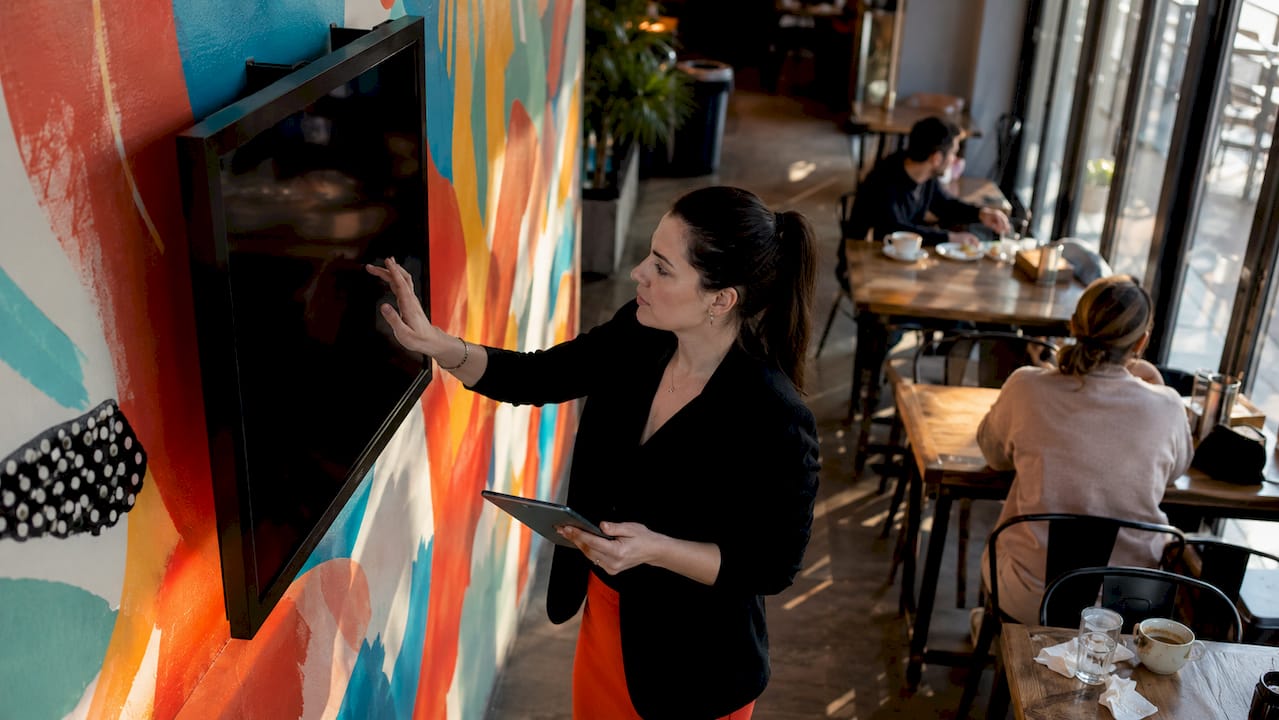
Digital signage is defined as networked display technology that delivers dynamic, updatable content to screens throughout a restaurant, and its role in table turnover is direct: it accelerates ordering decisions, reduces perceived wait times, and increases revenue per seat. The industry term for this operational application is guest-flow optimization, and digital signage is now its most measurable tool. Research shows that perceived wait time drops 20-35% when dynamic content engages diners, which translates directly to faster table cycles and higher daily covers. Platforms like Signstream and technologies such as McDonald’s Dynamic Yield AI are proving that well-deployed restaurant digital boards do far more than display a menu. They manage the entire dining pace.
How does digital signage reduce perceived wait times and influence customer behavior?
The gap between actual wait time and perceived wait time is where restaurants lose customers. Studies confirm that dynamic content reduces perceived wait by 20 to 35%, because engaged attention moves faster than idle attention. A diner watching a rotating highlight reel of seasonal dishes feels less impatient than one staring at a static printed menu.
The psychological mechanism is straightforward. When a screen shows appealing food visuals, limited-time offers, or even ambient lifestyle content, the brain shifts from monitoring the clock to processing information. This is not passive entertainment. It is a deliberate ordering trigger.
Here is what effective digital signage content does during the pre-order phase:
Highlights high-margin items with motion graphics that draw the eye before a server arrives
Answers common questions about allergens, ingredients, and portion sizes, reducing back-and-forth with staff
Promotes daily specials in real time, so servers spend less time reciting the same information at every table
Creates urgency with limited availability messaging that nudges faster decisions
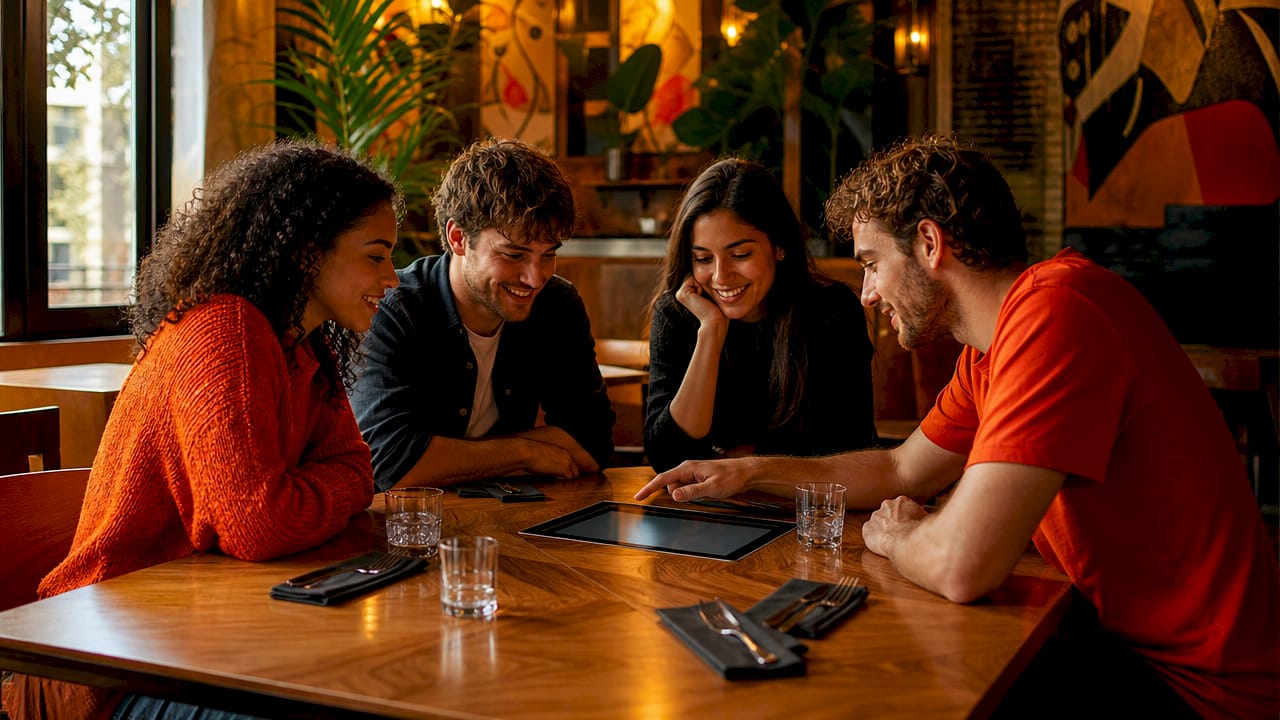
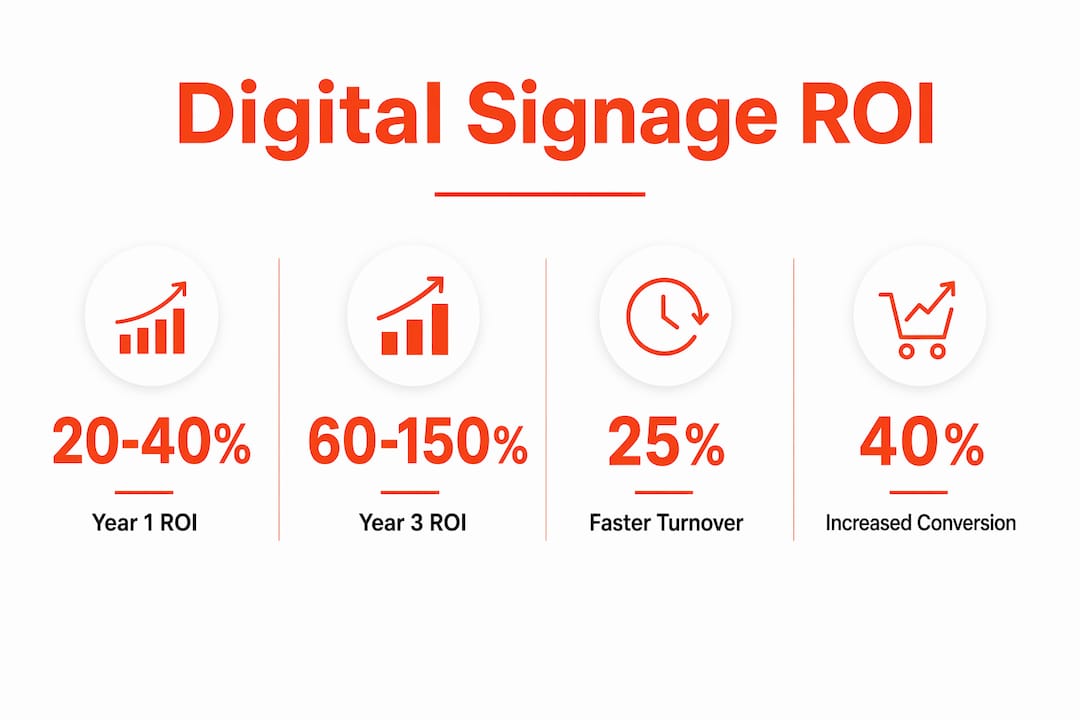
Tabletop interactive tablets take this further. Tableside tablets speed table turnover by 25% and encourage upsells through personalized pop-ups, while also enabling payment directly from the table. That last point matters enormously. The payment phase is the single biggest dead zone in table turnover, and removing server dependency from it alone can recover 5 to 8 minutes per cover.
Pro Tip: Schedule content to shift automatically by daypart. Breakfast boards should emphasize speed and value; dinner boards should feature premium items and wine pairings. The same screen, managed remotely, serves two completely different customer psychology profiles.
What measurable benefits and ROI can restaurants expect from digital signage?
The financial case for restaurant digital displays is well-documented. A well-executed deployment yields 20-40% ROI within the first year, climbing to 60 to 150% by year three when POS integration is included. Those numbers reflect both revenue gains and cost reductions working simultaneously.
On the revenue side, sales lifts on promoted items average 5 to 15%, with basket size increasing 3 to 8%. High-margin items, when featured prominently on digital menu boards, can see lifts of up to 30%. That is not a marginal improvement. For a restaurant doing 200 covers a day, a 5% basket size increase compounds into significant monthly revenue.
On the cost side, the savings are just as real:
Printing costs for menus, specials boards, and promotional materials are eliminated or dramatically reduced
Labor hours spent updating physical signage and briefing staff on daily changes are recovered
Food waste decreases because smart digital menu systems improve visibility of available inventory, reducing over-ordering of items already running low
Quick-service menu boards typically break even between 6 and 12 months
“Without pre-launch baseline metrics, many digital signage deployments fail to prove ROI and risk budget cuts after the initial investment.” — JAF Consulting, Digital Signage ROI 2026
The table below summarizes the financial impact across key performance areas:
Metric | Typical Impact |
Year 1 ROI | 20–40% with standard deployment |
Year 3 ROI | 60–150% with POS integration |
Sales lift on promoted items | 5–15%, up to 30% on high-margin items |
Basket size increase | 3–8% average |
Break-even timeline (QSR) | 6–12 months |
The critical prerequisite is baseline measurement. Pre-launch baseline metrics covering table turn time, transaction volume, and print costs for 60 to 90 days before deployment are what separate restaurants that prove ROI from those that guess at it.
How is AI-powered content personalization shaping restaurant digital signage?
AI personalization is the most significant development in restaurant digital boards since the shift from static to dynamic content. McDonald’s Dynamic Yield implementation is the benchmark. By using AI to serve contextual menu recommendations based on time of day, weather, and current order patterns, McDonald’s boosted average check size measurably across thousands of locations. The underlying technology is now accessible to independent restaurants, not just global chains.
The numbers behind AI personalization are compelling. AI-driven content boosts dwell time by 40% and conversion rates by up to 30% compared to static or manually scheduled content. Dwell time in a restaurant context means the time a customer spends actively engaging with a menu board or tabletop display before ordering. Longer, more focused engagement leads to larger, more deliberate orders.
Generative AI also solves a production problem that has held back smaller operators. Generative AI produces hundreds of localized content variants in minutes, meaning a restaurant group with locations in different neighborhoods can serve culturally relevant content on each screen without a dedicated design team.
The practical advantages over static content include:
Time-of-day adaptation: Lunch boards push fast, affordable options; evening boards feature premium dishes and add-ons
Weather-triggered content: Hot soup features on cold days, cold brew on warm afternoons
Inventory-aware updates: Items running low are deprioritized automatically, reducing customer disappointment
Content fatigue prevention: Rotating lifestyle and hedonic themes outperform repeated discount messaging
Pro Tip: Avoid running the same promotional loop for more than two weeks. Content fatigue reduces engagement over time, and motion-based visuals consistently outperform static images. Refresh your creative on a scheduled cycle, not when you remember to.
What types of digital signage work best for improving table turnover?
Not every signage format delivers the same result in every restaurant environment. The right choice depends on your service model, floor layout, and customer expectations.
Signage Type | Best For | Key Benefit |
Digital menu boards | All formats, especially QSR and fast-casual | Faster ordering, real-time price and item updates |
Tabletop interactive tablets | Full-service and casual dining | 25% faster turnover, direct payment capability |
Queue management displays | High-volume venues, takeout counters | Reduces perceived wait, manages crowd flow |
Self-service kiosks | QSR, food halls | Reduces server load, increases order accuracy |
Server-facing screens | Full-service kitchens and POS stations | Improves order accuracy, reduces kitchen errors |
POS integration is the feature that separates functional signage from genuinely high-performing signage. When your digital displays pull live data from your POS system, sold-out items disappear automatically, pricing stays consistent, and upsell prompts reflect what is actually available. Without that connection, you are managing two systems manually, which defeats the efficiency purpose entirely.
Hardware durability matters more than most operators expect. Restaurant environments involve heat, humidity, grease, and constant handling. Consumer-grade screens fail quickly in commercial kitchens and high-traffic dining rooms. Commercial-grade displays from manufacturers built for hospitality environments are a necessary investment, not a premium upgrade.
For restaurants considering a getting started guide for digital signage, the sequence is: identify your highest-impact location first (typically the ordering point or waiting area), deploy there, measure results for 60 days, then expand.
How can restaurants implement and optimize digital signage to maximize table turnover?
Implementation without a plan produces screens that look good but do not move the business forward. Here is the sequence that works:
Establish your baseline KPIs before any screen goes live. Measure average table turn time, covers per service, transaction value, and print costs for at least 60 days. This data is what you will compare against post-deployment results.
Map your content to customer journey stages. Pre-arrival content (window displays, entrance screens) should build appetite and set expectations. At-table content should guide ordering decisions. Post-meal content should promote desserts, loyalty programs, and return visit incentives.
Build a content calendar with daypart scheduling. Use your POS data to identify peak ordering windows and align your highest-converting content to those periods. A/B test two versions of a promotion across different screens or time slots to identify what drives orders.
Train your staff on the system. Servers who understand what the screens are promoting can reinforce those messages in conversation. A server who says “our screens are featuring the lamb tonight because it’s exceptional this week” turns a digital prompt into a personal recommendation.
Review analytics monthly. Track which content variations drive the highest basket size and fastest table turns. Retire underperforming content quickly. The Herhausen digital signage study confirms that over-repetition of static content reduces engagement, so continuous iteration is not optional. It is the operating model.
The restaurants that see the strongest results treat their digital signage as a live marketing channel, not a set-and-forget installation. Content freshness, staff alignment, and data-driven iteration are what separate a 10% revenue lift from a 30% one.
Pro Tip: Use your signage platform’s analytics to identify your three best-performing content pieces each month. Double down on those formats and retire the bottom three. This simple discipline compounds into significantly better performance over a full year.
Key takeaways
Digital signage drives table turnover by reducing perceived wait times, accelerating ordering decisions, and enabling direct payment from the table, with measurable ROI appearing within the first year of deployment.
Point | Details |
Perceived wait time reduction | Dynamic content reduces perceived wait by 20–35%, directly improving customer satisfaction and table pace. |
Tableside tablets accelerate turnover | Interactive tablets speed table turnover by 25% and enable payment without server dependency. |
ROI is proven and measurable | Expect 20–40% ROI in year one and 60–150% by year three with POS integration. |
AI personalization lifts conversion | AI-driven content increases dwell time by 40% and conversion rates by up to 30%. |
Baseline metrics are non-negotiable | Measure table turn time and transaction volume for 60–90 days before launch to prove results objectively. |
Why I think most restaurants are still underusing their screens
I have watched digital signage go from a novelty to a near-baseline expectation in hospitality, and the gap between what the technology can do and what most restaurants actually use it for is still surprisingly wide. Most operators install screens, load a static menu, and consider the job done. That is not digital signage. That is an expensive printed menu.
The restaurants getting real results are the ones treating their screens as a live revenue channel. They are scheduling content by daypart, connecting displays to their POS, and reviewing analytics the same way they review food cost reports. The ones struggling are usually dealing with two problems: content that has not been refreshed in months, and no baseline data to measure against. Both are fixable, but only if you decide to fix them before the screens go in.
Digital signage is becoming a baseline expectation rather than a differentiator, and venues without dynamic guest-facing displays risk losing competitive ground within three to five years. That window is closing faster than most operators realize. The good news is that the barrier to entry has dropped significantly. You do not need a design team or a technical department. You need a platform that makes content updates fast, a content strategy tied to your actual sales data, and the discipline to measure what you deploy.
— DKS
How Signstream helps restaurants turn tables faster
Signstream is built specifically for restaurant operators who want results without complexity. You can update every screen across multiple locations instantly from any device, schedule content by daypart, and connect your displays to live promotions without touching a single screen physically.
The Signstream platform supports POS-connected dynamic content, so your boards always reflect what is actually available and what you most want to sell. Pricing scales with your operation, and unlimited screens are included at no extra charge. Signstream also offers an ad exchange marketplace that lets you cross-promote with neighboring businesses and generate revenue from your own screens. If you are ready to turn your displays into a measurable revenue driver, explore interactive ad options built for restaurants.
FAQ
How does digital signage improve table turnover?
Digital signage reduces perceived wait times by 20 to 35% through dynamic content that engages diners before and during ordering. Tableside tablets also enable direct payment, removing the slowest phase of the table cycle entirely.
What ROI can a restaurant expect from digital signage?
A well-deployed system typically delivers 20 to 40% ROI in the first year, rising to 60 to 150% by year three when integrated with a POS system. Quick-service restaurants generally break even within 6 to 12 months.
What is the best type of digital signage for a full-service restaurant?
Tabletop interactive tablets are the most effective format for full-service restaurants, speeding table turnover by 25% while enabling upsells and direct payment without increasing server workload.
How often should restaurant digital signage content be updated?
Content should be refreshed at minimum every two weeks to prevent engagement fatigue. The most effective operators update content daily by daypart, using scheduling tools to automate the process.
Do restaurants need technical expertise to manage digital signage?
Modern platforms like Signstream are designed for non-technical users, allowing content updates from any device without IT support. The key requirement is a content strategy, not technical skill.
Recommended
Comments