

Screens and Tourism Revenue Sharing: A 2026 Guide

Digital screens are defined as the primary revenue-sharing infrastructure in modern tourism economies, connecting local attractions, hospitality businesses, and visitors through interactive, real-time content networks. The role of screens in tourism revenue sharing goes well beyond displaying promotions. Screens function as cooperative marketing platforms where multiple stakeholders pool advertising space, share visitor data, and distribute income across an entire destination. Smart signage in Paphos recorded over 140,000 QR code interactions in 2025 alone. That figure proves visitors actively engage with screen content when it is relevant, multilingual, and well-placed. Regional tourism boards and destination management organizations now treat screen networks as governance tools, not just marketing assets.
What is the role of screens in tourism revenue sharing?
Digital screens enable tourism revenue sharing by giving multiple businesses a single, shared channel to reach visitors at the same moment. A hotel lobby screen can promote a nearby restaurant, a local tour operator, and a cultural attraction simultaneously. Each partner contributes content and, in return, receives exposure on every other partner’s screens. This cooperative model is known in the industry as a shared digital signage network, and it replaces the old model where each business paid separately for isolated advertising.
The technology behind these networks makes the model practical. Modern screen platforms support:
QR code interactions that send visitors directly to booking pages, menus, or tour schedules
Multilingual content that adapts to visitor demographics in real time
Virtual tour previews that increase dwell time and purchase intent
Analytics dashboards that track which content drives the most clicks and conversions
Pro Tip: Set up your QR codes to track unique scans by location. That data tells you exactly which screen placement generates the most visitor action, so you can negotiate better terms with your network partners.
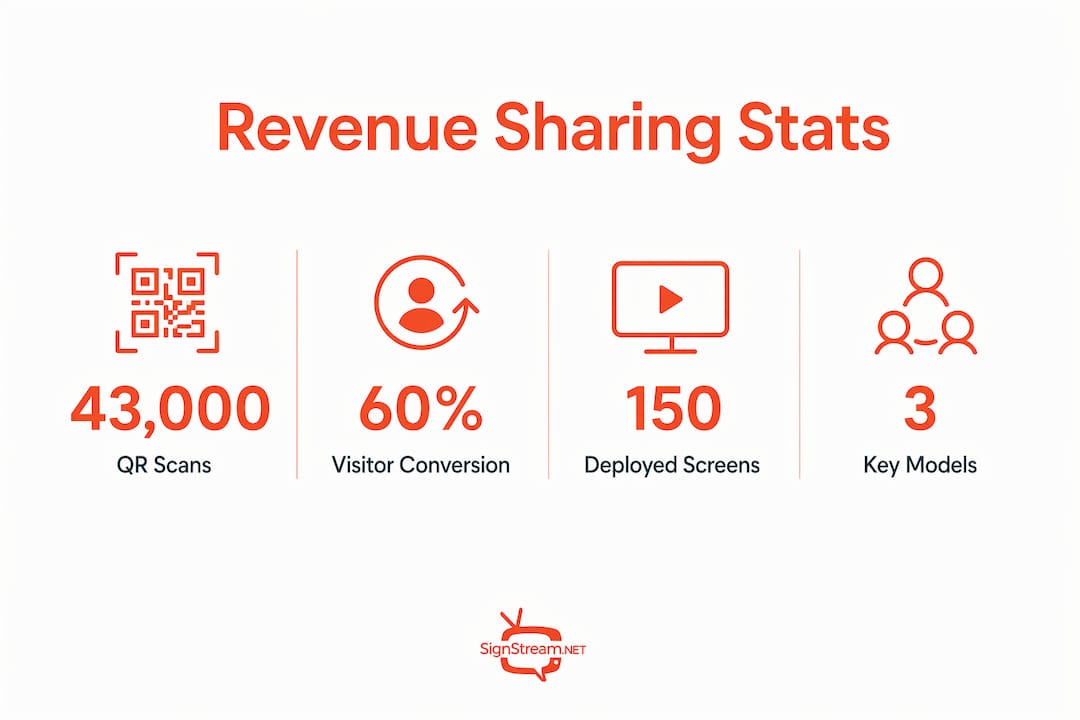
Paphos deployed 150 smart signs and recorded 43,000 scans in the first six months of 2026. That engagement rate shows what happens when screen content is tied to real visitor needs rather than generic advertising. The digital screens role in tourist engagement depends heavily on content relevance and placement strategy, not just screen count.
Data analytics capabilities are the hidden engine of this model. When you know that 60% of visitors who scanned a QR code at a hotel screen went on to book a restaurant, you can price that screen placement accordingly. Analytics turn screen networks from cost centers into measurable revenue tools.

How does governance shape screen-based revenue distribution?
Governance determines whether a screen network benefits all tourism operators or only the largest ones. Digital screens must be integrated into institutional governance and inclusive decision-making to deliver sustainable tourism benefits. Without governance backing, screen networks default to whoever has the most money and the biggest screens.
The most effective governance models follow these steps:
Form a multi-stakeholder committee that includes small operators, large hotels, transport providers, and local government representatives.
Define content contribution rules so every partner knows how much content they must supply and what they receive in return.
Set transparent revenue split formulas based on screen location, visitor traffic, and engagement metrics.
Audit the network quarterly to catch imbalances before they create resentment among smaller partners.
Build in digital literacy support so operators without technical staff can still participate fully.
Public-private collaboration and organizational culture shifts are essential for successful screen network adoption. Culture matters as much as technology. A destination where businesses compete fiercely will struggle to share screen space, even when the financial case is clear.
Rapid technology adoption can create a digital divide that harms small tourism businesses. Regional digital hubs and open partnership agreements help smaller operators access shared screen networks without bearing the full infrastructure cost. A café owner in a tourist district should have the same ability to appear on a hotel lobby screen as a major resort chain.
Pro Tip: Before launching a shared screen network, run a one-page participation agreement past all partners. Clear terms on content rights, revenue splits, and exit conditions prevent disputes that kill networks before they generate real returns.
What revenue sharing models work best for screen networks?
The most practical revenue sharing model for tourism screen networks is digital reciprocity. Exchanging screen ad space among local partners minimizes cash outlay and maximizes network value. Instead of every business paying cash for advertising, partners trade screen time. A tour operator promotes a restaurant; the restaurant promotes the tour. Both reach new visitors at zero media cost.
Beyond reciprocity, tourism operators use three other models:
Impression-based splits: Revenue from paid external advertisers is divided according to each partner’s share of total screen impressions.
Performance-based splits: Partners earn more when their content generates measurable actions, such as QR scans or booking completions.
Flat-fee pooling: All partners pay a fixed monthly fee into a shared fund that covers network management, content production, and platform costs.
The comparison below shows how these models differ in practice:
Model | Best for | Main risk |
Digital reciprocity | Small operators with limited cash | Unequal content quality |
Impression-based split | Networks with paid external ads | Favors high-traffic locations |
Performance-based split | Data-mature operators | Requires reliable analytics |
Flat-fee pooling | Early-stage networks | Low performers still share equally |
The most common failure in screen revenue sharing is treating screens as billboards. A billboard sells one message to a passive audience. A screen network sells an experience to an active visitor who is already in your destination and ready to spend. How screens influence travel spending depends on whether the content is timed to visitor intent, not just displayed on a loop.
Cross-promotion benefits compound over time. A visitor who books a restaurant through a hotel lobby screen is more likely to trust the hotel’s next recommendation. That trust increases average spend per visitor and improves the return on every screen in the network.
What challenges and opportunities define the future of screen-based tourism revenue?
Cybersecurity and data privacy are the two biggest barriers to scaling screen networks. Visitor interaction data is valuable, but collecting it without clear consent policies creates legal and reputational risk. A 2026 study of 668 travelers found that data security and community engagement outweigh pure technical performance as drivers of visitor trust and revisit intention. Visitors will engage with screens more when they trust how their data is used.
“AI applications in tourism governance must mesh with local institutional capacity and social approval to be effective. Algorithmic optimizations without governance backing face resistance and limited impact.” This finding from a 2026 Springer Nature governance study explains why the most technically advanced screen networks sometimes underperform. The technology is ready. The institutions often are not.
The opportunity side is significant. Real-time analytics now allow screen networks to shift content based on weather, crowd density, and time of day. A rainy afternoon in a coastal town is the perfect moment to push indoor attractions on every screen in the network. AI integration makes that kind of dynamic content management automatic. Tourism digital screen networks that combine AI content scheduling with participatory governance will outperform static networks by a wide margin.
Sustainable tourism alignment is another growing opportunity. Successful digital screen initiatives deliver year-round tourism development through multi-format content and community participation. Screens that promote local cultural events, off-peak attractions, and sustainable transport options serve both visitor experience goals and destination management priorities. That alignment gives screen networks political support from regional tourism boards, which accelerates funding and expansion.
Key Takeaways
Digital screens generate the most tourism revenue when they operate as governed, cooperative networks rather than isolated advertising displays.
Point | Details |
Screens as revenue infrastructure | Shared screen networks connect multiple operators and distribute visitor spending across a destination. |
Governance drives equity | Multi-stakeholder governance prevents digital divides and ensures small operators share in screen revenue. |
Digital reciprocity reduces cost | Trading screen ad space among partners cuts cash outlay and builds network value without media spend. |
Analytics enable fair splits | Engagement data from QR scans and impressions supports transparent, performance-based revenue sharing. |
AI and governance must align | Real-time AI content tools only deliver results when backed by institutional support and stakeholder buy-in. |
Why I think most tourism operators are leaving screen revenue on the table
Most tourism operators I have seen treat their screens as a one-way broadcast channel. They upload a promotional loop, set it to repeat, and consider the job done. That approach misses the entire point of what a connected screen network can do.
The operators who generate real revenue from screens think of them as community storytelling tools. They ask: what does a visitor need to know right now, and who else in this destination can help deliver that? A screen outside a museum that promotes a nearby food market, a harbor tour, and a local craft shop is not just advertising. It is a curated visitor experience that keeps spending local.
The uncomfortable truth is that governance is harder than technology. Getting six competing businesses to agree on content rules, revenue splits, and shared branding takes more time than setting up the screens. But that work is what separates a screen network that generates real returns from one that runs a promotional loop nobody watches.
My practical advice: start with two or three trusted partners, agree on simple reciprocity terms, and measure everything for 90 days. The data will make the case for expanding the network far better than any pitch deck. Community digital signage ecosystems grow fastest when early participants can show concrete results to prospective partners.
— DKS
Signstream’s ad network for tourism revenue sharing
Tourism operators who want to build a shared screen network without the technical complexity have a direct path forward with Signstream.
Signstream’s shared ad display network lets tourism businesses cross-promote across each other’s screens and earn revenue from their own displays, all managed from a single cloud-based platform. You can update content on unlimited screens from any device, run interactive ad campaigns with QR codes and multilingual content, and track engagement analytics without needing a technical team. Tourism operators using Signstream have reported measurable gains in visitor engagement and cross-referral bookings. The platform is built for operators who want results, not complexity.
FAQ
What is the role of screens in tourism revenue sharing?
Screens function as shared marketing platforms where multiple tourism operators exchange advertising space, track visitor engagement, and distribute income based on performance metrics. They replace isolated advertising with cooperative, data-driven revenue networks.
How do QR codes on tourism screens generate revenue?
QR codes link visitors directly to booking pages, menus, or tour schedules, creating a measurable path from screen exposure to purchase. Smart signage in Paphos recorded over 140,000 QR interactions in 2025, demonstrating the direct connection between screen engagement and visitor spending.
What governance structures support fair screen revenue sharing?
Multi-stakeholder committees that include small operators, large hotels, and local government representatives set transparent content rules and revenue split formulas. Without this structure, screen networks tend to favor operators with the largest budgets and most screen locations.
How does digital reciprocity work in tourism screen networks?
Digital reciprocity means partners trade screen advertising space instead of paying cash. A hotel promotes a local tour operator; the tour operator promotes the hotel. Both reach new visitors at no media cost, which makes the model accessible to small businesses.
What are the biggest risks in running a tourism screen network?
Data privacy and cybersecurity are the top risks, as visitor interaction data requires clear consent policies to avoid legal exposure. A 2026 study of 668 travelers confirmed that data security concerns directly affect visitor trust and willingness to engage with screen content.
Recommended
Comments