

How to Advertise Clearance Sales on Displays
- sbgerus
- 8 hours ago
- 7 min read

The most effective way to advertise clearance sales on displays is to combine high-traffic placement, tiered discount messaging, and real-time content updates. Digital point-of-sale signage, the industry term for screen-based in-store advertising, turns passive shoppers into buyers by delivering the right message at the right moment. Strategic display placement in entrances, endcaps, and checkout zones can boost product sales by 40–60%. That number reflects a fundamental shift: the screen is no longer decoration. It is your most productive sales tool.
How to advertise clearance sales on displays: choosing the right locations
Where you place a display matters as much as what it shows. Endcap displays outperform regular shelving by 300–500% in sales volume. That performance gap exists because endcaps sit at the natural turning points of a shopping aisle, where attention resets and impulse decisions happen.
Each display location inside your store serves a different purpose. Assign a specific mission to each zone rather than running the same content everywhere.

Zone | Display mission | Content type |
Store entrance | Announce the sale and set urgency | “Clearance starts today” countdown |
Endcap | Showcase specific clearance products | Product image, original price, sale price |
Aisle mid-point | Educate on product features | Short benefit statements |
Checkout | Cross-sell and add-on offers | “Add this for $X more” prompts |
Assigning display missions by zone raises conversion because each screen speaks to where the customer is in their buying decision. A shopper at the entrance needs to know a sale exists. A shopper at checkout is already committed and ready to add more.
Hardware matters too. Entrance and window-facing screens need a minimum brightness of 2,500 nits to remain readable in direct light. Interior screens perform well at 400–700 nits. Matching brightness to location prevents washed-out content that shoppers simply ignore.
Pro Tip: Place a countdown timer on your entrance display 48 hours before a clearance event ends. Shoppers who see a deadline on the way in are more likely to act before they leave.
What makes clearance sale messaging work on a screen?
72% of shoppers make unplanned purchases influenced by in-store messaging at the point of decision. That statistic means your display content is not just informational. It is a direct sales trigger.
The most effective clearance sale messaging uses tiered discounts rather than a blanket “everything on sale” approach. Here is how to structure those tiers:
20–30% off: Apply to lightly worn bestsellers and current-season items. These products still carry brand value, so the discount should feel like a reward, not a clearance signal.
40–50% off: Reserve for core clearance items that need to move within two to three weeks. This tier drives the bulk of clearance volume.
60%+ or BOGO: Use for dead stock and end-of-line products. Tiered discount structures protect your margins while maximizing volume recovery across all product categories.
Avoid messaging that implies your entire store is discounted. That framing trains customers to wait for sales before buying at full price. Instead, separate clearance collections visually using red “CLEARANCE” badges and strike-through pricing. The visual separation tells shoppers exactly which items are discounted without casting doubt on your full-price range.
Countdown language outperforms static discount signs. “48 hours left” or “Only 12 units remaining” creates time pressure that motivates action. Countdown-based clearance messaging boosts sales while maintaining brand perception better than a permanent discount sign ever could. A permanent discount sign signals desperation. A countdown signals a limited opportunity.
Pro Tip: Run two versions of your clearance creative: one with a countdown timer for the final 72 hours, and one without for the opening days. The timer version should replace the standard version automatically using scheduled content rules in your CMS.
What technology tools make clearance display campaigns easier?
The right content management system (CMS) is what separates a clearance campaign that runs itself from one that requires constant manual intervention. Modern retail digital signage CMS platforms allow you to swap up to 30% of content remotely without technical expertise. That capability means a store manager can update pricing, swap product images, or activate a countdown timer from a phone without calling IT.
Day-parting is one of the most underused features in retail display advertising. It lets you schedule different content for different times of day automatically. A morning slot might show a “doors open” clearance announcement. An afternoon slot might push the “only X hours left” urgency message. An evening slot might highlight the next day’s early-bird offer.
The table below compares content strategies by customer dwell time, which is how long a shopper typically spends in each zone.
Zone | Average dwell time | Recommended content length | Best content format |
Entrance | 3–5 seconds | 5 words or less | Bold headline + price |
Endcap | 10–20 seconds | One product focus | Image + price + CTA |
Checkout queue | 2–4 minutes | Multi-slide sequence | Product carousel + cross-sell |
Checkout queues are the single most valuable content real estate in your store. Shoppers are stationary, their phones are often pocketed, and they have nothing to do but look at your screen. A multi-slide display sequence at checkout can introduce three to five clearance products in under two minutes without feeling rushed.
Live inventory alerts add another layer of urgency. Connecting your display CMS to your point-of-sale system lets screens show real-time stock counts. “Only 3 left” is more compelling than any discount percentage.
Step-by-step best practices for running clearance sales on digital displays
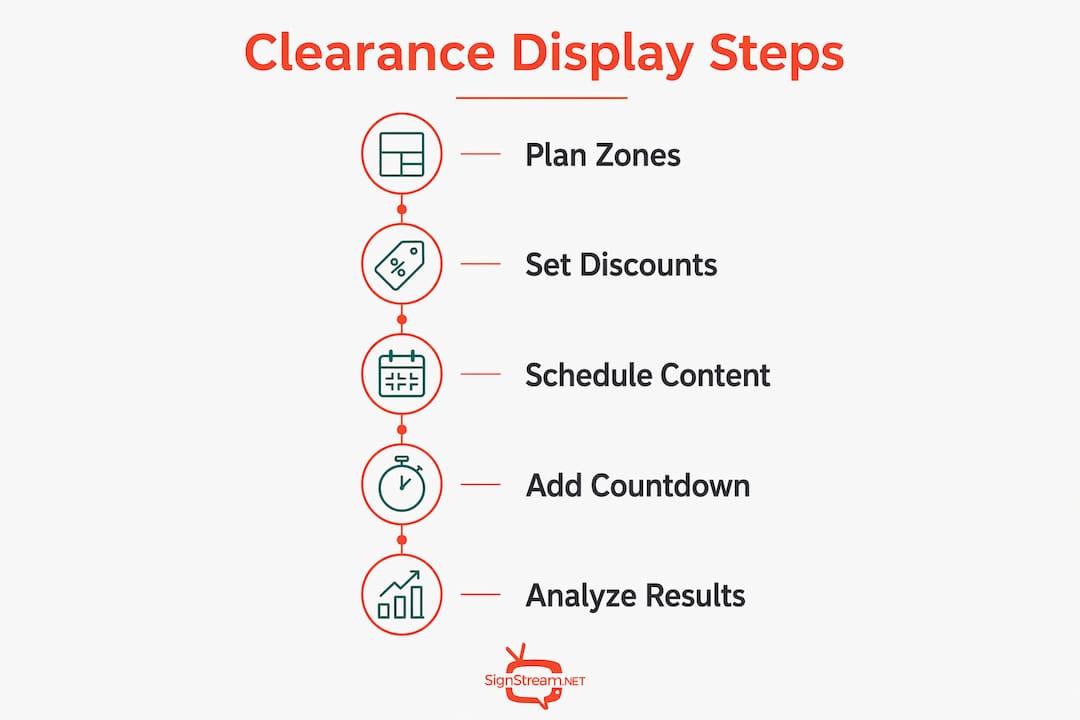
A clearance campaign that works follows a defined process. Skipping steps, especially the planning phase, is the most common reason clearance events underperform.
Audit and segment your inventory. Before designing a single screen, categorize products into your three discount tiers. Know exactly what needs to move and by when. This audit drives every content decision that follows.
Build your content calendar. Map out which messages run on which screens and at what times. Assign countdown timers to the final 72 hours. Schedule tier-specific content to match your discount structure. Use your CMS to automate the transitions so the campaign runs without daily manual updates.
Sync with your other marketing channels. Treat clearance sales as strategic operations and plan months ahead. Your in-store displays should mirror what you are running on email, social media, and your website. Inconsistent messaging across channels confuses customers and reduces trust. If your email says “50% off selected items” and your display says “up to 70% off everything,” shoppers feel misled when they arrive.
Measure what matters. Track footfall changes during the campaign period, average basket size, and repeat visit rates. These three metrics tell you whether your display advertising is driving traffic, increasing spend, or building loyalty. Most modern CMS platforms include basic analytics dashboards. Use them.
Watch for content fatigue. A display running the same creative for more than five days loses impact. Rotate at least one visual element every 48–72 hours to keep content fresh. This could be as simple as changing the background color, swapping the featured product, or updating the countdown number.
Pro Tip: After your clearance event ends, review which display zones drove the most basket-size increases. That data tells you where to concentrate your content investment for the next campaign.
A retail promotion checklist helps you avoid the most common execution gaps, from missing price updates to screens running outdated creative after a sale ends.
Key Takeaways
The most effective clearance sale display campaigns combine zone-specific messaging, tiered discounts, and automated content scheduling to maximize both sales volume and brand protection.
Point | Details |
Location drives ROI | Endcap displays outperform standard shelving by 300–500%, making placement your first priority. |
Tiered discounts protect margins | Structure discounts at 20–30%, 40–50%, and 60%+ to move stock without devaluing full-price items. |
Countdown language converts | Time-limited urgency messaging outperforms static discount signs for both sales and brand perception. |
CMS scheduling saves time | Day-parted content automation lets managers run full campaigns without daily manual updates. |
Measure three metrics | Track footfall, basket size, and repeat visits to evaluate and improve each clearance campaign. |
What I’ve learned running clearance campaigns on digital displays
The biggest mistake I see retail managers make is treating clearance displays as an afterthought. They design the discount, print a few paper signs, and expect results. Digital displays change the equation entirely, but only when you use them with intention.
The insight that changed how I think about this: the checkout queue is worth more than the entrance. Most retailers put their best creative at the front door, where dwell time is under five seconds. The checkout line gives you two to four minutes with a captive shopper who has already decided to spend money. That is where a well-sequenced clearance promotion display earns its keep.
I also think the industry underestimates how much brand damage a poorly executed clearance event causes. Running “SALE” on every screen in the store trains your customers to never pay full price. The tiered approach, with visual separation and specific product callouts, protects the perception of your full-price range while still moving stock efficiently.
The trend I am watching in 2026 is the integration of live inventory data with display content. When a screen can automatically show “only 2 left” because it is reading your POS system in real time, the urgency is genuine. Customers respond to real scarcity far more than manufactured urgency. That integration is becoming accessible to mid-size retailers, not just enterprise chains.
— DKS
Signstream makes clearance display advertising manageable
Running a clearance campaign across multiple screens used to require a dedicated IT team. Signstream changes that. The platform lets retail managers update content across unlimited screens from any device, with no technical background required.
Signstream’s scheduling tools let you build tiered clearance campaigns in advance, set countdown timers to activate automatically, and swap creative between zones without touching a single screen in person. Retailers using Signstream have reported measurable lifts in customer engagement after implementation. The platform also includes an ad exchange marketplace, so you can cross-promote with nearby businesses and generate revenue from your screens between clearance events. If you are ready to put your displays to work, explore Signstream’s interactive ad platform and see how quickly you can build your first campaign. You can also review how the platform works remotely before committing.
FAQ
What display locations give the best ROI for clearance sales?
Endcap displays deliver the highest return, outperforming standard shelving by 300–500% in sales volume. Checkout zones are the second-best location due to extended dwell time.
How should I structure discount messaging on clearance displays?
Use three tiers: 20–30% off for current bestsellers, 40–50% off for core clearance items, and 60%+ or BOGO for dead stock. This structure protects your brand while maximizing volume recovery.
Does countdown messaging actually increase clearance sales?
Yes. Countdown-based urgency messaging outperforms static discount signs for both conversion rate and brand perception. Shoppers respond to time limits more strongly than to percentage discounts alone.
How often should I update clearance display content?
Rotate at least one visual element every 48–72 hours to prevent content fatigue. Most CMS platforms let you schedule content updates in advance so changes happen automatically without manual intervention.
How do I measure whether my clearance displays are working?
Track three metrics: footfall during the campaign period, average basket size, and repeat visit rates. These figures show whether your display sales promotions are driving traffic, increasing spend, or building customer loyalty.
Recommended