

Increase Impulse Purchases with Digital Signage in 2026
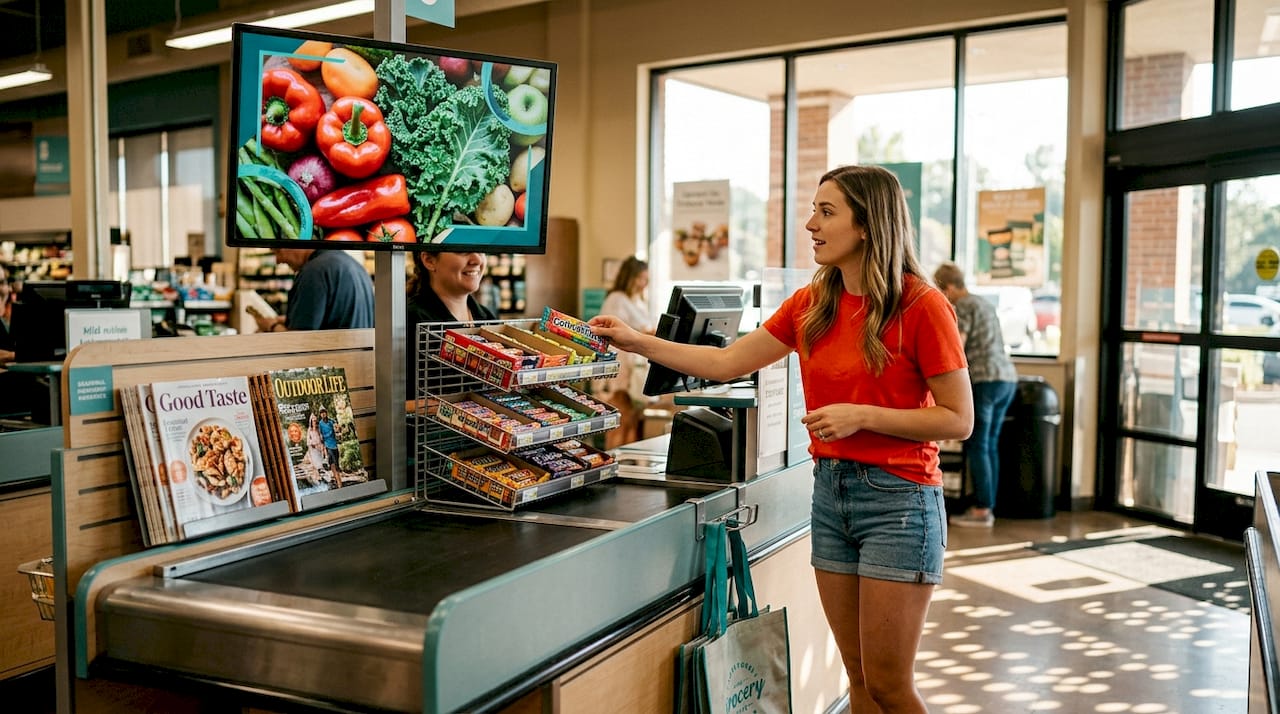
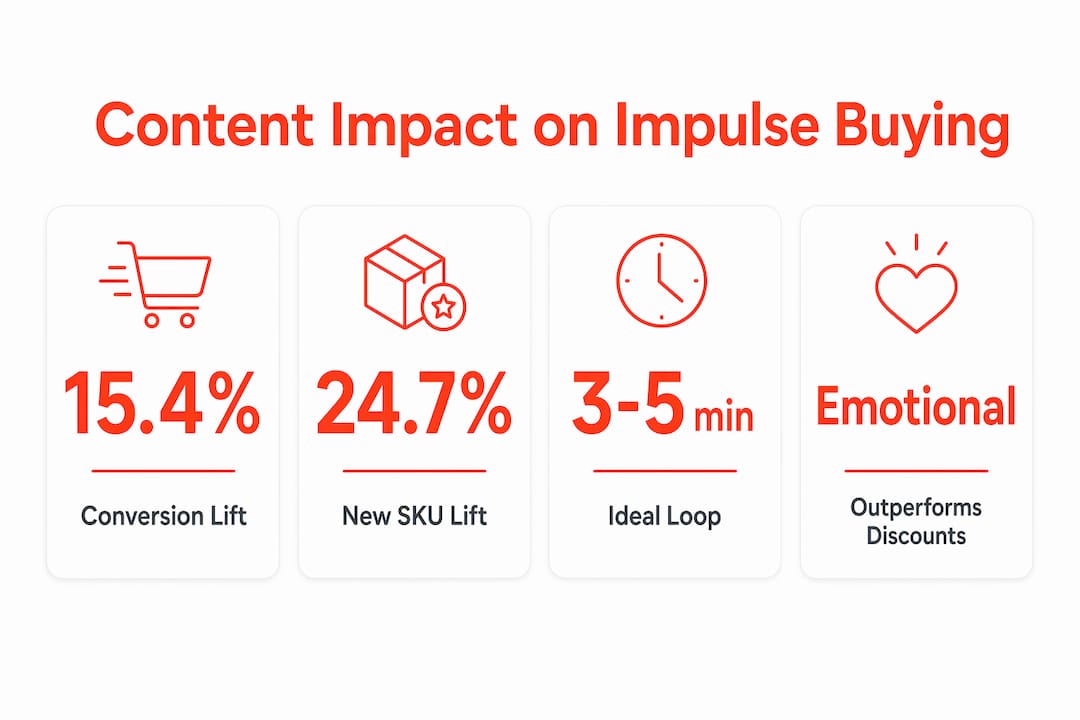
Digital signage is defined as the use of networked screens to deliver dynamic, targeted content that triggers unplanned buying decisions at critical moments in the shopper journey. For retail and service business owners, this is the most direct tool available to increase impulse purchases. Hedonic product categories see a 15.4% conversion lift via digital signage, with new SKUs reaching up to 24.7%. That means a well-placed screen showing the right content can move product that your staff never had to pitch. Platforms like Signstream, along with hardware solutions from ViewSonic and Epson, make it easier than ever to deploy this kind of targeted, real-time content across your entire store network.
How digital signage increases impulse purchases
The industry term for what digital signage does best is point-of-purchase stimulation. It works by intercepting shoppers at high-intent moments and delivering content that matches their emotional state. A study across 10 large Western European grocery stores found that facing digital signage in aisles yields an 8.1% lift in purchase odds. That lift is not random. It is the result of emotional and inspirational content meeting a shopper who is already in buying mode. The practical implication is clear: your screens need to do more than announce a price. They need to make a shopper feel something.
In-store digital displays work because they compress the awareness-to-decision cycle. A static shelf tag requires a shopper to notice it, read it, and self-motivate. A dynamic screen with motion, color, and social proof does that work automatically. This is why digital signage for retail consistently outperforms printed point-of-sale materials in conversion studies.
What content types drive impulse buying most effectively?
Not all signage content performs equally. The research is specific about what works.
Emotional and inspirational content outperforms price-cut messaging in grocery and general retail contexts. Price-cut only signage can actually reduce impulse conversion compared to storytelling or lifestyle visuals. Shoppers respond to aspiration, not arithmetic.
Social proof signals such as star ratings, review counts, and “best seller” badges displayed near decision points reduce shopper decision fatigue and increase impulse conversions. Shopify’s 2026 retail guidance confirms that making peer validation impossible to miss at high-intent locations is one of the most reliable conversion levers available.
Urgency cues including countdown timers, limited stock alerts, and flash sale notifications create the scarcity effect that pushes hesitant shoppers to act. These work best when the offer is genuine and the timer is accurate. Fake urgency erodes trust fast.
New product introductions benefit most from digital signage. New SKUs in hedonic categories reach up to 24.7% conversion lift, meaning your screens are the single best launch vehicle for new inventory.
Pro Tip: Rotate content in alignment with your average shopper decision window. If your checkout line averages 90 seconds, a 4-minute loop means most shoppers only see one or two messages. Design for the dwell time, not the full playlist.
Where should you place screens to maximize impulse buying?
Placement is the variable most business owners underestimate. The right content on a screen in the wrong location produces almost nothing. Assigning each screen a specific role by zone is the practice that separates high-performing retail signage networks from wasted hardware.
Here is how to think about zone-based placement:
Entry and window screens create curiosity and foot traffic. These screens should tease what is inside, promote a limited-time offer, or display lifestyle content that matches your brand. Their job is to pull people in, not to close a sale.
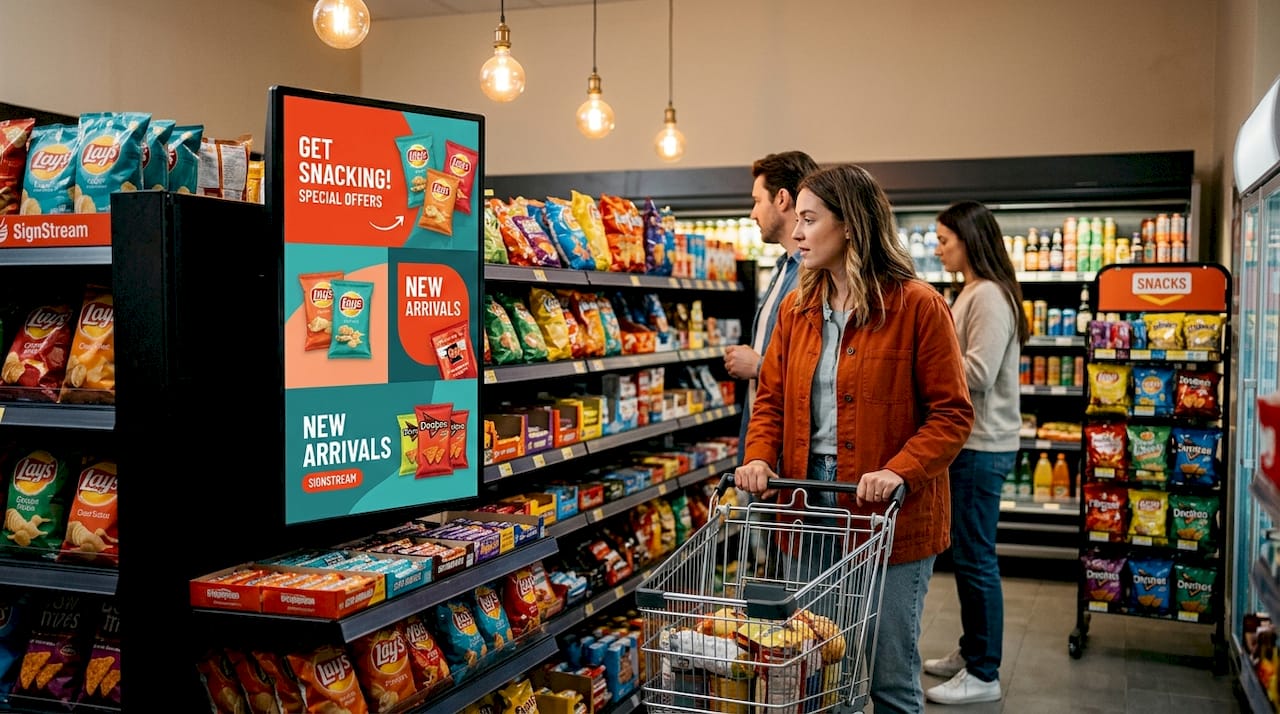
Aisle and endcap screens are where product discovery happens. Research confirms that checkout-zone signage nudges impulse add-ons while aisle and endcap displays educate and promote impulsive product discovery. Place inspirational content near relevant SKUs, not generic brand advertising. A screen next to your protein supplements should show a workout result, not your logo.
Checkout and point-of-sale screens are your highest-conversion real estate. Shoppers are stationary, mentally committed to buying, and open to one more item. Use this zone for complementary product suggestions, loyalty program prompts, and short-form social proof. Location-based digital cart ads at the point of purchase increase both purchase quantity and total spending.
Hero or feature screens near store centers work best for brand storytelling. Beyond promotional messaging, brand storytelling on hero screens supports repeat visits and emotional brand connection, which indirectly supports impulse sales over time.
Zone | Primary job | Best content type |
Entry / window | Drive foot traffic | Lifestyle visuals, teaser offers |
Aisle / endcap | Product discovery | Inspirational content, new SKU launches |
Checkout / POS | Impulse add-ons | Social proof, complementary products |
Hero / feature | Brand connection | Storytelling, loyalty messaging |
Pro Tip: Treat each screen zone as a separate campaign. Set distinct KPIs for each zone before you launch. A checkout screen measured on basket size tells you something useful. A checkout screen measured on brand recall tells you nothing.
For a deeper look at endcap strategy specifically, the guide on retail endcap digital displays covers placement mechanics and content formats in detail.
How should you time and rotate content to sustain sales lifts?
Timing is where most retail signage programs stall after an initial lift. The content that drove results in week one becomes invisible by week four if you do not refresh it. Circular content rotations with 3 to 5 minute playlists aligned to queue or dwell times keep shoppers engaged and prevent irritation from short repetitive loops.
Beyond loop length, consider these timing practices:
Daypart scheduling matches content to shopper mood. Lunch-hour shoppers in a service environment respond differently than Saturday afternoon browsers. Configure your content management system to swap messaging automatically by time of day.
Weekend and late-day programming tends to produce stronger impulse results. Shoppers later in the day and on weekends are generally in a more relaxed, exploratory mindset, which makes them more receptive to unplanned purchases.
Auto-updating widgets for countdowns, live inventory levels, or Google Calendar event feeds keep content feeling current without requiring daily manual updates. Platforms like Signstream and Mango Display support these widget types natively.
Seasonal and promotional refreshes should be scheduled at least two weeks in advance. Scrambling to update screens the day a promotion launches is a common operational failure that reduces the effectiveness of the campaign.
Pro Tip: Avoid building your entire content strategy around discounts. Price-cut messaging trains shoppers to wait for deals. Brand storytelling and lifestyle content build the emotional connection that makes shoppers buy at full price.
How can you measure digital signage impact on impulse purchases?
Measurement is where most retail signage investments either prove their value or quietly disappear from the budget. The standard framework is straightforward: use 60-day pre and post measurement windows comparing signage-promoted SKUs against baseline sales, while tracking footfall, basket size, dwell time, and repeat visits. Single-day comparisons introduce too much noise from weather, events, and staffing variables to be meaningful.
Defining metrics before deployment significantly improves accuracy in assessing digital signage impact. This sounds obvious, but most businesses install screens and then try to reverse-engineer what success looks like. Set your baseline numbers first.
Zone-based attribution links each screen location to specific sales outcomes. Your checkout screen should be measured against basket size and add-on attachment rate. Your aisle screen should be measured against the SKUs it promotes. Your entry screen should be measured against foot traffic counts and conversion rate from entry to purchase.
Metric | What it measures | Screen zone |
Basket size | Impulse add-on effectiveness | Checkout / POS |
SKU sales lift | Product discovery impact | Aisle / endcap |
Foot traffic | Entry conversion | Entry / window |
Dwell time | Engagement depth | All zones |
Repeat visit rate | Brand connection | Hero / feature |
The most common measurement pitfall is comparing a promoted SKU to itself during a period that includes an external variable, such as a competitor promotion or a local event. Always run a control SKU alongside your test SKU to isolate the signage effect.
Key takeaways
Digital signage increases impulse purchases most reliably when emotional content, strategic placement, and consistent measurement work together across every screen zone.
Point | Details |
Emotional content outperforms discounts | Inspirational and lifestyle messaging drives higher impulse conversion than price-cut ads. |
Zone-based placement multiplies results | Assign each screen a specific role: entry, aisle, checkout, or hero. |
Playlist length must match dwell time | Use 3 to 5 minute rotations aligned to actual queue or browsing time. |
Measure with 60-day windows | Short measurement periods introduce noise; compare promoted SKUs against a control baseline. |
Social proof at decision points converts | Star ratings and best-seller badges near high-intent locations reduce hesitation and lift sales. |
What most retailers get wrong about impulse signage
The assumption I see most often is that more screens equal more sales. It does not work that way. I have watched businesses install six screens in a small footprint and see zero measurable lift because every screen was showing the same brand video on a 30-second loop. The shopper saw it once and tuned it out permanently.
The deeper mistake is treating digital signage as a broadcast medium rather than a decision-support tool. Television is broadcast. A screen positioned 18 inches from a shopper’s hand as they reach for a product is a conversation. The content has to match that context precisely. A screen showing a recipe next to your fresh pasta is a conversation. A screen showing your company’s founding story in the same spot is noise.
The future of this space is AI-driven content personalization. Systems that read foot traffic patterns, time of day, and inventory levels to serve the right message automatically are already emerging. Businesses that build clean content libraries and measurement habits now will be positioned to take advantage of that shift without rebuilding from scratch. The retailers who will struggle are the ones still treating their screens as digital posters.
My honest advice: start with two zones, set clear metrics for each, and run a 60-day test before scaling. The data will tell you exactly where to invest next.
— DKS
How Signstream helps you drive impulse sales
Signstream is built specifically for retail and service businesses that want to act on everything covered in this article without hiring a developer or managing complex software.
You can update content across every screen in your network instantly from any device, which means your countdown timers, flash sale alerts, and social proof widgets are always current. Signstream supports auto-updating widgets for countdowns, calendars, and live feeds, so your urgency messaging runs on schedule without manual intervention. Scaling from a single location to a multi-store network costs nothing extra. Signstream’s ad exchange marketplace also lets you cross-promote with neighboring businesses and generate revenue from your own screens. Review the platform pricing plans to find the right fit for your store size and goals, or explore how the platform works to see the content management and scheduling features in action.
FAQ
What is the average conversion lift from retail digital signage?
Hedonic impulse product categories see a 15.4% conversion lift from digital signage, with new SKUs reaching up to 24.7%. Results vary by content type, screen placement, and product category.
Does emotional content really outperform discount signage?
Yes. Research from a study across 10 Western European grocery stores shows that inspirational and emotional content outperforms price-cut messaging for impulse conversion. Discount-only signage can reduce impulse buying in some retail contexts.
How long should a digital signage content loop be?
Content rotations of 3 to 5 minutes aligned to actual queue or dwell times keep shoppers engaged without causing irritation from repetitive short loops.
How do I measure whether my signage is increasing sales?
Use a 60-day pre and post measurement window, compare signage-promoted SKUs against a control baseline, and track basket size, footfall, dwell time, and repeat visits by screen zone.
Which screen placement drives the most impulse purchases?
Checkout and point-of-sale screens consistently produce the highest impulse conversion because shoppers are stationary and already in a buying mindset. Pair them with social proof content and complementary product suggestions for the strongest results.
Recommended
Comments