

Role of Screens in Regional Tourism Campaigns: A Guide
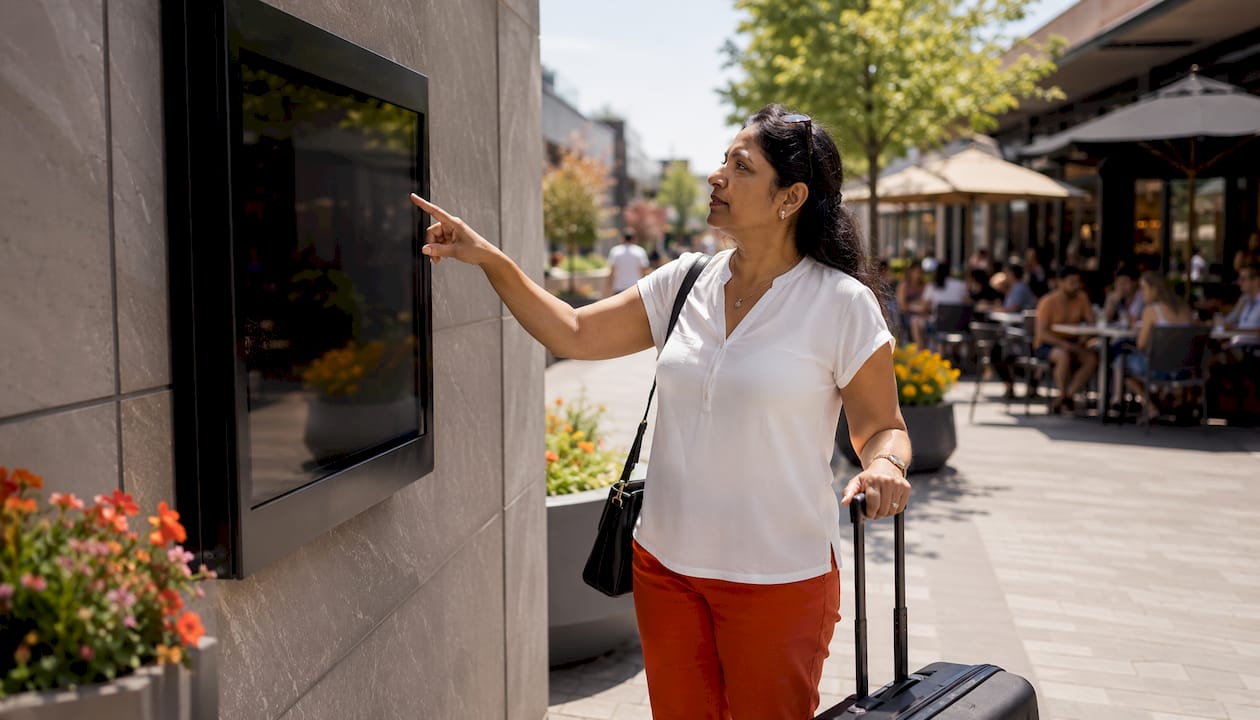
Networked digital screens are one of the most direct tools a venue operator can deploy in a regional tourism campaign. They build destination awareness at high-traffic touchpoints, create the kind of cultural affinity that UNWTO and Netflix research links to sustainable visitor growth, guide on-site behavior through wayfinding and live offers, and generate ad revenue when screens are pooled across a regional network. The role of screens in regional tourism campaigns is not passive display; it is an active, measurable channel that converts attention into footfall, bookings, and shared income.
Start here:
Join or build a regional screen network with at least three partner venues
Set three baseline KPIs before launch: QR scan rate, offer redemptions, and weekly impressions
Run a 6–8 week pilot with dynamic QR codes tied to a trackable landing page
Table of Contents
How do screens drive results in regional tourism campaigns?
Screens placed at traveler touchpoints do five distinct jobs in a regional campaign.
Awareness is the most obvious. The Italian “Let’s Marche” campaign placed 24 large-format digital screens and 18 video walls in major railway stations, reaching more than 60 million visitors over two months. That kind of mass reach is only possible when screens are positioned where travelers already are.
Cultural affinity is where screens earn their long-term value. Short-form video that shows local food, festivals, and landscapes does more than advertise. According to UNWTO and Netflix research, audiovisual content acts as a cultural mirror, building emotional connections that shape destination choice and generate economic spillovers well beyond a single campaign.
“Audiovisual content can act as a cultural mirror and foster long-term affinity that supports destination choice and broader economic spillovers.” — UNWTO/Netflix research on screen tourism
Wayfinding and micro-conversion turn passive viewers into active visitors. An events calendar on a lobby screen, a transit map in a hotel corridor, or a “book now” offer card with a dynamic QR code all reduce friction and extend average stay length.
Promotions work best when they are time-sensitive and scannable. A 6–8 second offer card with a QR code tied to a booking page outperforms a static poster because it is trackable and swappable in real time.
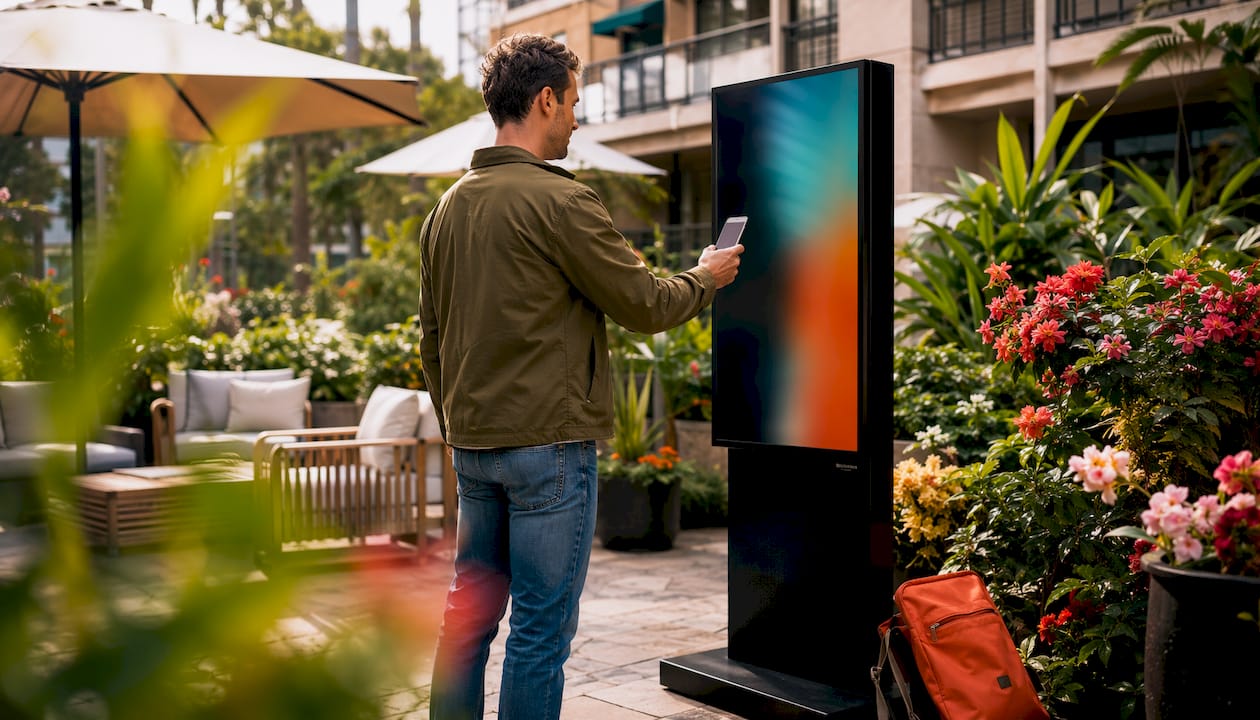
Monetization closes the loop. When venue operators pool their screens into a shared ad inventory, local tourism businesses can buy placements across the entire network, and operators earn a share of that revenue. VisitBritain research reported that among recent UK visitors roughly half agreed film/TV influenced their decision to visit; 53% took part in at least one film/TV related activity while on a trip. That influence translates directly into commercial value for operators who can demonstrate it.
Why shared screen networks outperform isolated screens
A single screen in one venue reaches a limited audience. A coordinated network across a tourism district reaches every traveler touchpoint simultaneously, with consistent creative and pooled ad inventory that no single operator could sell alone.
An MDPI cluster study found that membership in a regional tourism cluster improves digital marketing adoption, brand image, and competitiveness for small and medium hospitality businesses. Shared networks deliver exactly that: pooled scheduling, consistent templates, and aggregated audience data that give small operators negotiating power with regional advertisers.
Practical advantages of a shared network:
Lower per-screen content cost because creative is produced once and distributed across all locations
Higher ad yield because advertisers pay for network-wide reach, not single-venue impressions
Simplified analytics: one dashboard shows performance across every screen in the region
Faster campaign updates: a single content change pushes to all screens instantly
Signstream clients running shared screen setups have reported a substantial rise in class attendance after deploying coordinated screen campaigns, a result that reflects what happens when consistent messaging reaches the same audience across multiple touchpoints.
Pro Tip: Before recruiting partner venues, map the traveler journey through your region and identify the three or four locations where visitors spend the most dwell time. Those are your anchor screens. Build the network outward from there, and advertisers will follow.
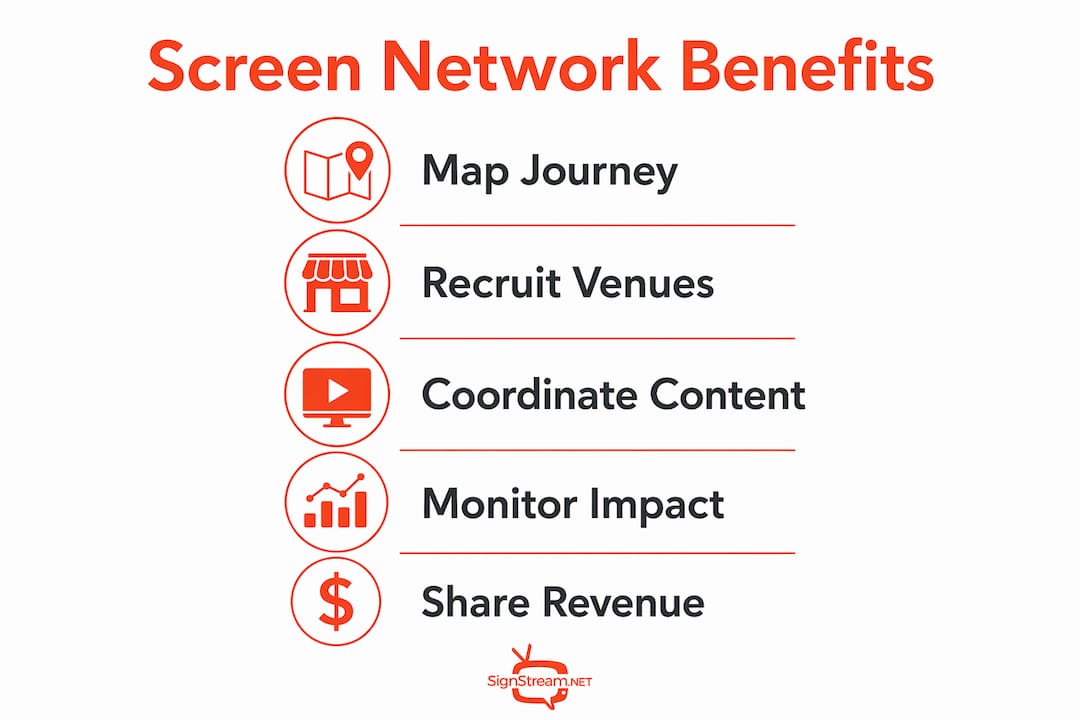
For a deeper look at why tourism districts use shared display networks, the mechanics of pooled inventory and governance are worth reviewing before you recruit partners.
What content should you show, and when?
A regional tourism screen campaign needs five content pillars to cover the full visitor journey.
Destination story — 15–30 second video clips showing local culture, food, and landmarks. These build affinity and are most effective in visitor centers and hotel lobbies where dwell time is high.
Seasonal campaigns — rotating creative tied to events, holidays, or off-peak incentives. Swap these monthly or when booking data shows a dip.
Events and itineraries — a rolling calendar of local activities with a QR code linking to a booking or info page. Works well in transit hubs and restaurant waiting areas.
Practical info — transit schedules, weather, and opening hours. Low-glamour but high-utility content that keeps screens relevant between campaign bursts.
Commercial offers — 6–8 second offer cards with dynamic QR codes. Keep these short, high-contrast, and tied to a trackable URL.
Frequency rules are straightforward. High-traffic zones like stations and airports need short loops of 8–15 seconds per card so the message lands before the traveler moves on. Visitor centers and hotel lobbies support longer storytelling loops of 60–90 seconds because dwell time is higher.
Pro Tip: Schedule cultural affinity content during morning and early afternoon when travelers are planning their day, and switch to commercial offers and event promos in the late afternoon when purchase intent peaks.
UNWTO and Netflix research confirms that screen content with genuine cultural depth has longer-term value than single promotional spots. Build at least 30% of your loop around destination storytelling, not just offers.
What does the technical and operational setup look like?
You do not need proprietary hardware to run a regional screen network. Smart TV apps, standard media players, and existing commercial displays all work with a hardware-agnostic cloud content management system.
Setup item | Typical approach | Notes |
Displays | Existing commercial TVs or new medium-sized screens | BYO displays keep entry costs low |
Media player | Smart TV app or plug-in player | Hardware-agnostic players reduce lock-in |
Content management | Cloud-based CMS with scheduling and templates | Mobile and browser control for fast updates |
Ad exchange | Regional ad pool with revenue-share split | Operators earn per impression or per campaign |
Analytics | Impressions, dwell time, QR scan rate | Dashboard shared with tourism partners |
Initial creative | 3–5 template-based assets per pillar | Produced once, reused across all network screens |
Governance basics every network needs:
A named content approver at each venue with clear turnaround times
An ad policy that excludes inappropriate or competing categories
An emergency override protocol for safety or weather alerts
A revenue-share agreement signed before the first ad runs
Signstream’s ad display network handles the ad exchange and revenue-share mechanics, so operators do not need to build a separate billing or reporting layer. For connected screen workflows, the CMS handles scheduling, permission tiers, and real-time content swaps from any device.
How do you measure whether screens are moving visitors and revenue?
Attribution is the part most operators skip, and it is the part that justifies the investment to tourism partners and advertisers.
Primary KPIs to track from day one:
Impressions per screen per day
QR scan rate (scans ÷ estimated impressions)
Offer redemptions tied to screen-specific codes
Direct bookings from UTM-tagged QR landing pages
Incremental footfall measured by pedestrian counters or POS data
Ad revenue per screen per month
“Always-on, data-driven targeting paired with clear KPIs and stakeholder governance can shift regional market share.” — Pafos Region digital marketing campaign findings
The Pafos Region campaign, which ran from 2023 to 2025, used traveler intent data and stakeholder collaboration to increase national tourist arrivals and improve regional visibility. The lesson for U.S. operators: governance and measurement are not optional extras. They are what converts a screen pilot into a fundable, scalable program.
Set a reporting cadence of weekly impressions and monthly conversion summaries. Share these with tourism partners and advertisers in a simple one-page dashboard. That transparency builds trust and makes it easier to sell the next campaign cycle.
What does a realistic launch timeline look like?
Phase | Weeks | Key actions |
Discovery | — | Map traveler journey, recruit 3–5 partner venues, confirm governance |
Setup | 2–6 | Install or activate screens, build 3–5 creative templates, configure tracking |
Live pilot | 6–12 | Run campaign, collect QR and footfall data, weekly check-ins |
Scale | 12+ | Add venues, sell regional ad inventory, optimize content by KPI |
Decision gate at week 12: if QR scan rate is above baseline and at least one advertiser has paid for a placement, the network is viable. Move to scale. If neither condition is met, audit the content loop and screen placement before adding more venues.
Legal, accessibility, and governance checklist
Before any screen goes live in a public or commercial venue, confirm these items.
Accessibility: use minimum 24pt fonts, high-contrast color ratios (4.5:1 for text), and captions on all video content
Permits: check local signage ordinances for transit hubs, historic districts, and outdoor-facing windows; requirements vary by U.S. city and county
Privacy: limit audience analytics to aggregate data only; disclose QR-driven tracking in a linked privacy statement
Ad policy: define prohibited categories (alcohol near schools, competing brands, political content) before the network opens to advertisers
Emergency override: every screen must be reachable for immediate content replacement during safety events
Pro Tip: For in-store and venue signage consistency across a regional network, establish a single brand style guide before creative production begins. Inconsistent fonts and color use across partner venues undermine the campaign’s credibility with advertisers.
Key Takeaways
Networked screens outperform isolated displays in every measurable dimension of a regional tourism campaign, from impressions and cultural affinity to ad revenue and attribution.
Point | Details |
Screens drive cultural affinity | UNWTO/Netflix research links audiovisual content to long-term destination choice and economic spillovers. |
Networks multiply impact | MDPI cluster research shows shared digital networks improve brand image and competitiveness for small operators. |
Measurement is non-negotiable | Track QR scan rate, offer redemptions, and incremental footfall from week one to justify investment. |
12-week pilot is the entry point | Run a structured pilot with governance and tracking before scaling to a full regional network. |
Signstream accelerates deployment | Signstream’s cloud CMS, ad exchange, and smart TV apps let operators launch and monetize a regional screen network without custom hardware. |
Why coordinated screen networks are worth the effort
The conventional wisdom is that small venue operators should focus on social media and leave destination marketing to tourism boards. That framing misses a real opportunity. A screen in your venue is already reaching the visitor at the moment of highest intent, physically present in the destination, ready to spend. Social media reaches people before they decide. Your screen reaches them after they have already arrived.
The Pafos and Marche campaigns both demonstrate that coordinated, always-on screen networks can shift measurable market share when paired with governance and data. Neither required a massive budget. Both required operators willing to share scheduling and creative across a network.
The revenue-share model is what makes this sustainable. When your screen earns ad income from regional tourism businesses, the cost of the network pays for itself over time. That is not a theoretical benefit. It is the model that tourism revenue-sharing guides are built around, and it is the reason operators who join early have a structural advantage over those who wait.
Signstream makes this straightforward to deploy
Signstream’s cloud-based platform gives venue operators everything needed to run a regional screen campaign without custom hardware or a technical team. You get unlimited screen deployment, a built-in ad exchange marketplace, smart TV apps, dynamic QR codes, scheduling, and analytics, all managed from a browser or mobile device. Onboarding is fast, and the platform scales from a single-venue pilot to a multi-location regional network without extra per-screen charges.
For operators ready to monetize their screens and join a regional ad network, the ad display network page outlines the revenue-share model in detail. If you want to talk through a pilot before committing, book a free consultation and get a deployment plan built around your venue and region.
Useful sources and further reading
Research and case studies:
UNWTO/Netflix: Cultural Affinity and Screen Tourism — foundational evidence for cultural affinity content strategy
VisitBritain: Screen Tourism Research — visitor behavior data on screen-influenced travel decisions
MDPI: Cluster Association and Digital Marketing in Tourism — evidence base for shared network benefits
DailyDOOH: Let’s Marche Campaign — transit screen reach example
Pafos Region Smart Tourism Campaign — data-driven regional campaign governance
Signstream implementation guides (recommended reading order):
Digital Screens’ Role in Tourist Engagement — start here for operational context
Tourism Digital Screen Networks: A Pro Guide — network rollout and monetization tactics
Build a Connected Screen Tourism Network — step-by-step build guidance
Screens and Tourism Revenue Sharing — revenue-share models and governance
Recommended
Comments