

How to Manage Digital Signage Across Franchises

Managing digital signage across franchises is the process of centrally controlling and coordinating dynamic visual content across multiple store locations to ensure consistent branding and effective customer communication. For franchise owners running five locations or five hundred, the gap between a polished brand experience and a chaotic one often comes down to how well your signage system is built. Cloud-based content management systems (CMS), standardized hardware, and smart content scheduling are the three pillars that make cross-location digital signage work. Get these right, and you have a network that updates in seconds, stays on brand, and gives local managers just enough control to stay relevant.
What are the essential tools to manage digital signage across franchises?
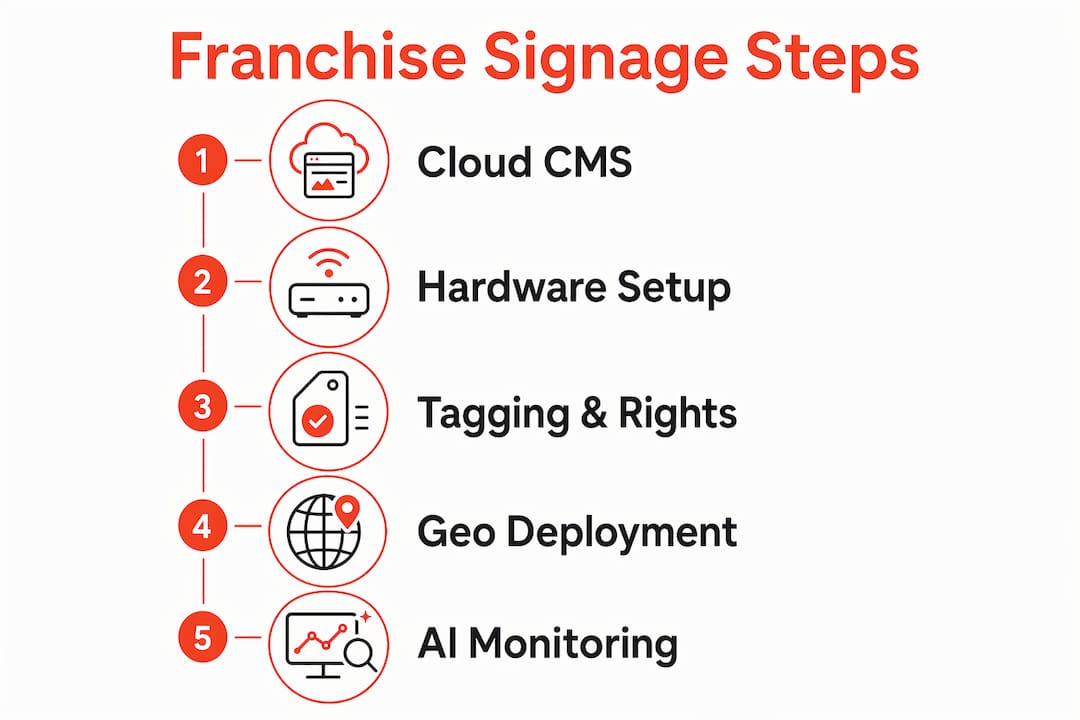
The foundation of any franchise signage solution is a cloud-based CMS. Platforms like Fusion Signage and Esprit Digital give you centralized control over every screen in your network from a single dashboard. Centralized cloud-based CMS control enables instant, 100% compliance across franchise networks. That means a price change, a new promotion, or a brand update goes live everywhere at once, with no phone calls to individual store managers.
Hardware standardization is the second pillar. When every location runs the same media player and display hardware, troubleshooting becomes predictable. You are not diagnosing a different setup every time something goes wrong. Esprit Digital’s CMS supports thousands of screens with high-availability architecture, but that only works reliably when the hardware underneath it is consistent.
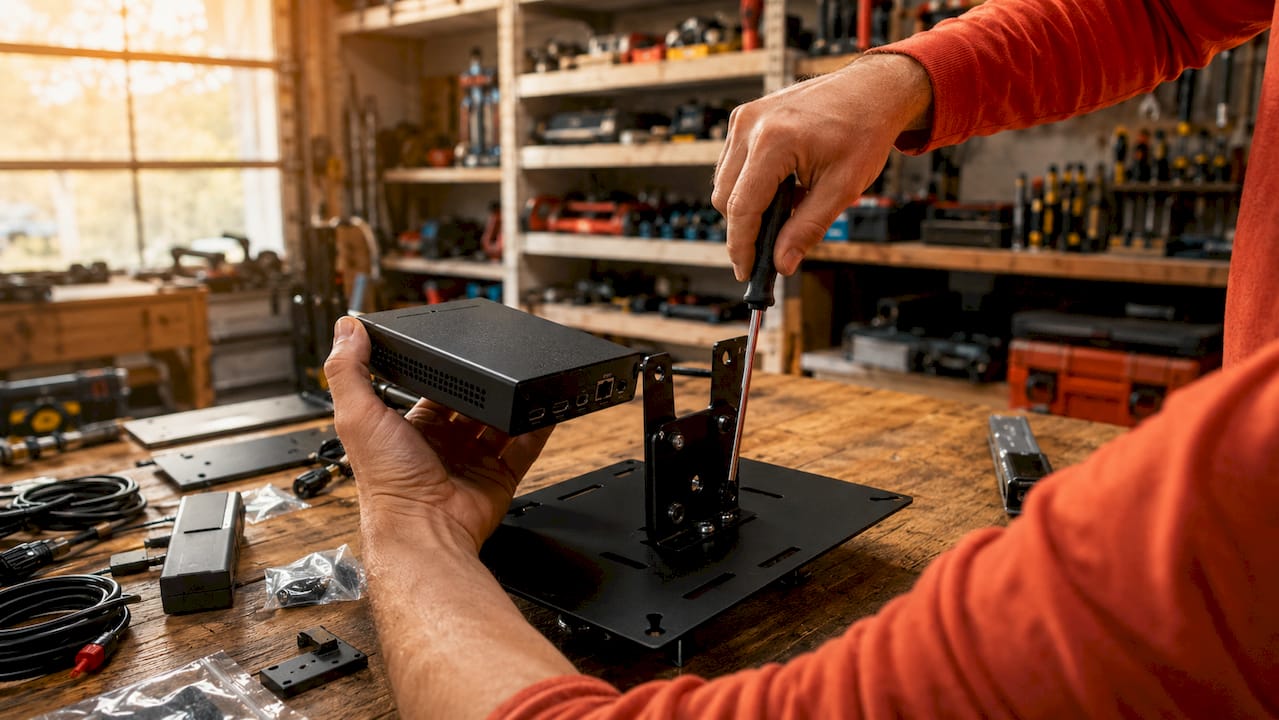
The third pillar is tagging and permissions. A well-configured CMS lets corporate push brand-approved content while giving local franchisees the ability to add location-specific promotions within defined boundaries. This hybrid model keeps your brand intact without making every local manager feel like they are running a puppet show.
CMS Feature | Why It Matters for Franchises |
Centralized scheduling | Push content updates to all locations simultaneously |
User role management | Separate corporate and local manager permissions |
Content tagging | Target specific locations, regions, or screen types |
Real-time updates | Correct errors or swap promotions instantly |
Multimedia support | Run video, images, and live data feeds on one screen |
Pro Tip: Set up a “local content zone” in your CMS template. This reserves one section of the screen for franchisee-controlled content while locking the rest to corporate-approved assets.
How to deploy and synchronize content across all franchise locations
A structured rollout prevents the most common deployment failures. The process below applies whether you are launching signage in three locations or thirty.
Audit your locations. Document screen sizes, mounting positions, and internet connection quality at every site before you configure anything. Mismatched hardware specs discovered after deployment cost time and money.
Build a master content library. Upload all brand-approved assets, including logos, fonts, video files, and approved promotional templates, to your CMS before assigning content to any screen.
Create location groups. Tag screens by region, store type, or audience profile. A downtown flagship and a suburban drive-thru need different content, even within the same brand.
Set your scheduling rules. Automated content scheduling and playlist management enable dayparting, which means your breakfast promotion runs at 7 a.m. and your dinner special takes over at 4 p.m. automatically.
Assign local permissions. Give franchisees access to a defined content zone and a library of pre-approved local assets. This keeps them engaged without opening the door to off-brand content.
Run a test broadcast. Push a test playlist to all screens 48 hours before go-live. Catch connectivity issues, resolution mismatches, and scheduling conflicts before customers see them.
Monitor and iterate. Use your CMS analytics to track which content runs, when, and on which screens. Adjust playlists based on performance data, not guesswork.
Geo-targeted content deployment is worth building into your system from day one. A franchise in Miami promoting a summer drink special and one in Chicago promoting a warm-weather return event are telling different stories to different customers. Cloud CMS systems can update campaigns instantly across locations, so geo-targeting does not require manual intervention at each site.
What common challenges arise with multi-location digital signage?
Connectivity problems are the most frequent issue franchise operators face. A screen that goes offline reverts to a static image or a blank display, both of which damage the customer experience. The fix is a CMS with automatic content caching, so screens continue playing the last downloaded playlist even when the internet drops.
Standardizing hardware and providing effective training reduces troubleshooting and compliance issues across the network. That is not just a best practice. It is the difference between a support ticket that takes ten minutes and one that takes three days.
Content compliance is the second major challenge. Without clear permissions, local staff upload off-brand images, outdated pricing, or unapproved fonts. The solution is a locked template system where the only editable zones are the ones you explicitly open up. Brand guidelines get enforced by the software, not by policing individual managers.
Training is the third challenge, and it is the most underestimated. Local staff turnover in franchise environments is high. A CMS that requires a 40-page manual is a CMS that will be misused within six months of launch.
Choose a platform with an interface that non-technical staff can learn in under an hour.
Record short video tutorials for common tasks like uploading a local promotion or adjusting screen brightness schedules.
Build a simple escalation path: local manager handles content, regional manager handles scheduling, corporate handles brand assets.
Run a quarterly content audit to catch compliance drift before it becomes a pattern.
Pro Tip: Lock your master templates at the corporate level and only share editable versions with franchisees. A franchisee who cannot accidentally break the brand layout is a franchisee who will use the system confidently.
How does intelligent signage hardware improve franchise operations?
Modern digital signage hardware goes well beyond playing video. Devices with embedded neural processing units (NPUs) run artificial intelligence tasks directly on the device, without sending data to a remote server. Intelligent digital signage hardware with embedded NPUs delivers AI performance on the edge, reducing latency and improving video playback quality. For a QSR drive-thru running a dynamic menu board, that difference is visible and measurable.
AI-driven digital signage helps franchises manage foot traffic by monitoring crowd density and queue lengths. Dynamic content adaptation reduces perceived wait times and improves the customer experience in busy locations. A screen that shows a two-minute wait time and a relevant upsell item is doing the work of a trained staff member.
The integration of AI and edge computing in digital signage is transforming franchise operations by enabling smarter, faster content delivery and operational intelligence. For franchise owners, this means fewer staff hours spent managing screens and more time spent on the floor.
Hardware Feature | Operational Benefit |
Embedded NPU | Runs AI tasks locally, no cloud dependency for real-time decisions |
4K video support | Consistent, high-quality display across all locations |
Edge computing | Faster content updates, lower latency at peak traffic times |
Crowd monitoring | Adjusts messaging based on real-time foot traffic data |
Remote diagnostics | Identify and resolve hardware issues without an on-site visit |
Franchise groups scaling into new markets benefit most from this technology. Bailey Nelson’s success illustrates how cloud platforms support thousands of screens internationally with consistent brand messaging. Intelligent hardware makes that consistency possible even in locations with variable internet quality.
Key takeaways
Centralized cloud-based CMS, standardized hardware, and clear permission structures are the three non-negotiable requirements to manage digital signage across franchises at scale.
Point | Details |
Use a cloud-based CMS | Platforms like Fusion Signage and Esprit Digital give you instant control over every screen in your network. |
Standardize your hardware | Consistent devices across locations reduce troubleshooting time and improve content reliability. |
Build a hybrid permission model | Lock brand assets at the corporate level while giving franchisees a defined local content zone. |
Automate scheduling with dayparting | Set time-based playlists so the right content runs at the right time without manual intervention. |
Invest in intelligent hardware | Devices with embedded NPUs handle AI tasks locally, improving responsiveness and reducing operational load. |
What I have learned from watching franchises get signage wrong
Franchise owners consistently underinvest in the CMS setup and overinvest in the screens themselves. A beautiful 4K display running a poorly organized content system is just an expensive way to show the wrong thing. I have seen franchise groups spend months debating screen size and less than a day thinking about how content will actually be managed across 50 locations.
The brands that get this right choose a cloud-based signage platform early, before they need it, and build their permission structure before they hand access to a single franchisee. They treat the CMS as a brand asset, not a technical afterthought.
The other mistake I see constantly is treating all locations as identical. A multi-location signage strategy that ignores local context misses the point of digital signage entirely. The whole advantage over printed materials is that you can be specific. Use that.
The future of franchise signage is not more screens. It is smarter use of the screens you already have. AI-driven content adaptation, deeper analytics, and tighter integration with point-of-sale data are the trends worth watching in 2026. Franchises that build a solid CMS foundation now will be positioned to take advantage of those tools without rebuilding from scratch.
— DKS
How Signstream makes franchise signage management simple
Managing screens across multiple locations does not have to be complicated or expensive. Signstream is built specifically for businesses that need to update content across unlimited screens instantly, from any device, without requiring technical expertise from local staff. Franchise clients, including restaurants and retailers, have reported a 25% rise in engagement metrics after switching to Signstream’s platform.
Signstream’s cloud CMS gives corporate teams full brand control while letting local managers handle location-specific content within approved boundaries. The platform includes an ad exchange marketplace, so you can cross-promote with nearby businesses and generate revenue from your own screens. Check out Signstream’s pricing plans to see how affordable it is to run a professional signage network across your entire franchise. You can also explore how the platform works remotely before committing to anything.
FAQ
What is digital signage management for franchises?
Digital signage management for franchises is the process of controlling, scheduling, and updating visual content across multiple store locations from a single platform. A cloud-based CMS handles this centrally, so every screen stays current and on brand.
How do I keep brand consistency across all franchise locations?
Use a CMS with locked corporate templates and a defined local content zone. Hybrid signage management models let franchisees customize within approved boundaries while corporate controls the brand assets.
What is dayparting in digital signage?
Dayparting is the practice of scheduling different content to play at different times of day automatically. A breakfast promotion runs in the morning and a dinner special takes over in the afternoon, with no manual changes required at each location.
How does AI improve digital signage in franchise environments?
AI-powered hardware with embedded NPUs monitors foot traffic, adjusts messaging in real time, and reduces perceived wait times. This is especially effective in QSR drive-thrus and high-traffic retail locations where content relevance changes by the minute.
Can local franchise managers update their own screens?
Yes, with the right CMS permission structure in place. Avoid common platform mistakes by choosing a system that separates corporate and local access clearly, so local managers can add relevant content without touching brand-critical assets.
Recommended
Comments