

Build a Connected Screen Tourism Network in 2026

A connected screen tourism network is the strategic integration of physical visual anchors, digital content layers, and serialized storytelling across multiple venues to create a continuous visitor experience. This approach is the industry standard for tourism professionals who want to move beyond isolated displays and create a digital signage in tourism system that actually guides, informs, and retains visitors. The core insight is simple: screens alone do not build engagement. Connected networks do. When you build a connected screen tourism network with all three pillars working together, you redistribute visitor flows, reduce overcrowding at hotspots, and generate measurable engagement data across every venue.
What do you need to build a connected screen tourism network?
The foundation of any connected tourism platform is three components working in sync: physical anchors, a digital layer, and a storytelling framework. Physical anchors include gallery displays, QR code panels, and digital signage at key visitor touchpoints. The digital layer adds AR overlays, short video content, and audio guides that visitors access through their phones or on-screen prompts. The storytelling framework ties every touchpoint into a single narrative arc that carries visitors from one venue to the next.
Hardware and software requirements
Your hardware choices set the ceiling for what your network can deliver. At the entry level, commercial-grade screens with media players handle basic content display. At the enterprise level, you need screens with edge computing capability, meaning the screen itself can cache and serve content locally without depending on a live internet connection. Offline caching of assets is critical in transit hubs, basement exhibits, and heritage sites with poor connectivity. Without it, your storytelling breaks the moment a visitor steps into a low-signal zone.

On the software side, you need a centralized content management system that controls all screens from one dashboard. Centralized channel manager platforms allow stakeholders to update content across multiple venues instantly, and integration can be completed within 24 hours without an in-house IT team. That speed matters when you are coordinating content across a museum, a visitor center, and three outdoor heritage sites simultaneously.
Stakeholder and partnership requirements
No tourism digital network succeeds without the right people at the table before deployment begins. You need local content studios for production, tourism offices for destination alignment, and technology providers for infrastructure. A one-month co-creation workshop with local studios before deployment is the recognized best practice for aligning content with cultural assets and visitor expectations. Skipping this step produces generic content that visitors ignore.
Pro Tip: Secure content provenance from day one. Store verified, high-resolution source files in a cloud-based edge registry. Networks that skip this step suffer pixelation and formatting errors when content is manually transferred between venues.
How to design the visitor journey across your network
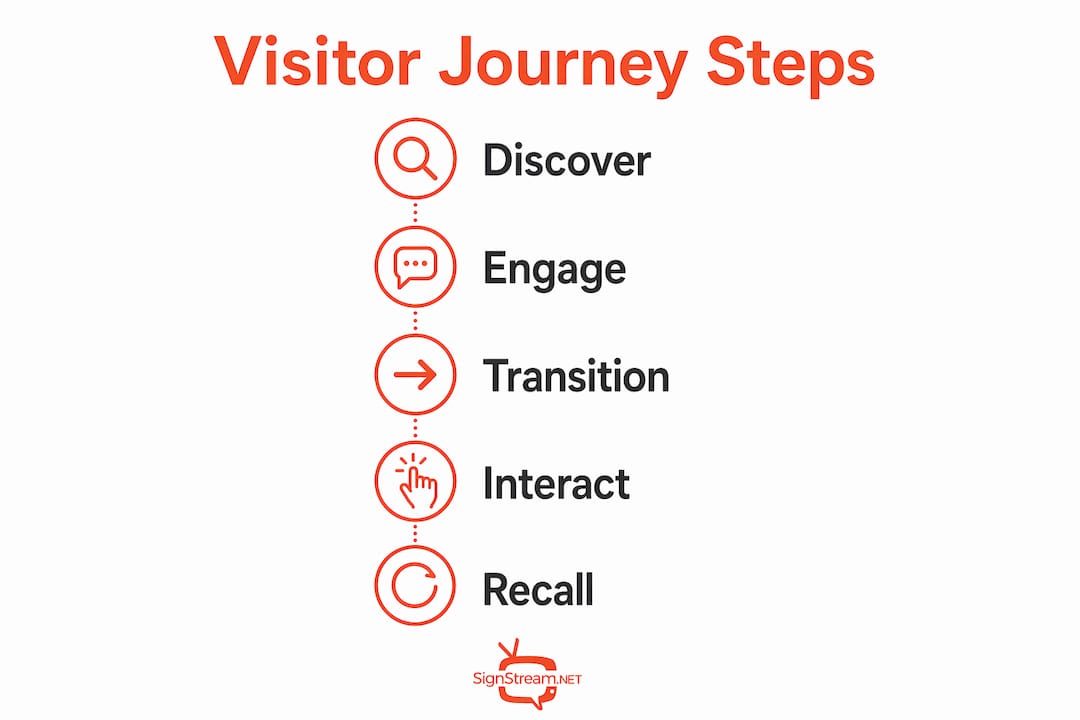
The visitor journey is the sequence of experiences a person has as they move from one venue to the next. Designing it well is the difference between a network that feels intentional and one that feels like a collection of unrelated screens. Successful connected screen networks are executed as transmedia storytelling projects that incorporate physical, digital, and audio components synchronized as a cohesive journey.
The three-pillar anchor strategy
The three pillars are physical, digital, and storytelling. Physical anchors are the screens, panels, and QR codes that exist in the real world. Digital anchors are the AR overlays, video clips, and podcast episodes that visitors access at each physical point. The storytelling anchor is the narrative thread that connects every touchpoint. User navigation across interconnected platforms, not hardware alone, drives the success of digital tourism experiences. That finding reframes the entire design challenge: your job is not to install screens, it is to design a path.
Milestones from concept to deployment
A realistic deployment roadmap follows this sequence:
Discovery and audit. Map all existing venues, screens, and content assets. Identify connectivity gaps and visitor flow data.
Co-creation workshop. Bring local studios, tourism offices, and technology partners together for a structured four-week session to define the narrative arc and visitor flow.
Content production. Develop synchronized assets: AR overlays, short video clips (90 seconds or under performs best on venue screens), QR-linked audio guides, and static signage.
Platform configuration. Set up your centralized content management system, configure offline caching for low-connectivity zones, and test content formatting across all screen sizes.
Pilot deployment. Launch at one venue first. Collect engagement data for 30 days before expanding.
Full network rollout. Deploy across all venues with a shared content calendar and a defined update schedule.
Pro Tip: Align your storytelling with local cultural assets that are not already featured in mainstream tourism materials. Visitors who discover something genuinely new are far more likely to share it, which extends your network’s reach without additional media spend.
For a deeper look at multi-venue network strategies, the operational details behind content scheduling and venue coordination are worth reviewing before you finalize your roadmap.
What technologies enable efficient network management?
Managing a connected tourism platform across multiple venues requires infrastructure that centralizes control without creating bottlenecks. The key technologies are channel managers, exchange platforms, and AI-native content systems. Each solves a different operational problem.
Channel managers and exchange platforms
A channel manager is software that pushes content updates to every screen in your network from a single interface. Venue showcase digital tools confirm that channel managers and exchange platforms are the operational backbone for simplifying network management across tourism venues. Without one, updating 20 screens across five venues means logging into each system separately, a process that introduces errors and delays.
Exchange platforms go one step further. They allow venues to share content with each other and, in some cases, generate revenue from third-party advertisers displaying content on their screens. Signstream’s ad exchange marketplace does exactly this: venues cross-promote with local businesses and earn revenue from their own screens. That turns your network from a cost center into a revenue source.
AI-native platforms and data privacy
AI-native platforms analyze real-time territorial data such as visitor sentiment, hotel occupancy rates, and travel flows, then adjust content across the network dynamically. This improves content relevancy compared to seasonal update models, where content stays static for months regardless of what visitors actually want. The practical implication is that a screen near a sold-out attraction can automatically promote an alternative site, redistributing foot traffic in real time.
Data privacy is a real concern in this setup. Unified digital infrastructure that connects tourism stakeholders is a strategic move to regain control over visitor data, not just a technology upgrade. Build your data governance policy before you collect a single visitor interaction. Define what you collect, where it is stored, and who has access.
The most common pitfall in network management is fragmentation: different venues using different platforms that cannot communicate with each other. Avoid this by standardizing on one content management system before deployment, not after.
How to troubleshoot challenges and measure success
Every connected screen network faces three categories of problems: technical, operational, and content-related. Knowing which category a problem belongs to tells you who needs to fix it.
Technical challenges include connectivity failures, screen synchronization errors, and content formatting issues. Offline caching solves the connectivity problem. Standardized content templates solve the formatting problem. Synchronization errors usually trace back to inconsistent file formats across venues.
Operational challenges include slow content updates, stakeholder disagreements over messaging, and unclear ownership of the content calendar. A shared content governance document, agreed upon during the co-creation workshop, prevents most of these issues.
Content challenges include low engagement, visitor confusion about where to go next, and storytelling gaps between venues. Analytics solve this. Track dwell time at each screen, QR code scan rates, and venue-to-venue transition rates. These three metrics tell you exactly where your visitor journey breaks down.
Your core KPIs should be:
Dwell time per screen: Are visitors stopping to engage, or walking past?
QR scan rate: Are visitors following the digital layer prompts?
Venue transition rate: Are visitors moving from one network venue to the next?
Visitor redistribution: Are lesser-known venues receiving more traffic after network launch?
Pro Tip: Build an offline content cache at every venue before launch. Cache at least 72 hours of content locally on each media player. This prevents any connectivity outage from breaking the visitor experience, especially in heritage sites and underground spaces.
Key takeaways
A connected screen tourism network succeeds when physical anchors, a digital content layer, and serialized storytelling are designed and managed as one integrated system, not three separate projects.
Point | Details |
Three-pillar foundation | Physical anchors, digital layers, and storytelling must work together from day one. |
Co-creation before deployment | A structured workshop with local studios and tourism offices prevents generic, low-engagement content. |
Centralized management is non-negotiable | A single channel manager platform eliminates update errors and reduces operational overhead across venues. |
Offline caching protects the experience | Cache content locally on every media player to prevent connectivity failures from breaking visitor journeys. |
Measure redistribution, not just views | Track venue transition rates and foot traffic shifts to prove the network’s real-world impact. |
Why most screen networks fail before they start
The most common mistake I see tourism professionals make is treating a connected screen network as an AV installation project. They hire a hardware vendor, mount screens, and then wonder why engagement is flat six months later. The hardware is the least important part. The visitor journey design is everything.
The networks that actually work, including deployments I have seen in North Wales and across heritage sites in Spain, share one trait: the storytelling was designed before a single screen was purchased. The physical anchors were chosen because they fit the narrative, not because they were the most convenient locations. That discipline is rare, and it is the reason most networks underperform.
The shift toward unified digital infrastructure is also a strategic business move, not just a technology decision. Tourism professionals who build these networks gain direct access to visitor behavior data that was previously locked inside third-party booking platforms. That data is worth more than the screens themselves over a three to five year horizon.
My honest advice: start with one venue, one story, and one clear visitor action you want to drive. Prove the model works at small scale before expanding. The temptation to launch across every venue at once is real, but the networks that scale successfully are always the ones that started small and iterated fast.
— DKS
How Signstream fits into your network build
Tourism professionals who want to move from planning to deployment need a platform that handles the operational complexity without requiring a dedicated IT team.

Signstream is built for exactly this use case. The platform lets you manage multiple screens from any device, push content updates instantly across all venues, and access an ad exchange marketplace that generates revenue from your screens. Clients using Signstream have reported a 25% rise in engagement metrics after implementation. You can book an on-site consultation to get a deployment plan tailored to your venue network, or start with a free consult to map out your options. Signstream deploys on unlimited screens at no extra charge, which makes it a practical fit for multi-venue tourism networks of any size.
FAQ
What is a connected screen tourism network?
A connected screen tourism network is a system of digital displays, QR panels, and content layers across multiple venues that deliver a continuous, synchronized visitor experience. The three core components are physical anchors, a digital content layer, and serialized storytelling.
How long does it take to build a connected tourism network?
A realistic timeline from discovery to full deployment is three to five months. The co-creation workshop alone takes approximately one month, and a 30-day pilot at one venue is standard practice before full rollout.
What is the most important technology for managing multiple venues?
A centralized channel manager is the most critical technology. It allows you to update content across all venues instantly from one dashboard, and integration can be completed within 24 hours without an in-house IT team.
How do you measure success in a screen tourism network?
The four key metrics are dwell time per screen, QR scan rate, venue transition rate, and visitor redistribution to lesser-known sites. These metrics reveal where the visitor journey works and where it breaks down.
Why is offline caching important for tourism screen networks?
Offline caching stores content locally on each media player so the visitor experience continues even when internet connectivity fails. This is especially critical in heritage sites, underground spaces, and transit hubs where connectivity is unreliable.
Recommended
Comments