

Franchise Digital Signage Explained for Multi-Location Owners
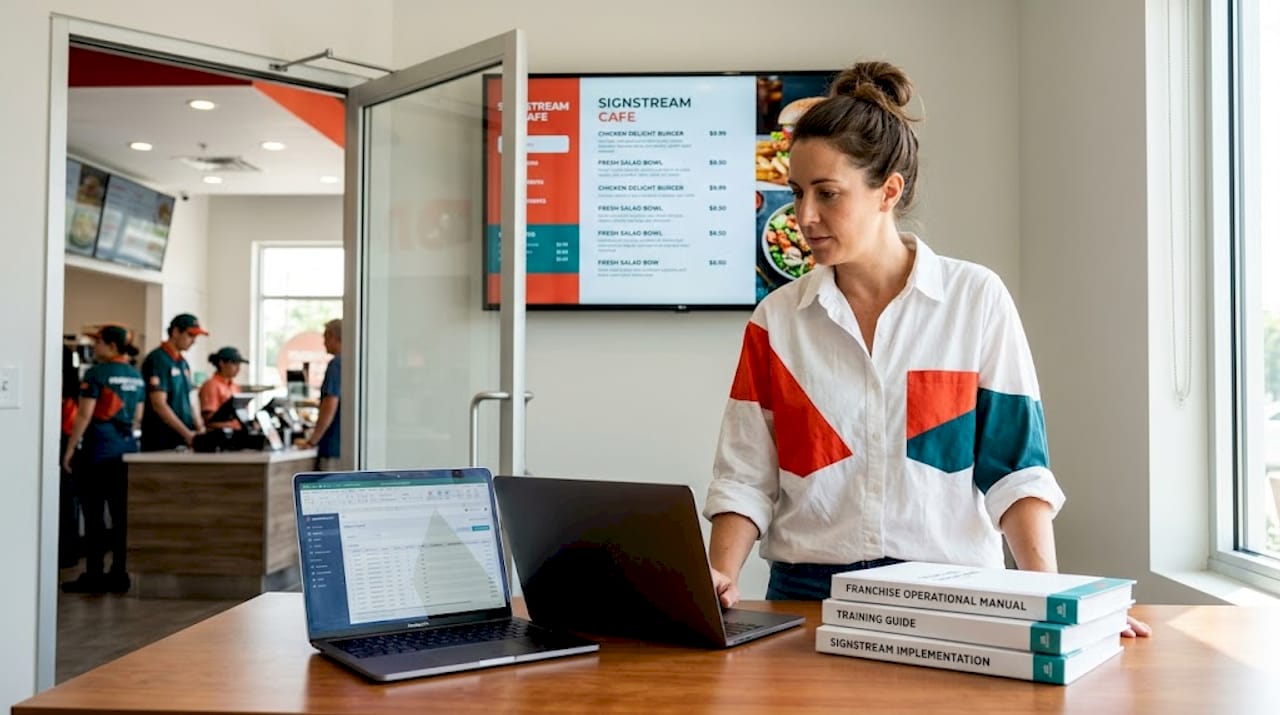
If you’re running a franchise and still relying on printed posters, static menu boards, or emails to communicate across your locations, you’re leaving real money on the table. What is franchise digital signage explained simply? It’s a network of digital screens across all your locations, centrally managed from one platform, delivering dynamic content that you can update in real time. This is not just a flashier version of a poster. It’s an operational system that touches marketing, sales, customer experience, and even revenue generation. This article covers how it works, why it matters, and how to implement it without the usual headaches.
Table of Contents
Key takeaways
Point | Details |
Centralized multi-location control | Franchise digital signage lets you manage content across all locations from one dashboard, instantly. |
Sales lift is measurable | Digital signage delivers an average 32% increase in retail sales and reduces dependency on costly print materials. |
Cloud platforms scale without friction | Cloud-based systems support unlimited screens and role-based permissions, making growth manageable. |
Content strategy is non-negotiable | Treating digital screens like print boards is the most common and costly mistake franchise operators make. |
Revenue goes both ways | Your screens can generate income through third-party advertising, not just drive sales. |
What is franchise digital signage and how it works
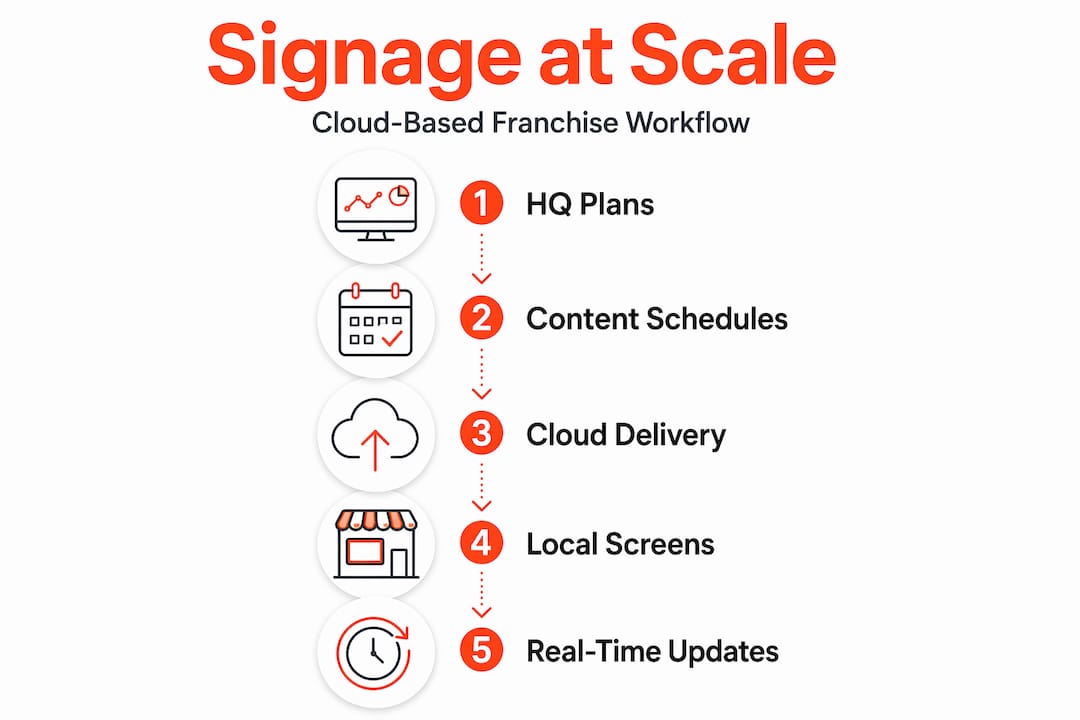
Franchise digital signage is a network of digital displays, spread across multiple locations, all managed through a central software platform. Think of it as a content publishing system where headquarters controls the master content feed, and individual franchise locations can pull from that feed, add local content, or both, depending on the permissions set by the franchisor.
The content itself can include anything from promotional offers, limited-time deals, and digital menu boards, to employee announcements, queue management screens, and interactive ads. Unlike a single-location business that might update one screen manually, a franchise operation needs to push updates to dozens or hundreds of screens simultaneously, across different cities or time zones, and do it accurately every time.
Here’s how the core components work together:
Display hardware: Commercial-grade screens, including LED panels, video walls, and mounted TVs, installed at each location.
Media players: Small devices connected to each screen that receive and play content from the cloud.
Content management software (CMS): The central hub where you create, schedule, and publish content to any screen or group of screens.
Network connectivity: Each location connects to the platform via the internet, enabling real-time remote updates.
Analytics layer: Tracks what content is playing, when, and on which screen, giving you performance data.
Cloud-based management is what makes this genuinely practical at scale. You don’t need an IT team on-site at every location to push updates. One person at headquarters can schedule a national promotion to go live at 8 a.m. tomorrow across 200 locations, and each screen updates automatically.
Pro Tip: Set up location groups in your CMS from day one. Grouping screens by region, store type, or time zone means you can push targeted content to the right audience without updating every screen manually.
Benefits that go beyond the obvious
Most franchise owners come to digital signage thinking about one thing: better-looking ads. That’s a narrow view of what this technology actually delivers.
Retail sales increase an average of 32% after implementing digital signage, and average purchase amounts rise by 29.5%. Those numbers come from the psychology of dynamic visual content. Moving images, timely promotions, and contextual messaging capture attention in ways that static print never can. A digital menu board that highlights a high-margin item during the lunch rush outperforms a printed menu that shows the same item all day.
Beyond sales, here is where franchise operators consistently find value:
Brand consistency: Every location shows the same approved brand visuals, fonts, and messaging. No rogue franchise owner putting up a hand-written sign.
Real-time updates: Pull a product that’s sold out. Launch a flash sale. Update pricing across all locations in minutes, not days.
Reduced print costs: Most businesses reach positive ROI within 6 to 18 months largely because they eliminate recurring design, print, and shipping costs.
Customer experience: Dynamic signage reduces perceived wait times and increases brand recall, two metrics that directly affect customer loyalty.
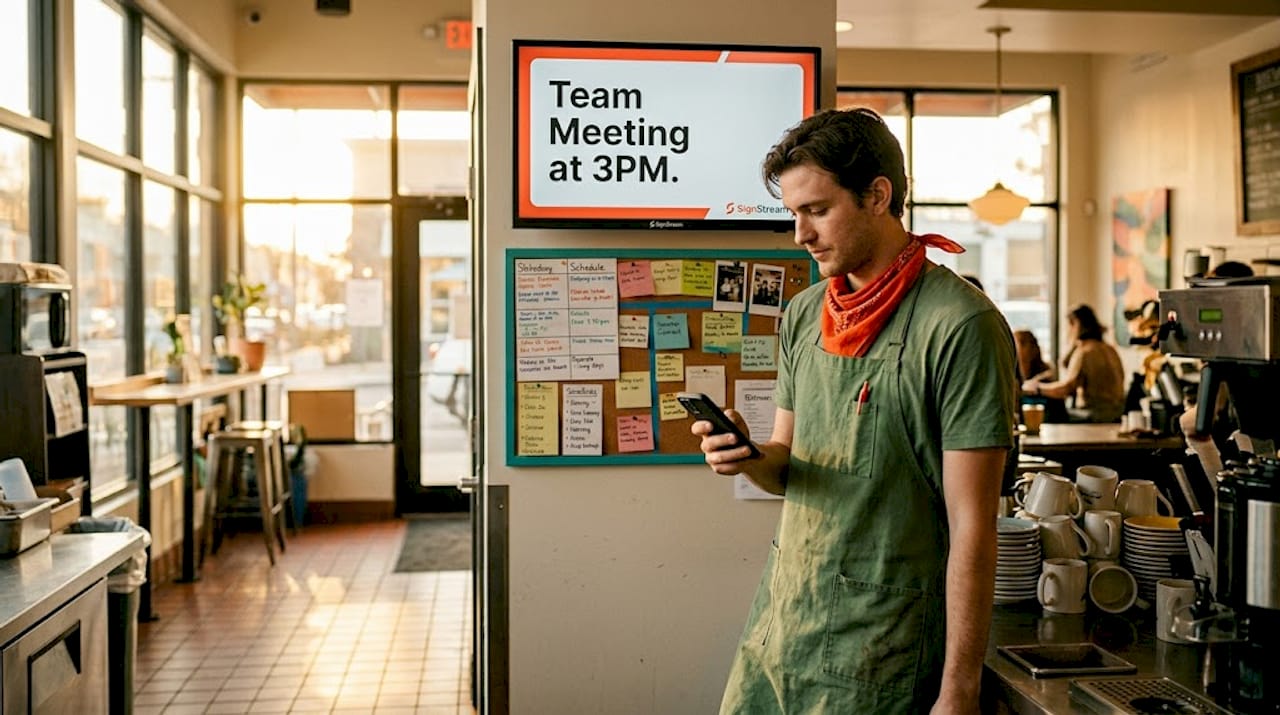
Internal communications: Screens in staff areas can display shift schedules, safety reminders, or training updates, replacing printed notices that nobody reads.
Third-party advertising revenue: Your screens can host local or national ads during off-peak hours, turning a cost center into an income source.
Pro Tip: Don’t overlook the staff-facing screens. Franchises that use digital signage for internal communication report faster onboarding and better compliance with promotional campaigns because employees actually see the updates.
Scaling and integrating across multiple locations
This is where franchise digital signage gets genuinely powerful, and where most generic signage systems fall apart. A solution built for a single café cannot manage 150 franchise locations without becoming a full-time administrative burden.
Modern franchise signage solutions use role-based permissions and location grouping to give headquarters control without micromanaging every screen. A regional manager might have access to update screens in their territory. A franchisee might be able to add a local event announcement but cannot override the national menu board template. This structure keeps brand standards intact while giving local operators the flexibility they need.
The table below shows how centralized and localized control typically divide in a franchise signage system:
Function | Headquarters control | Franchisee control |
Brand templates and logos | Full control | View only |
National promotions | Schedules and publishes | Cannot override |
Local events or announcements | Approves or sets limits | Can add within permissions |
Pricing updates | Can push globally | Can adjust locally if permitted |
Analytics and reporting | Full network visibility | Location-level data only |
Cloud-based platforms enable rapid deployment with consistent brand messaging and local customization, which is exactly what the franchise model demands. Adding a new location means connecting a new screen to the existing platform, not rebuilding your content infrastructure from scratch.
Integration with your broader marketing and IT ecosystem matters too. Franchise signage is most effective when it connects to existing corporate IT and marketing workflows rather than running as a standalone system. That means integrating with your POS system for real-time pricing, your marketing calendar for automatic campaign scheduling, and your analytics tools for performance tracking.
Pro Tip: Before signing any contract, ask the vendor how new locations are onboarded. If the answer involves sending a technician to every site, that’s a cost that will scale badly as you grow.
Common mistakes that hurt results
The biggest mistake franchise operators make is treating their digital screens like expensive print posters. They design content in landscape layout with dense text, update it once a month, and wonder why the results are underwhelming. Effective digital signage requires fresh, contextual, and time-bound content that takes advantage of the medium’s dynamic capabilities.
Other mistakes that show up regularly:
No content strategy: Publishing content without a plan for frequency, message rotation, or audience timing leads to screens that go stale fast.
Ignoring local customization: A national chain running identical content in every location misses the opportunity to connect with local customers on a relevant level.
Poor hardware placement: A screen mounted behind a counter where customers never look, or in a glare-heavy spot, wastes the investment entirely.
No measurement plan: If you don’t define what success looks like before launch, you won’t know whether your signage is working or not. Networks that offer audience verification and measurement have a clear competitive advantage.
Underestimating content management effort: Someone needs to own this. Digital signage without a content owner becomes outdated quickly and loses its effectiveness.
Pro Tip: Plan your content in 4-week cycles before you go live. Map out what each screen will show during each part of the day, and rotate messages every 7 to 10 seconds to hold attention without overwhelming viewers.
How to select and implement the right solution
Getting franchise digital signage right comes down to asking the right questions before you commit to any platform or hardware. Here’s a practical sequence to follow:
Define your scale and scope. How many locations do you have now, and how many do you expect in two years? Your platform needs to handle both without a price hike on every screen you add.
Identify your content types. Do you need menu boards, promotional displays, interactive kiosks, employee communication screens, or a mix? Different content types have different technical requirements.
Evaluate software ease of use. If your franchisees need to add local content, the platform must be simple enough that non-technical users can operate it without training every time.
Assess integration needs. Will the system connect to your POS, loyalty program, or marketing automation tools? Build this into your evaluation criteria from the start.
Build a content update schedule. Decide how often content will change at the network level and who is responsible for each update. Agree on this before launch.
Set measurable success metrics. Define specific targets: sales lift percentage, print cost reduction, customer dwell time, or ad revenue generated. Review them at 90 days, 6 months, and 12 months.
You can explore franchise signage solutions that connect revenue generation directly to your content strategy, which changes the ROI conversation entirely.
Pro Tip: Run a pilot at two or three locations before a full rollout. Compare sales data, customer feedback, and operational load from those locations against your control sites. This gives you real data to justify the network-wide investment.
My honest take on where franchise signage is heading
I’ve watched franchise digital signage go from a novelty to a genuine operational necessity over the past decade. Early adopters used it for one thing: prettier menus. What I’ve seen since then is a complete shift in how the best franchise operators think about their screens.
The most sophisticated networks are no longer just broadcasting content. They’re generating data as a performance marketing asset, measuring dwell time, testing creative, and using AI to decide which content runs at what time of day. That’s a fundamentally different proposition than a rotating slideshow.
What I find underrated is the revenue angle. Most franchise owners focus entirely on using signage to drive sales in-store. Very few think about selling screen time to complementary local businesses or running programmatic ads during non-peak hours. AI-enabled signage with advanced audience targeting makes this not just possible but measurable. Your screen network can become a media asset.
My advice to franchise leaders is this: don’t buy a signage platform based on the features you need today. Buy the one that can grow with your data strategy, your IT infrastructure, and your marketing ambitions. The gap between operators who treat signage as a digital poster and those who treat it as an integrated communication and revenue channel is only going to widen.
— DKS
See how Signstream handles franchise signage at scale
If this article has clarified what you need and what to avoid, Signstream is built to deliver exactly that. It’s a cloud-based signage platform designed for businesses that need to manage multiple locations without technical complexity or per-screen fees.
Signstream lets you update unlimited screens instantly from any device, schedule content by location group, and track performance through built-in analytics. Clients in food service, retail, and fitness have reported measurable results within the first quarter, including a 25% rise in class attendance at one elite sports club. The ad exchange marketplace lets you cross-promote with neighboring businesses and generate income from your own screens. You can explore how it works remotely or get started without needing an IT team to configure anything.
FAQ
What is franchise digital signage?
Franchise digital signage is a network of digital displays across multiple locations, managed centrally through cloud-based software that allows real-time content updates, brand-consistent messaging, and local customization from a single platform.
How does franchise digital signage work across many locations?
Content is created and scheduled through a central content management system and pushed to screens at each location via the internet. Role-based permissions let headquarters control brand templates while franchisees manage approved local content.
What are the main benefits of digital signage for franchises?
Research shows digital signage delivers an average 32% increase in retail sales while cutting print costs, improving brand consistency, and opening up third-party advertising revenue streams.
How long does it take to see ROI from franchise digital signage?
Most businesses reach positive ROI within 6 to 18 months, driven by increased sales, reduced print spend, and in some cases, advertising income generated by the screens themselves.
What is the biggest mistake franchise owners make with digital signage?
The most common mistake is designing content like a static print material. Effective digital signage needs fresh, contextual, and time-bound content that changes with the time of day, audience, and business goals.
Recommended
Comments