

Why Window Display Screens Attract Shoppers in 2026

Window display screens are the most powerful pre-entry conversion tool a retailer controls. A passerby decides whether to enter your store in roughly 2.3 seconds of sidewalk dwell time, which means your window has one job: communicate instantly and compellingly. Static posters and mannequins cannot change with your promotions, react to the weather, or tell a story in motion. Digital window display screens, the industry term is commercial-grade high-brightness displays, do all three. Understanding why window display screens attract shoppers requires looking at the hardware specs, the psychology of visual engagement, and the content strategies that convert curiosity into foot traffic.
Why window display screens attract shoppers: the technical foundation
The first reason digital window screens outperform every other storefront format is purely physical. A consumer television produces 250 to 400 nits of brightness. On a sunny afternoon, that screen appears nearly black behind glass. Commercial window displays operate at 3,000 nits or above, which is the threshold required to remain legible in direct sunlight. That difference is not a minor spec upgrade. It is the gap between a screen nobody notices and one that stops foot traffic.
Beyond brightness, commercial-grade displays include active cooling systems that prevent the hardware from overheating during extended operation in sun-exposed windows. A consumer TV mounted in a south-facing window will throttle its brightness or shut down within hours. Retailers who invest in commercial-grade technology avoid this failure point entirely and protect the continuity of their storefront messaging.

Mounting orientation also matters more than most retail managers expect. A landscape-oriented screen positioned at eye level for a standing adult captures attention from the widest angle. Portrait orientation works well for fashion and product-focused content where vertical framing mirrors the human body. The wrong orientation for your content type reduces readability and wastes the brightness advantage you paid for.
Key technical requirements for effective window display screens:
Brightness: 3,000+ nits minimum for direct sunlight visibility
Cooling: Active ventilation or sealed cooling to prevent thermal shutdown
Panel type: Commercial-grade LCD or LED, not consumer TV panels
Orientation: Matched to content format and shopper sightline
Operating hours: Rated for 16 to 24 hours of continuous use
Pro Tip: Before purchasing a display, confirm the manufacturer’s rated brightness at full-screen white, not peak brightness on a small test patch. Many panels advertise peak figures that do not reflect real-world storefront performance.
What psychology explains the pull of window display screens?
The behavioral science behind window display effectiveness is well established. Visual engagement triggers emotional arousal, and emotional arousal is a strong predictor of impulse purchasing. A peer-reviewed study using structural equation modeling with 400 consumers confirmed that technology-enabled visual merchandising creates this arousal response, which then mediates the decision to buy. The implication for retail managers is direct: the screen is not just an advertising surface. It is an emotional trigger.
“The window is the only zone where customers see the display before deciding to enter. It is the pre-walk-in decision zone, and everything shown there shapes whether the shopper crosses the threshold.” — DisplayDetails Storefront Guidance, 2026
The behavioral factors that make window screens compelling include:
Motion: Moving content captures peripheral vision more reliably than static images. The human eye is wired to detect movement as a survival mechanism, and retail screens exploit this instinct.
Color contrast: Bold, contrasting colors signal novelty and urgency. Seasonal color use in window displays increases shopper dwell time and perceived product value.
Storytelling: A three-second product story shown in a looping video creates more emotional connection than a price tag ever will.
Curiosity gaps: Screens that show partial information, such as a countdown to a sale or a teaser for a new product, compel passersby to stop and look longer.
The data from Frank Mayer and Associates reinforces this at scale. 76% of U.S. shoppers discovered a new product or brand through retail displays, and 63% said displays influenced their choice between similar products. These numbers come from a survey of 1,119 U.S. shoppers in January 2026, making them the most current benchmark available for retail display influence. For retail managers, this means window screens are not a luxury. They are a discovery channel.
The creative content shown on the screen matters as much as the hardware. Research confirms that emotional arousal mediates impulse buying, which means a technically perfect screen showing dull content will underperform a lower-spec screen showing emotionally resonant visuals. Technology and creativity must work together.
How do digital screens compare to traditional window displays?
The difference between a static window display and a digital screen is not just aesthetic. It is operational, financial, and measurable.
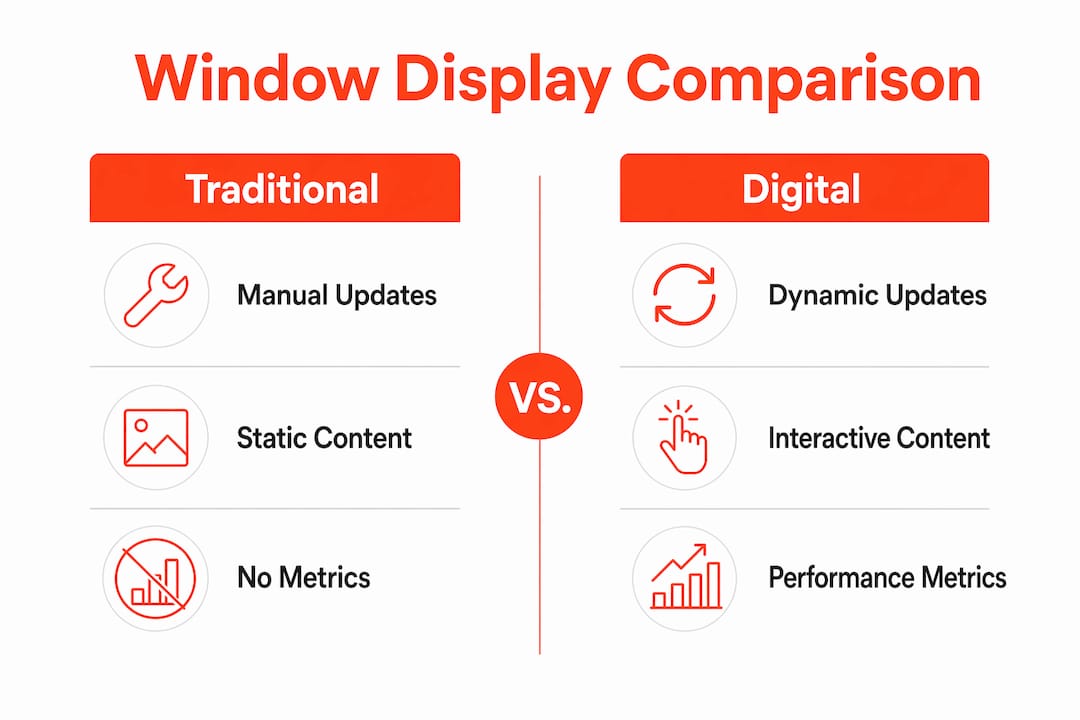
Feature | Traditional window display | Digital window display screen |
Content updates | Manual, requires physical labor and props | Remote, instant updates from any device |
Cost per update | High (printing, installation, staff time) | Near zero after hardware investment |
Engagement capability | Static, no motion or interactivity | Dynamic content, motion, QR codes, interactive triggers |
Transparency option | Full visibility of store interior | Transparent LED maintains 70% to 90% visibility |
Measurement | No direct tracking | Links to foot traffic and POS data |
Seasonal flexibility | Days or weeks to change | Minutes to update across multiple locations |
Transparent LED screens represent the most significant recent development in this comparison. Modern transparent LEDs offer 70% to 90% transparency with profiles as thin as 2mm, which means shoppers can see through the screen to the physical merchandise behind it while still viewing dynamic digital content. This eliminates the traditional trade-off between showcasing products and running digital promotions. Luxury retailers and flagship stores have adopted this format to create what Unilumin describes as floating holographic effects that stop foot traffic without blocking the store interior.
Interactive and motion-triggered window screens push the engagement advantage further. A sportswear brand case study found that motion-triggered window displays increased shopper engagement by 45%. That figure reflects the difference between a passive screen and one that responds to a shopper’s presence, creating a personalized moment that static displays cannot replicate.
The measurement gap is equally important. Traditional displays offer no direct performance data. Digital screens can be connected to foot traffic counters, point-of-sale systems, and analytics dashboards to show exactly which content drives entry and purchase behavior. This moves window display investment from a gut-feel decision to a data-driven one.
Practical strategies to maximize window screen performance
Knowing why window display screens attract shoppers is only half the job. Executing that knowledge in your store requires a clear content and measurement strategy.
Keep loops short and visual. Content loops of 5 to 8 seconds with large visuals and minimal text perform best for passersby. Shoppers will not stop to read a paragraph. Lead with an image or motion sequence, then add one line of text.
Use color and lighting contrast deliberately. Bold, contrasting colors command attention from a distance. Retailers who apply seasonal color strategies in window displays see measurable increases in dwell time. Match your color palette to the season, the promotion, and your brand identity simultaneously.
Update content on a regular schedule. A window screen showing the same content for three weeks trains regular passersby to ignore it. Tie content updates to your promotional calendar: new product launches, seasonal sales, local events, and weekly specials all justify a refresh.
A/B test your content. Run two different creative executions on alternating days and compare foot traffic data. This requires connecting your screen management platform to a foot traffic counter or your POS system. Linking screen impressions to purchase data creates sharper optimization of display spend and increases ROI, which is exactly what QSIC’s in-store ad performance dashboard is designed to do.
Add QR codes for omnichannel depth. A QR code on your window screen connects the physical storefront to your online store, loyalty program, or a specific product page. This extends the engagement beyond the 2.3-second window and gives you a trackable conversion point.
Position screens at eye level and angle them toward foot traffic flow. A screen mounted too high or facing directly outward rather than angled toward the direction shoppers are walking loses a significant portion of its potential audience.
Pro Tip: Use your window screen to promote what is inside the store right now, not what you wish you had. Real-time inventory-driven content, such as “3 left in stock” or “New arrivals today,” creates urgency that generic brand content cannot match. Platforms like Signstream make these real-time updates possible without requiring technical expertise.
For a broader look at how in-store digital networks drive revenue beyond the window, the principles of content scheduling and audience targeting apply equally well inside the store.
Key takeaways
Window display screens attract shoppers by combining commercial-grade brightness, emotionally resonant content, and real-time flexibility to create a pre-entry conversion moment that static displays cannot replicate.
Point | Details |
Brightness is non-negotiable | Commercial displays need 3,000+ nits to remain visible in direct sunlight. |
Psychology drives the pull | Visual engagement triggers emotional arousal, which predicts impulse buying behavior. |
Digital beats static on every operational metric | Remote updates, motion content, and measurement capability give digital screens a clear advantage. |
Content quality determines results | A technically perfect screen with dull content underperforms a well-designed creative execution. |
Measurement closes the loop | Connecting screen exposure to POS data transforms window displays into accountable marketing assets. |
The part most retailers get wrong about window screens
I have reviewed a lot of retail window display setups over the years, and the most common mistake is not the hardware choice. It is the assumption that installing a bright screen is enough. Retailers spend real money on commercial-grade displays, mount them correctly, and then load a static JPEG that has not changed since the screen was installed. The screen is technically superior to a poster, but the content strategy is identical to one.
The research is clear on this point. Emotional arousal mediates the impulse buying effect of window screens, which means the creative execution is doing the behavioral heavy lifting, not the panel specs. A screen showing a well-edited 6-second video of a product being used in a real context will outperform a screen showing a high-resolution product photo every time.
The second mistake I see is treating the window screen as isolated from the rest of the marketing operation. Your window screen should be showing the same promotion your social media is running, the same offer your email list received this morning, and the same product your staff is trained to recommend today. When those four channels align, the window screen becomes a physical confirmation of a message the shopper has already encountered, and that recognition accelerates the decision to enter.
The retailers who get the most from their window screens are the ones who treat content scheduling with the same discipline they apply to their paid advertising. They plan a content calendar, they test variations, and they measure outcomes. The technology makes all of that possible. The discipline is what makes it profitable.
— DKS
How Signstream powers your window display strategy
Signstream is built for exactly the kind of retail window display strategy this article describes. The cloud-based digital signage platform lets you update content across unlimited screens instantly from any device, with no technical expertise required. You can schedule seasonal promotions, push real-time product updates, and manage content across multiple store locations from a single dashboard. Signstream’s analytics tools connect screen performance to the business outcomes that matter, so you move beyond impressions and start tracking actual engagement. Check the pricing plans to find the right fit for your store count and budget. Signstream also includes an ad exchange marketplace, so you can cross-promote with local businesses and generate revenue directly from your screens.
FAQ
Why do window display screens attract more attention than posters?
Digital window screens use motion, color contrast, and dynamic content to trigger the eye’s natural response to movement, which static posters cannot replicate. Commercial displays also operate at 3,000+ nits of brightness, keeping content visible in direct sunlight where printed materials fade or become unreadable.
What brightness level does a window display screen need?
A window display screen needs at least 3,000 nits of brightness to remain visible in direct sunlight. Consumer televisions at 250 to 400 nits appear nearly black behind glass on a sunny day, making commercial-grade panels a requirement for storefront use.
How does window display content influence shopper behavior?
Visual engagement from window displays triggers emotional arousal, which research identifies as a strong predictor of impulse purchasing. A 2026 survey found that 76% of U.S. shoppers discovered a new product or brand through retail displays, confirming the importance of window display effectiveness as a discovery channel.
What is a transparent LED window screen?
A transparent LED screen is a commercial display that maintains 70% to 90% transparency, allowing shoppers to see the physical store interior and merchandise while the screen simultaneously shows dynamic digital content. This format is used in flagship and luxury retail to combine digital engagement with physical product visibility.
How do you measure the impact of a window display screen?
Connect your window display screen management platform to foot traffic counters and point-of-sale data to measure how content changes affect store entry rates and purchase conversion. Linking screen impressions directly to transaction data moves window display investment from a branding expense to a measurable revenue driver.
Recommended
Comments