

Cross-Location Promotional Screens: Real Examples That Work
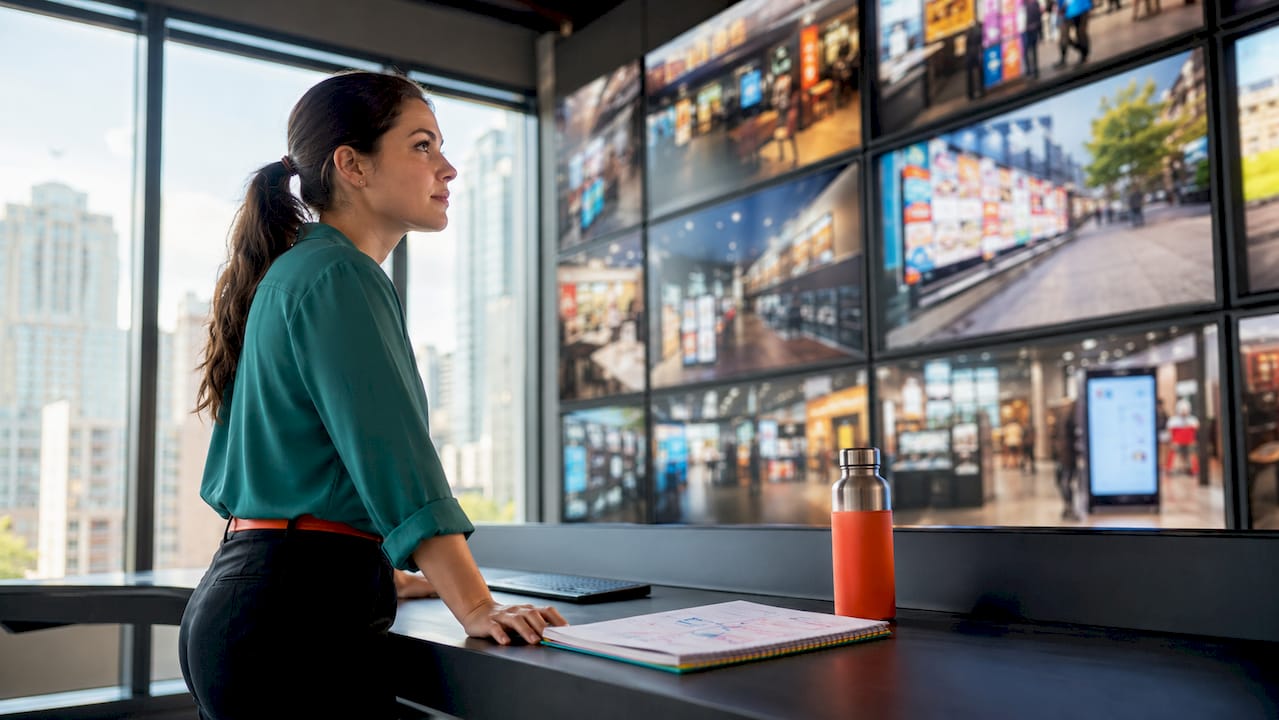
Cross-location promotional screens are digital displays deployed across multiple physical sites, each delivering content that can be centrally managed yet locally customized. The best examples of cross-location promotional screens prove one thing clearly: brands that combine a consistent national message with location-specific creative outperform those running identical content everywhere. CKE Restaurants, Disney+, and Hulu have all demonstrated this with measurable results. The industry term for this category is multi-location digital signage, and it sits at the intersection of out-of-home advertising, interactive technology, and data-driven campaign management.
1. What are effective examples of cross-location promotional screens in retail and quick-serve restaurants?
CKE Restaurants set the benchmark for data-driven multi-location marketing screens. The brand combined a national NFL campaign with micro-local creative pushed to specific ZIP codes based on actual transaction data. The result was an 8–11% sales lift in NASCAR and soccer markets. That lift came directly from matching screen content to what local customers already cared about, not from spending more.
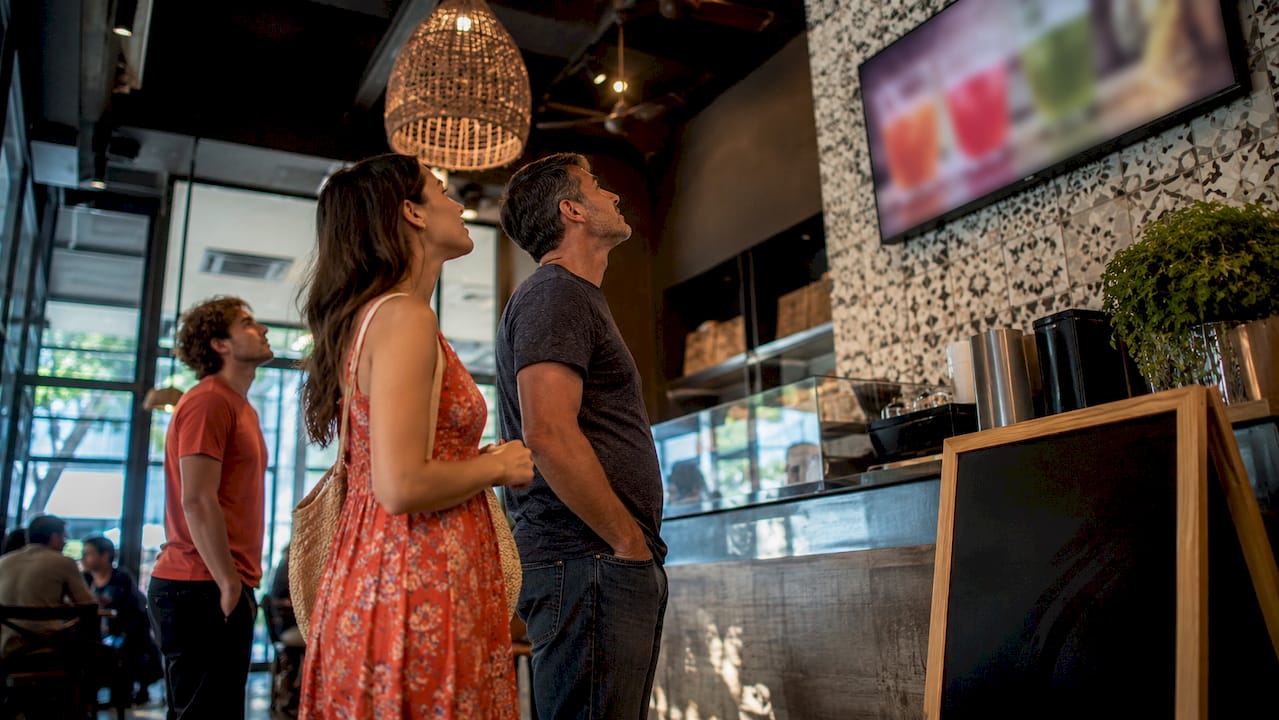
The mechanics behind that campaign matter. CKE used Amazon DSP pixels to tag households, then served location-specific video ads to those audiences. Screens in NASCAR markets showed different creative than screens in soccer-heavy ZIP codes. The national brand identity stayed intact while the local message drove the transaction.
Quick-serve restaurants apply this same logic to digital menu boards. A location near a college campus can promote late-night deals while a suburban location promotes family bundles, all from the same central platform. Consistent brand colors, typography, and motion style across all screens help customers process information faster, regardless of which location they visit.
Use real transaction data to identify which promotions resonate by location
Push location-specific creative without rebuilding the entire campaign
Keep brand visuals consistent across all screens to build recognition
Update content centrally so every location reflects the current promotion
Pro Tip: Schedule content changes to align with local events. A screen near a stadium should reflect game-day promotions starting four hours before kickoff, not the standard weekly rotation.
2. How do interactive and immersive promotional screens enhance cross-location engagement?
Disney+ and Hulu ran one of the most cited examples of interactive cross-site promotional displays in recent years. The campaign transformed retail store windows in Manhattan and Santa Monica into gesture-controlled storefronts where pedestrians could navigate trailers using hand movements. No touchscreen required. No app download. Just a person on the sidewalk interacting with a brand in real time.
The technology behind it came from Visual Feeder, which mapped digital content directly to the architecture of each store window. Each location had a different physical footprint, so the content was tailored to fit the specific dimensions and sight lines of that window. This is what separates immersive advertising displays from standard digital signage. The screen becomes part of the environment rather than an interruption in it.
Motion tracking and projection mapping now make it possible for any retail window to function as an interactive discovery platform. The Disney+ and Hulu campaign called the experience “Choose Your Drama,” letting pedestrians navigate between trailers by moving their hands left or right. That level of participation creates a brand memory that a static poster cannot replicate.
Gesture control removes the friction of touchscreens in high-traffic outdoor environments
Content mapped to store architecture feels native rather than inserted
Interactive experiences generate social sharing, extending reach beyond the physical location
Each location can run the same interactive mechanic with locally relevant content
Stat to know: The Disney+ and Hulu campaign ran simultaneously in Manhattan and Santa Monica, two markets with very different pedestrian demographics. The same interactive mechanic worked in both locations because the content, not just the technology, was adapted per site.
3. What role does geofencing play in cross-location promotional screen strategies?
Geofencing is the practice of triggering digital ads when a mobile device enters a defined geographic boundary. It works as a direct complement to physical promotional screens because it extends the campaign from the screen to the customer’s phone, laptop, and connected TV. A customer who sees your screen in a parking lot can receive a follow-up ad on their phone within the hour.
A local auto dealer demonstrated exactly how powerful this combination can be. The dealer set up five geofenced locations targeting competitor lots and nearby high-traffic areas. Dynamic video ads were customized based on proximity. The campaign generated $180,000 in net-new revenue in 90 days, with a customer acquisition cost of $615 per vehicle sold.
The key to that result was cross-device frequency. The initial location-triggered impression on mobile was followed by retargeted ads on laptops and connected TVs as the buyer moved through the research-to-decision journey. The screen at the physical location started the conversation. The geofenced digital campaign kept it going.
Here is how to structure a geofencing campaign alongside physical screens:
Identify the five to ten highest-value locations near your sites, including competitor lots and transit hubs
Set geofence boundaries that match realistic foot traffic patterns, typically 500 feet to a quarter mile
Create dynamic video ads that reference the proximity of your nearest location
Set cross-device retargeting to follow up within 24 hours of the initial impression
Track conversions back to specific geofence zones to identify which locations drive the most revenue
Geofencing element | Purpose | Result |
Competitor lot targeting | Intercept buyers at the decision point | Captures in-market audience |
Proximity-based video | Personalizes the message by distance | Increases ad relevance |
Cross-device follow-through | Sustains visibility across the buyer journey | Reduces drop-off between awareness and purchase |
Attribution by zone | Identifies highest-value locations | Improves future budget allocation |
Pro Tip: Run your geofencing campaign and your physical screen content on the same promotional message at the same time. A customer who sees the same offer on a screen and then on their phone within an hour is far more likely to act than one who sees two different messages.
4. How do multi-location brands avoid campaign cannibalization while running promotional screens?
Campaign cannibalization happens when two locations from the same brand compete against each other in digital ad auctions. Both locations bid on the same keywords or audience segments, driving up costs and splitting conversions that should have gone to one location. Centralized campaign management in a single platform, similar to Google’s My Client Center structure, is the direct solution.
The fix is architectural. Each location gets its own asset group with location-specific creative, a defined geographic boundary, and a separate budget. The central platform controls brand standards and campaign timing. Individual locations cannot override the national creative, but they can activate local promotions within the approved framework. This structure prevents bidding conflicts while preserving local relevance.
Real-time data integration is what makes this work at scale. When a location’s screen shows a promotion, the connected digital campaign should reflect the same offer. If the screen updates, the digital ads update. Disconnected systems create situations where a customer sees one offer on a screen and a different offer online, which erodes trust and wastes ad spend.
Use a single campaign management platform to control all locations from one dashboard
Assign each location its own geographic boundary to prevent audience overlap
Sync screen content with digital ad creative so the message is consistent across channels
Review attribution data weekly to catch cannibalization before it compounds
5. Comparison of cross-location promotional screen strategies
Choosing the right approach depends on your budget, your locations, and how much local customization your brand can support. The three main strategies each serve a different use case.
Strategy | Best for | Key advantage | Main limitation |
Segmented creative campaigns | QSR and retail chains with transaction data | Proven sales lift with local relevance | Requires data infrastructure and creative production at scale |
Interactive storefronts | High-foot-traffic urban retail and entertainment brands | Memorable brand experience, social sharing | High upfront technology cost, site-specific installation |
Geofencing with physical screens | Local businesses and multi-location service brands | Low cost, measurable revenue attribution | Requires mobile ad management alongside physical screen operations |
Segmented creative campaigns, like the CKE Restaurants model, work best when you have transaction data to justify the local variation. Interactive storefronts work best in urban environments where pedestrian density is high enough to justify the installation cost. Geofencing works best for local businesses that want to extend the reach of a physical screen without a large production budget.
Choosing the right digital signage platform is the decision that determines whether any of these strategies can be executed efficiently. A platform that cannot push location-specific content at scale will bottleneck every campaign you run.
Content scheduling by time of day adds another layer of effectiveness to any of these strategies. A screen that shows wayfinding content in the morning, promotional content at lunch, and entertainment content in the evening performs better than a screen running the same loop all day.
Key takeaways
The most effective cross-location promotional screen strategies combine centralized brand control with location-specific content, and the brands that add interactive or geofenced layers consistently outperform those that run static, uniform campaigns.
Point | Details |
Local data drives sales lift | CKE Restaurants achieved an 8–11% sales lift by matching screen content to local transaction data. |
Interactivity creates brand memory | Disney+ and Hulu’s gesture-controlled storefronts turned passive pedestrians into active brand participants. |
Geofencing extends screen reach | A geofenced campaign alongside physical screens generated $180,000 in net-new revenue in 90 days for one auto dealer. |
Centralized management prevents waste | Running all locations from one platform stops campaign cannibalization and keeps creative consistent. |
Content scheduling multiplies impact | Shifting screen content by time of day and local event schedule increases relevance without increasing spend. |
What I have learned from watching these campaigns play out
The brands that get the most from multi-location digital signage are not the ones with the biggest screens or the highest production budgets. They are the ones that treat each location as a distinct audience with distinct motivations, while keeping the brand architecture tight enough that every screen still feels like the same company.
The CKE Restaurants case is the one I return to most often when advising operators. The insight was not technical. It was observational. Someone noticed that NASCAR fans and soccer fans buy differently, and they built a campaign around that fact. The technology just delivered it. That order of operations matters. Data first, creative second, technology third.
Interactive storefronts are genuinely exciting, but I would caution most operators against treating them as a first step. The Disney+ and Hulu campaign worked because the brand had the creative depth and the foot traffic to justify the investment. For most multi-location businesses, the higher-return move is getting location-specific content right on existing screens before adding gesture control or projection mapping.
The cannibalization problem is the one most operators discover too late. I have seen franchise groups spend months wondering why their digital ad costs keep rising, only to find that three of their own locations were bidding against each other. Centralized management is not a luxury for large networks. It is the baseline requirement for running any multi-location campaign efficiently.
— DKS
How Signstream helps you run cross-location screens at scale
Managing promotional screens across multiple locations does not have to mean managing multiple systems. Signstream’s cloud-based digital signage platform lets you update every screen instantly from any device, push location-specific content without rebuilding campaigns from scratch, and track performance across all sites from one dashboard.
Signstream clients, including elite sports clubs, restaurants, and retailers, have reported a 25% rise in class attendance after deploying location-specific screen content. The platform supports unlimited screens at no extra charge, and the ad exchange marketplace lets you cross-promote in other local businesses while generating revenue from your own screens. No technical expertise required. See the full pricing breakdown and find the plan that fits your location count and budget.
FAQ
What are cross-location promotional screens?
Cross-location promotional screens are digital displays deployed across multiple physical sites, managed from a central platform but capable of showing location-specific content. They are the multi-location equivalent of a single in-store display, scaled across a network.
How did CKE Restaurants use promotional screens to lift sales?
CKE Restaurants combined a national NFL campaign with micro-local creative based on transaction data, achieving an 8–11% sales lift in targeted ZIP codes. The campaign used Amazon DSP pixels to identify and serve location-specific ads to relevant households.
What is the best practice for avoiding campaign cannibalization across locations?
Centralized campaign management with location-specific asset groups and defined geographic boundaries prevents locations from bidding against each other. Each location operates within the same platform but with its own creative and audience parameters.
How does geofencing work with physical promotional screens?
Geofencing triggers mobile ads when a device enters a defined boundary near your location or a competitor’s site. Combined with physical screens, it creates a two-touch campaign where the screen starts the conversation and the mobile ad continues it across devices.
Can small businesses use cross-location digital signage affordably?
Yes. Cloud-based platforms like Signstream deploy across unlimited screens without per-screen fees, making multi-location digital signage accessible for businesses with tight budgets and small marketing teams.
Recommended
Comments