

Types of Franchise-Wide Screen Campaigns Explained
Franchise-wide screen campaigns fall into six core types: national broadcast campaigns, programmatic DOOH (digital out-of-home) buys, place-based/in-venue campaigns, point-of-purchase and menu-board campaigns, co-op and cross-location networks, and localized digital ad tie-ins. Each one solves a different problem, and picking the wrong type for your goal wastes budget fast.
National broadcast works best for brand launches and holiday pushes where reach and consistency matter more than context. Programmatic DOOH fits regional pushes when you need geographic precision without buying billboards outright. Place-based campaigns win when the venue itself gives you audience context (a gym, a waiting room, a checkout line). Point-of-purchase and menu boards drive the actual moment of decision. Co-op networks pool local budgets for bigger regional plays and, increasingly, let franchisees monetize their own screen space through ad-exchange marketplaces.
National broadcast: best for uniform messaging and brand launches, prioritizes reach and consistency.
Programmatic DOOH: best for regional flexibility, prioritizes geographic and time-of-day targeting.
Place-based/in-venue: best for contextual relevance, prioritizes dwell time and mindset matching.
Point-of-purchase/menu boards: best for conversion, prioritizes speed of comprehension.
Co-op/cross-location networks: best for shared reach, prioritizes budget pooling and monetization.
Localized digital tie-ins: best for tying screen content to app or web promos, prioritizes cross-channel consistency.
A centralized platform like Signstream supports every one of these campaign types from a single dashboard, which matters especially when managing numerous locations.
Key Takeaways
Franchise-wide screen campaigns succeed when national consistency, regional targeting, and local relevance run through one governed system rather than six disconnected tools.
Point | Details |
Match campaign type to goal | Use national broadcast for reach, programmatic DOOH for regional targeting, and place-based for context. |
Protect brand with templates | Lock core creative and limit local edits to a few tokenized fields like hours or CTAs. |
Apply the 70/30 allocation | Reserve roughly 70% of budget and control for corporate, 30% for local flexibility. |
Track conversion, not just views | Use promo codes, QR scans, and POS integration to tie screen exposure to actual sales. |
Centralize execution with Signstream | Signstream lets franchise networks run all six campaign types from one dashboard with unlimited screen deployment. |
Table of Contents
Types of Franchise-Wide Screen Campaigns and When to Use Them
National Broadcast Campaigns: Centralized Distribution to All Screens
Programmatic DOOH and Regional Campaigns: Geotargeted Buys on Digital Billboards and Transit Screens
Place-Based and In-Venue Screen Campaigns: Reaching Audiences in Context
Point-of-Purchase and Menu-Board Campaigns: Influence at the Moment of Choice
Co-Op and Cross-Location Promotional Networks: Pooled Budgets and Ad-Exchange Monetization
Campaign Governance, Approval Workflows, and the 70/30 Corporate-Local Allocation
Launch Checklist: Step-by-Step Plan to Run a Franchise-Wide Screen Campaign
SignStream in Practice: How a Centralized Platform Supports These Campaign Types
Get a SignStream Consult to Map Your Screen Campaign Strategy
Types of Franchise-Wide Screen Campaigns and When to Use Them
Every franchise system eventually asks the same question: should this message go to every screen in the network, or just the ones where it actually applies? That question is the whole reason these campaign types exist as distinct categories rather than one blanket strategy.
National broadcast campaigns push a single piece of content to every screen in the system simultaneously. Programmatic DOOH campaigns buy inventory on screens you don’t own outright, targeted by geography and venue type. Place-based campaigns live inside a specific physical environment and lean on what the visitor is already doing there. Point-of-purchase and menu-board campaigns sit at the transaction moment. Co-op campaigns blend corporate and franchisee dollars to fund a shared push. Localized tie-ins connect screen content to a digital promotion running elsewhere.
Franchise marketing strategies that ignore this taxonomy tend to treat every screen the same way, which produces bland, low-performing content nobody notices. A gym lobby screen running the same 30-second national spot as a highway billboard is a missed opportunity, not consistency. The strongest digital screen campaign types work in combination: a national brand message anchors the network, while regional and place-based layers adjust the delivery to context.
National Broadcast Campaigns: Centralized Distribution to All Screens
National broadcast campaigns push one piece of creative to every screen across every location, on the same day, with no variation beyond a few controlled fields. Think product launches, holiday promotions, and brand-refresh announcements. Restaurant chains rely on this format for menu launches; fitness franchises use it for national challenge announcements or seasonal membership pushes.
The creative itself needs to scale across screen orientations and sizes without redesign. That means building master templates in a format that adapts to portrait menu boards, landscape lobby displays, and outdoor digital signage without a designer touching each version by hand.
Version control matters more here than almost anywhere else in franchise advertising models. If a national asset goes out with a pricing error or an outdated legal disclaimer, you need the ability to pull it from every screen in the network within minutes, not days.
Build content in a format that resizes cleanly across screen types and aspect ratios.
Maintain a rollback plan so a flawed asset can be pulled network-wide immediately.
Use tokenized fields (store hours, local phone number, a location-specific CTA) instead of hardcoded text.
Lock the core message and layout so local edits can’t drift off-brand.
Local tokens are the safety valve that keeps a national campaign from feeling robotic. A single sentence like “Open until 9 PM at your local branch” pulled dynamically from a location database lets every store feel personal without anyone touching the creative file.
Pro Tip: Build your national templates with three or four token fields maximum. More than that, and franchisees start treating the whole asset as editable, which is exactly what breaks brand consistency.
Programmatic DOOH and Regional Campaigns: Geotargeted Buys on Digital Billboards and Transit Screens
Programmatic DOOH lets you buy screen inventory you don’t own, through automated auctions, targeted by location, venue type, and time of day. It’s fundamentally different from a direct buy, where you negotiate a fixed placement on a specific billboard for a set price and duration. Programmatic buying works through demand-side platforms that let advertisers bid on inventory in real time and adjust targeting as the campaign runs.
Direct buys still make sense when you want a guaranteed placement, like a highly trafficked location near a flagship store. Programmatic is the better fit when you’re running a regional campaign across dozens of markets and want the flexibility to shift spend toward whichever screens are performing.
Targeting levers for programmatic DOOH include:
Geography: zip code, radius around a location, or designated market area.
Venue type: transit stations, retail centers, gyms, or office buildings.
Time of day: morning commute versus evening dinner rush.
Audience context: matching creative to what people are likely doing near that screen.
Budget shapes vary widely, but the appeal of programmatic for franchise systems is that daily spend can flex up or down without renegotiating a contract, which is a meaningful shift from traditional out-of-home buying.
Coordination between corporate and local teams is where this gets tricky. Corporate needs blackout windows during national campaigns so a regional programmatic buy doesn’t step on a brand launch, while franchisees still need enough flexibility to opt into local promotions that don’t conflict. A shared calendar with locked national windows and open regional slots solves most of this friction before it starts.
Place-Based and In-Venue Screen Campaigns: Reaching Audiences in Context
Place-based screens work because they meet people inside a specific mindset, not a general audience. A gym lobby screen reaches someone thinking about fitness goals. A clinic waiting room reaches someone with time to kill and low tolerance for hard-sell messaging. A retail checkout screen reaches someone actively deciding what to add to their cart.
The creative that performs on a highway billboard rarely performs in a waiting room, because dwell time and emotional context are completely different. A billboard has three seconds to land a message. A waiting room screen might have five minutes of a captive, low-distraction audience, which opens the door to longer-form content, educational messaging, or a slower brand story.
Common place-based venues for franchise networks include:
Gyms and fitness studios, where messaging around class schedules or challenges performs well.
Medical and dental offices, where informational content works better than hard promotions.
Retail and mall common areas, where shorter, high-frequency rotations hold attention.
Restaurant waiting areas, where menu previews and loyalty program pitches fit naturally.
Venue-hosted screens also raise partnership questions that pure owned-media campaigns don’t. If a franchise location shares screen space with a host venue, like a shopping center or an event space, get clear on content approval rights and revenue splits before launch. Location-based digital experiences, including virtual tours tied to specific venues, can extend this in-venue strategy beyond the physical screen and into pre-visit marketing.
Point-of-Purchase and Menu-Board Campaigns: Influence at the Moment of Choice
Point-of-purchase screens sit exactly where a buying decision gets made, which makes them some of the highest-converting real estate in a franchise’s entire screen network. A large share of purchase decisions form in-store, which is exactly why menu boards and checkout screens deserve more strategic attention than most franchise systems give them.
Keep legibility non-negotiable. Large fonts, high contrast, and no more than one offer per screen at a time.
Design for a five-second glance. Customers at a counter aren’t reading paragraphs. They’re scanning for a price, a name, or an image.
Sync every price and promo with your POS and inventory systems. A menu board advertising a sold-out item erodes trust fast.
Rotate offers on a predictable cadence so regular customers notice new promotions without feeling bombarded.
The integration piece matters most here. A promotion that runs on the screen but isn’t reflected at the register creates confusion at exactly the moment you’re trying to close a sale, which defeats the entire purpose of the format.
Co-Op and Cross-Location Promotional Networks: Pooled Budgets and Ad-Exchange Monetization
Co-op marketing pools funds from the franchisor and a group of franchisees to run a campaign none of them could afford alone. Contribution structures typically split costs across a regional group, with corporate often matching a percentage of what local owners contribute.
Digital billboard marketplaces have changed the economics here in a real way. Self-serve platforms let a regional co-op group launch a campaign with a modest daily budget and adjust it on the fly, instead of committing to a long-term contract for a single physical board.
Co-op groups typically split contributions by region or district rather than by individual location.
Self-serve digital marketplaces lower the barrier to entry for smaller franchise groups.
Location targeting lets a co-op group concentrate spend where store density is highest.
Performance tracking built into the marketplace shows which locations are pulling their weight.
Ad-exchange marketplaces add a second dimension: instead of only buying inventory, a franchise location can sell unused screen time to other local businesses, or trade placements with a nearby complementary business. That turns a cost center into a modest revenue stream, and it’s one of the more underused features in franchise advertising models today.
Half-empty co-op buys almost always underperform and sour franchisees on the next round.*
Campaign Governance, Approval Workflows, and the 70/30 Corporate-Local Allocation
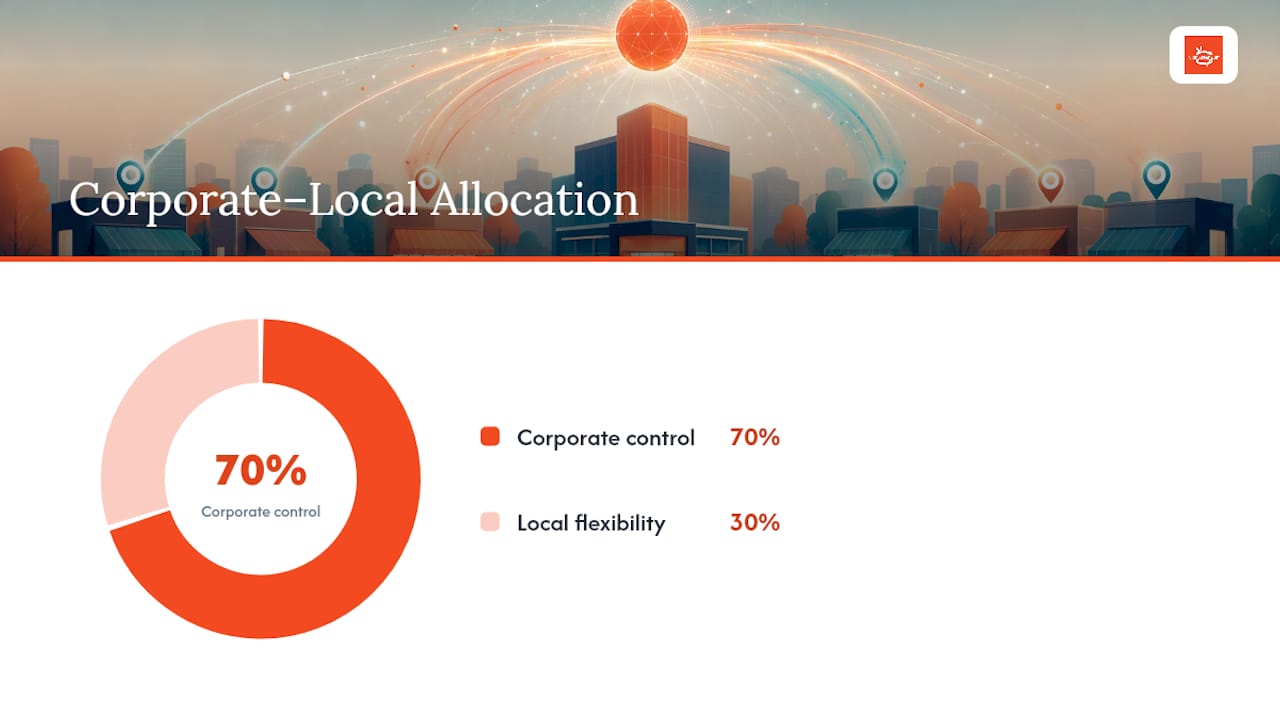
A 70/30 allocation framework is one of the more practical models for balancing brand consistency with local relevance: 70% of screen marketing budget and content control stays with corporate, while 30% flexes to local decision-making. In practice, that means national broadcast and core brand campaigns dominate screen time, while local franchisees get a defined lane for community promotions, local events, or seasonal offers that don’t require corporate sign-off.
Approval workflows are what make this ratio actually work instead of becoming a source of constant friction.
National content gets approved once, centrally, before it ever reaches a screen.
Local customizations route through a lightweight review, since they use pre-approved templates rather than freeform creative.
A defined SLA window, often something like a 90-minute initial review followed by a one-to-three-day owner sign-off, keeps campaigns moving without bottlenecking at corporate.
Role-based permissions restrict who can edit what, so a local manager can update a promo price but can’t touch the logo or brand colors.
Templates constrain creative freedom to fields that don’t threaten brand identity.
SLA windows prevent local campaigns from stalling in an approval queue.
Role-based access keeps accountability clear when something goes wrong.
Franchise systems that skip formal governance almost always end up with drift: a location running an off-brand promotion, a logo that’s the wrong shade of blue, or messaging that contradicts a national campaign running the same week. Managing signage consistency across multiple franchise locations gets significantly easier once templates and SLAs are locked in before the first campaign launches, not after the first mistake.
Measurement, KPIs, and Attribution for Screen Campaigns
Screen campaigns generate real data, but only if you’re tracking the right things. Impressions and dwell time tell you whether people are actually looking at the screen. QR and scan engagement tell you whether they’re acting on it. Promo redemptions and footfall lift tell you whether the campaign moved revenue.
Impressions and estimated dwell time: foot traffic near the screen, weighted by likely view duration.
QR code and short-link scans: direct digital engagement tied to a specific screen or campaign.
Promo code redemptions: the clearest line between screen exposure and a completed sale.
Footfall lift: comparing traffic before and after a campaign launch at a given location.
Attribution gets easier when every screen campaign carries its own promo code or unique short link. POS integration closes the loop further, letting you tie a specific redemption back to the screen that likely drove it, rather than guessing. Structured tracking of this kind lines up with what the SBA recommends for small-business marketing: define metrics before launch, not after.
Reporting cadence should differ by audience. Franchisors typically want a monthly network-wide view showing which regions and campaign types are outperforming. Franchisees want a weekly or even daily view of their own location’s numbers, since that’s what actually affects their decisions. Building both views from one dashboard, rather than exporting separate reports for each audience, saves real time once you’re managing more than a few dozen locations.
Launch Checklist: Step-by-Step Plan to Run a Franchise-Wide Screen Campaign
Define the objective and audience. Decide whether this is a national push, a regional test, or a place-based pilot before you touch creative.
Set the budget and allocation split. Confirm how much falls under the 70/30 corporate-local framework versus co-op funding.
Build creative from approved templates. Confirm sizing works across every screen type in the network.
Run legal and compliance checks. Pricing, disclaimers, and any region-specific regulatory language get reviewed before scheduling.
Schedule the rollout. Stagger regional or programmatic buys around any national blackout windows.
Confirm local opt-ins. Franchisees participating in co-op or place-based elements need to sign off before launch.
Run a QA pass. Preview every template variation on the actual screen hardware, not just a desktop mockup.
Soft-launch on a small subset of screens. Catch formatting or scheduling issues before the full rollout.
Monitor the first 48 hours closely. Watch for technical failures, not just performance numbers.
Measure, document, and update templates. Feed what you learned back into the next campaign’s playbook.
Pro Tip: Treat your soft launch as mandatory, not optional, even for campaigns you’ve run a dozen times before. Screen hardware varies enough across locations that a template rendering perfectly on one display can crop badly on another.
SignStream in Practice: How a Centralized Platform Supports These Campaign Types
Running six different campaign types across a franchise network without a centralized system means juggling separate tools for scheduling, approvals, and reporting, which is exactly the kind of friction that kills consistency. Signstream is built to handle that cascade from one dashboard: a national asset goes out to every screen, templated local tokens get applied by location, regional DOOH-style promotions get scheduled through the ad-exchange marketplace, and performance data rolls up into one reporting view.
One elite sports club using Signstream reported an increase in class attendance after implementing centralized screen promotions, a result tied directly to consistent, well-timed messaging across every location in the network rather than a scattered, location-by-location approach.
Features that map directly onto the campaign types covered here include:
Centralized scheduling that pushes national content to unlimited screens at no added cost per screen.
Local token fields for store hours, pricing, and location-specific calls to action.
An ad-exchange marketplace for cross-promotion and monetizing unused screen time.
Analytics dashboards that track performance across the entire network from a single login.
The workflow in practice looks like this: a national asset gets built once, local tokens populate automatically by location, regional buys get scheduled through the marketplace, and the resulting numbers land in one dashboard instead of six disconnected spreadsheets.
What actually deserves priority this quarter
If your franchise system is running screen campaigns without formal governance, fix that before you spend another dollar on new creative. Set your approval templates and SLA windows first. Wire up measurement second, so you know whether anything you launch is actually working. Only then run a regional programmatic or co-op pilot, and use co-op funds specifically to test new formats. That sequence matters because a franchisee who sees early proof from a co-op-funded pilot becomes your best advocate for the next round of buy-in. Skip the sequence, and you’ll spend more time defending the strategy than improving it.
Get a SignStream Consult to Map Your Screen Campaign Strategy
Running national, regional, and place-based campaigns on separate tools is the fastest way to lose brand consistency across a franchise network. Signstream replaces that patchwork with one platform: centralized scheduling for national pushes, local tokens for franchisee flexibility, an ad-exchange marketplace for co-op and cross-promotion revenue, and analytics that show every location’s performance in one view.
If you’re managing screens across more than a handful of locations, an on-site consultation can map exactly which campaign types fit your network’s layout, from menu-board conversions to regional DOOH buys. If you want a lighter first step, a free consult walks through your current screen setup and shows where centralized control would save the most time. Either way, the next move is simple: book a session and get a clear read on where your current setup is leaving performance on the table.
Sources
Recommended
Comments