

Retail Promotion Checklist for Digital Screens

A retail promotion checklist for digital screens is a structured tool that confirms your promotions are compliant, measurable, and consistently executed from planning through final reporting. Without one, you risk expired content running on screens, brand violations across locations, and zero visibility into what actually moved sales. The industry term for this practice is digital signage governance, and it covers everything from content freshness and access controls to measurement frameworks and creative standards. This checklist approach applies whether you manage two screens in a single store or 200 screens across a national chain.
1. Compliance and governance items for digital screen promotions
Governance is the foundation of every effective digital signage strategy. Locked templates and role-based access not only prevent unauthorized edits but also create an auditable process that demonstrates compliance to regulators. That matters in retail, where price promotions and product claims carry legal weight.
Your compliance checklist should cover:
Content freshness: Remove expired promotions within 24 hours. Stale pricing or outdated offers destroy shopper trust faster than no promotion at all.
Brand compliance: Use locked CMS templates that enforce approved fonts, colors, and logo placement. No one should be able to go rogue with a store-level edit.
Legal requirements: Confirm ADA contrast ratios for on-screen text, verify that privacy disclosures appear where cameras or sensors collect data, and check that promotional pricing matches POS system pricing.
Access control: Assign role-based permissions so store managers can swap approved assets but cannot alter brand templates. Corporate retains override authority.
Audit trail: Log every content change with a timestamp and user ID. This documentation protects you during compliance reviews.
Governance failures arise mainly from process gaps, not creative issues. A single rogue edit on a high-traffic screen can undermine a national campaign in hours.
Pro Tip: Schedule a weekly automated content audit inside your CMS. Flag any asset with an expiry date within seven days and route it to the content owner for renewal or removal.
2. Planning your screen placement and content for retail promotions
Screen placement is a strategic decision, not a real estate one. Planning KPI measurement upfront outweighs ad-hoc approaches, and that discipline starts with understanding where shoppers actually pause, not just where foot traffic is highest.
Follow this sequence when planning placements and content:
Map audience movement, not just volume. A screen near the entrance captures awareness. A screen at the checkout captures decision-making. Each location needs a different message and format.
Match format to dwell time. A screen in a quick-service queue needs a message readable in under six seconds. A screen in a fitting room corridor can carry a 15-second product story.
Build a creative system, not one-off assets. Develop a core message with daypart variants (morning commuter vs. afternoon browser) and location variants (urban flagship vs. suburban outlet).
Prepare digital capture paths. Every screen promotion should connect to a measurable action: a QR code to a landing page, a loyalty app scan, or a specific SKU at the register. Without a capture path, you cannot attribute sales.
Define primary KPIs before launch. Footfall delta, basket size uplift, and dwell time are the three metrics most retail managers can access from existing door counters and POS systems.
Pro Tip: Place a pilot screen in your highest-dwell location first. Two weeks of real data from one screen will tell you more about format and message performance than any pre-launch spec sheet.
3. Measurement and evaluation metrics your checklist must include
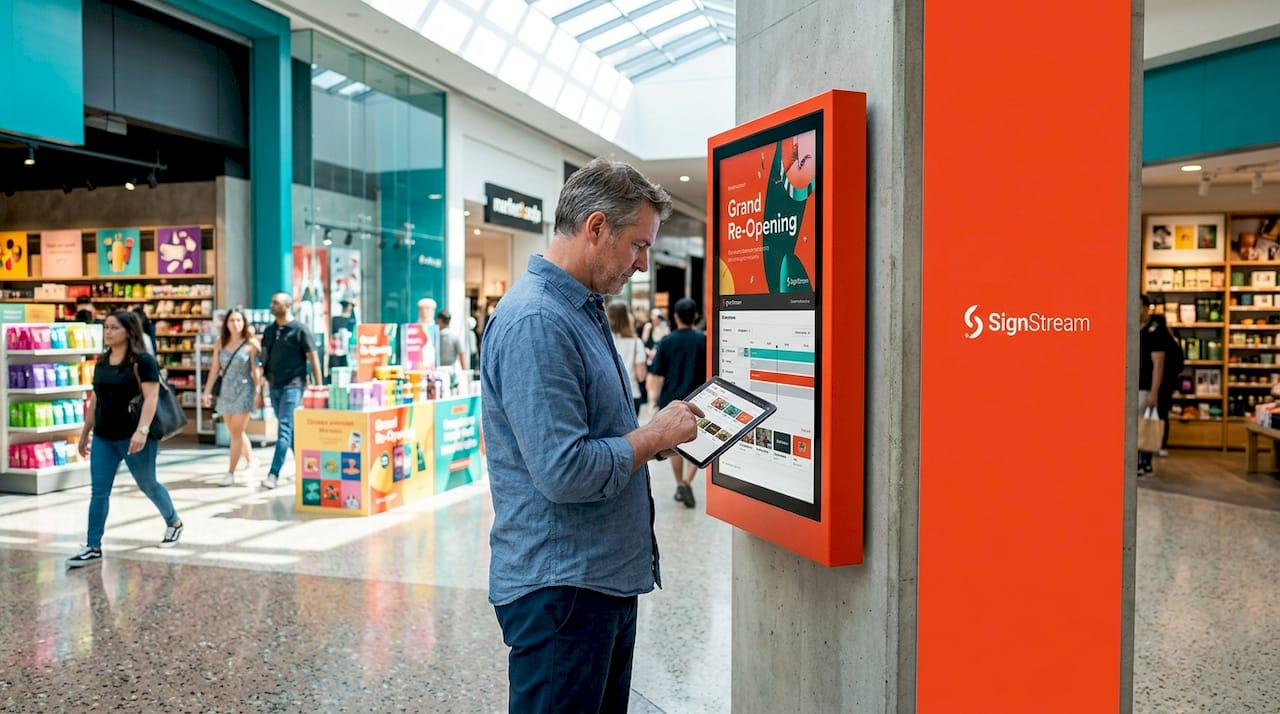
Measurement is where most retail digital signage programs fall short. Evaluating promotion impact requires tracking footfall, basket size, dwell time, and repeat visits across a recommended 60-day pre- and 60-day post-promotion window. That 120-day view filters out seasonal noise and gives you a reliable baseline.
Metric | How to measure it |
Footfall delta | Door counter data vs. control store or prior period |
Basket size uplift | POS transaction averages during promotion vs. baseline |
Dwell time | In-store sensor data or video analytics near screen zones |
Repeat visits | Loyalty program scan frequency before and after campaign |
Digital capture rate | QR code scans or landing page visits attributed to screen |
Fragmented in-store media measurement is the industry’s biggest attribution problem, and it is being addressed by linking unified metrics to POS and loyalty data. Retailers who connect these data sources can determine whether their screens are compounding the impact of other media or simply duplicating it.
“Real-time measurement and cloud-based dashboards allow retail digital signage promotions to be adjusted dynamically for better ROI.” — Digital signage in 2026
Do not wait until a campaign ends to check performance. Cloud dashboards and sensor insights let you tune creative, swap underperforming assets, and shift screen schedules while the promotion is still running. That mid-flight agility is one of the clearest advantages digital screens hold over printed POS materials.
4. Multi-location rollout checklist for retail digital screens
Operational process discipline is the biggest factor in smooth multi-location rollouts, outweighing creative quality every time. A brilliant campaign that goes live three days late in 40% of stores is a failed campaign. Your rollout checklist keeps execution tight.
Before any campaign goes live across locations, verify:
Hardware health: Confirm all media players are online and screens are displaying correctly. A screen showing a blue error state is worse than no screen at all.
Content version control: Check that every location is running the approved asset version, not a draft or a previous campaign’s files.
Permission review: Audit role-based access before each major campaign. Staff turnover means permissions drift over time.
Timely scheduling: Set content go-live times in the CMS to match store opening hours and promotion start dates exactly. Manual uploads at launch create errors.
Audit documentation: Record hardware status, content version, and go-live confirmation for each location. This log is your proof of delivery.
Trialing a single screen for two weeks before a full rollout surfaces practical issues that spec sheets never reveal. Use a pilot location to stress-test your scheduling, access controls, and content update workflow before scaling.
Pro Tip: Create a pre-launch sign-off form that store managers complete 48 hours before go-live. It takes five minutes and eliminates the most common rollout failures: wrong content, offline players, and missing access credentials.
5. Interactive and creative best practices for your promotion checklist
The most effective promotional content for screens respects one constraint above all others: shoppers are moving. Your message has between three and eight seconds to land, depending on screen location and store environment.
Lead with one clear offer. “20% off all footwear today” outperforms a screen trying to communicate three promotions simultaneously. Simplicity drives action.
Use limited-time framing. Countdown timers and “today only” language create urgency without requiring a price reduction. They work particularly well on screens near checkout.
Add social proof selectively. A short customer testimonial or a “bestseller” label on a product image increases credibility without cluttering the layout.
Deploy QR codes with purpose. Interactive elements like QR-enabled signage increase engagement, but only when the destination is worth the scan. Link to an exclusive offer, a product demo video, or a loyalty sign-up, not a generic homepage.
Test by daypart and location. A promotion that performs well on a Saturday afternoon screen near the entrance may underperform on a Tuesday morning screen near the stockroom corridor. Treat each screen zone as its own channel.
Avoid information overload. More than three text elements on a single screen frame reduces comprehension. Use motion to sequence information rather than stacking it.
A good digital out-of-home strategy layers high-impact brand visibility, consistent frequency across multiple environments, and measurable digital capture. Each screen in your network should have a defined role: awareness, consideration, or conversion. Assign that role before you brief creative, and your content will be sharper for it. For more on how in-store digital networks drive revenue, the mechanics of screen placement and content sequencing are worth studying in detail.
Key takeaways
A retail promotion checklist for digital screens works because governance, measurement planning, and creative discipline are built in before a single asset goes live.
Point | Details |
Governance comes first | Locked templates and role-based access prevent errors and create an auditable compliance record. |
Measure before you launch | Define footfall, basket size, and dwell time KPIs upfront and set a 60-day pre/post comparison window. |
Placement drives performance | Match screen location to audience dwell time and assign each screen a specific role in the purchase journey. |
Pilot before you scale | Trial one screen for two weeks to surface operational issues before a full multi-location rollout. |
Simplicity wins on screen | One clear offer per frame, with a defined digital capture path, outperforms complex multi-message layouts. |
What I’ve learned from watching retail screen programs succeed and fail
Most retail digital screen programs that underperform share one trait: they were planned like a print campaign. The team briefed creative, approved assets, and pushed content live. Then they waited 90 days and looked at sales data with no baseline, no control group, and no mid-flight adjustments. The result was a number that could mean anything.
The programs that work are built backwards from measurement. Before the first asset is designed, the team has agreed on what success looks like in numbers, which data sources will confirm it, and who owns the weekly performance review. That discipline sounds obvious, but it is genuinely rare in practice.
The second pattern I’ve seen consistently is that governance failures hit multi-location retailers hardest. One store running an expired promotion, one screen showing the wrong price, one location where a well-meaning manager uploaded their own graphic. These are not creative problems. They are process problems, and locked templates with role-based access solve them completely.
The quick win most teams overlook is the pilot deployment. Running one screen in your best-performing location for two weeks before a national rollout costs almost nothing and tells you everything. You will find scheduling conflicts, access permission gaps, and content format issues that no amount of pre-launch testing in a boardroom would have caught. Build the pilot into your checklist as a non-negotiable step, not an optional one.
— DKS
How Signstream supports your retail promotion checklist
Signstream’s cloud-based digital signage platform is built for exactly the kind of governance, measurement, and multi-location control this checklist demands. You can update unlimited screens instantly from any device, assign role-based access to store teams, and use locked templates to protect brand compliance across every location.
Signstream’s integrated dashboards give you real-time proof-of-play reporting and performance analytics, so you can make mid-flight adjustments instead of waiting for post-campaign data. The platform’s ad exchange marketplace also lets you cross-promote with other local businesses and generate revenue from your own screens. Retail managers who want to see how remote management works in practice can explore the platform’s full workflow without needing any technical background to get started.
FAQ
What is a retail promotion checklist for digital screens?
A retail promotion checklist for digital screens is a structured set of verification steps covering compliance, content scheduling, screen health, measurement setup, and creative standards. It confirms that every promotion runs correctly, on time, and with measurable outcomes across all locations.
How often should digital screen content be audited for freshness?
Content should be reviewed at least weekly, with automated expiry flags set for any asset within seven days of its end date. Inconsistent or inaccurate signage directly harms shopper trust and brand credibility.
What metrics should I track for digital screen promotions?
Track footfall delta using door counters, basket size uplift from POS data, dwell time from in-store sensors, and repeat visit frequency from loyalty program data. A 60-day pre- and post-promotion window gives the most reliable comparison.
How do I manage digital screen promotions across multiple store locations?
Use a CMS with role-based access controls and locked templates to centralize content management. Conduct a hardware health check and permission audit before every campaign launch, and run a pilot screen for two weeks before a full rollout.
Do QR codes on retail screens actually improve engagement?
Yes, when linked to a specific offer or action rather than a generic page. QR-enabled signage increases measurable engagement, but the destination must deliver clear value to the shopper to justify the scan.
Recommended
Comments