

Audience Targeting on Retail Screens: What It Means in 2026

Audience targeting on retail screens means customizing the content displayed on in-store digital signs in real time, based on the demographic and behavioral profile of the shoppers standing in front of them. Instead of running the same looped video all day regardless of who walks by, a smart digital screen detects anonymous shopper attributes like age, gender, and dwell time using AI-powered sensors and computer vision, then triggers the most relevant ad from a predefined campaign set within milliseconds. The result is a retail environment where your screens work like a precision media channel, not a bulletin board.
Key elements that define audience targeting on retail screens:
Real-time detection: Sensors and cameras identify shopper attributes as they approach the screen, with no manual input required.
Anonymized data processing: No personally identifiable information (PII) is collected or stored. Attributes are processed locally and discarded after matching.
Segment matching: Detected attributes are mapped to predefined audience segments set by the retailer or advertiser.
Dynamic content delivery: The screen displays the ad creative that best fits the matched segment, switching automatically between campaigns.
Measurement: Metrics like impressions, dwell time, and qualified views are captured for campaign reporting.
What types of audience targeting apply to retail digital signage?
Retail screen advertising draws on four core targeting dimensions, each serving a different marketing objective. Understanding which one fits your campaign goals is the first decision any retail marketer needs to make.
Demographic targeting: Screens detect age range and gender to serve relevant ads. A screen near a men’s grooming aisle, for example, can prioritize content when a male shopper is detected, rather than playing a generic loop.
Geographic targeting: Content varies by store location, region, or even aisle placement. A screen in a downtown flagship store can run different promotions than one in a suburban outlet, reflecting local shopper profiles.
Interest-based targeting: Inferred from category affinity and shopper context. A shopper lingering near the beverage section signals interest that can trigger a relevant promotion, even without any purchase history.
Behavioral targeting: Dwell time, repeat visits, and in-store movement patterns all feed into this dimension. Shoppers who spend more time in front of a screen signal higher engagement, which can inform both content selection and campaign reporting.
Each of these dimensions can work independently or in combination. Behavioral and demographic data together, for instance, give you a much sharper picture of who is actually engaging with your screens and when.
How does audience targeting actually work on retail screens?
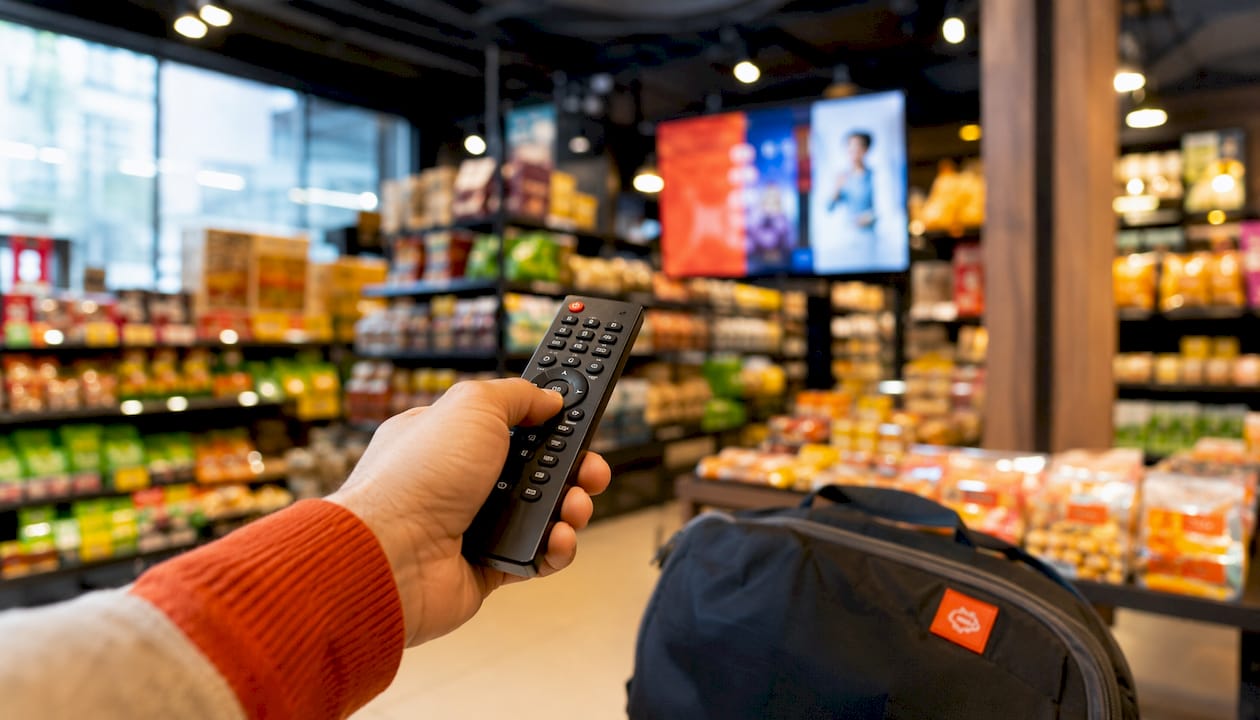
The process runs faster than most marketers expect. Computer vision scans anonymous shopper attributes as they move in front of a screen, matches those attributes to predefined seller segments, and triggers the right ad creative, all within milliseconds. There is no human decision in the loop.
Input data | Processing step | Output action |
Camera feed (anonymous) | Edge AI detects age range, gender, group size | Shopper profile created locally |
Dwell time signal | Attribute matched to predefined segment | Segment identified |
Location/aisle context | Campaign rules applied | Ad creative selected |
Engagement data | Metrics logged (impressions, views) | Campaign report updated |
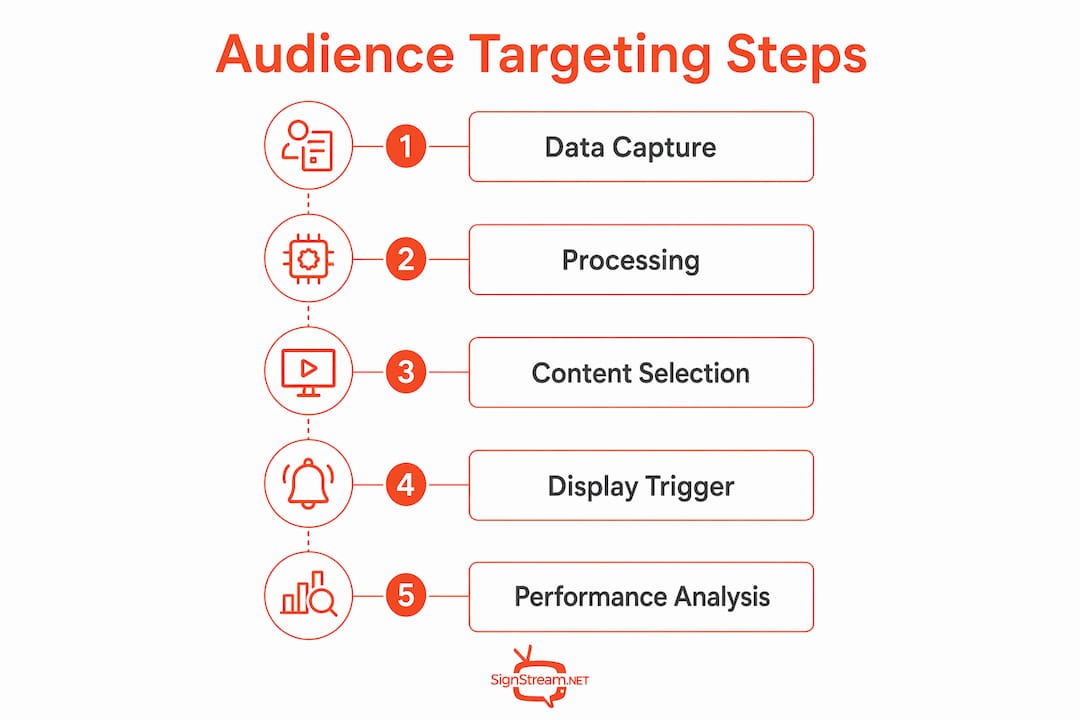
Edge processing handles all of this locally on the device. No personal data travels to a central server, which keeps latency low and privacy compliance intact. The screen switches content without any visible delay, so the shopper experience feels natural rather than mechanical.
Key technology components and operational steps:
AI-powered cameras and sensors capture visual data from the screen’s field of view.
Edge computing hardware processes data on-device, avoiding cloud transmission of personal attributes.
Segment libraries defined by the retailer or advertiser determine which shopper profiles trigger which campaigns.
Content management systems hold the ad creatives and apply the campaign rules in real time.
Analytics dashboards aggregate anonymized metrics for post-campaign reporting.
Why audience targeting in retail digital signage pays off
The business case is straightforward. Targeted messaging reduces ad waste by ensuring promotions reach shoppers who are actually relevant to the campaign, rather than broadcasting to everyone who passes by. That efficiency directly improves return on ad spend.
Beyond ROAS, there is a media inventory angle that many retail managers overlook. When you can sell screen time based on addressable audiences rather than just location, you can charge premium rates. Advertisers pay more for verified reach among a defined demographic than for a screen placed near a particular shelf. That shift in valuation turns your in-store screen network into a genuinely high-margin media asset.
Key benefits of audience-targeted retail screen advertising:
Higher ad effectiveness: Relevant content drives stronger shopper attention and recall than generic loops.
Reduced wastage: Ads reach only the shoppers who match the target segment, making every playout count.
Premium media pricing: Addressable audience data justifies higher CPMs for advertisers.
Flexible campaign management: Digital screens allow instant creative updates and A/B testing across the network without printing or shipping costs.
Monetization potential: Retailers can sell screen inventory to brand partners, creating a new revenue stream from existing infrastructure.
Privacy and ethics: what responsible targeting looks like
The most common concern retailers raise about audience targeting is privacy. The good news is that modern systems are built specifically to avoid it being a problem. Anonymized data processing means the system never identifies a specific individual. It detects that a shopper appears to be a woman in her 30s, matches that to a segment, and moves on. No name, no face record, no persistent profile.
Edge processing reinforces this. Because all analysis happens on the device itself, no personal data is transmitted or stored anywhere. That architecture makes GDPR compliance straightforward, and it applies equally well to US privacy frameworks like the California Consumer Privacy Act (CCPA).
Best practices for privacy-responsible audience targeting:
Process data at the edge: Keep all attribute detection local to the screen device, with no cloud transmission of visual data.
Collect no PII: Design segment libraries around anonymous attributes only, never names, loyalty IDs, or biometric records.
Post clear in-store notices: Inform shoppers that screens use anonymous audience detection, even when no legal requirement mandates it.
Audit segment definitions regularly: Review what attributes trigger which campaigns to prevent unintended discriminatory targeting.
Work with GDPR-compliant vendors: Verify that any third-party technology provider meets both US and international privacy standards.
Pro Tip: Use website engagement scoring principles to benchmark how your in-store audience segments perform against your digital channel data. The overlap often reveals which shopper profiles are most valuable across both environments.
What industry research and Signstream’s platform tell us about 2026
The shift from location-based to audience-based retail media valuation is the defining trend of 2026. Modern smart signage converts in-store shoppers into anonymized, addressable, and measurable audiences that can be targeted with programmatic ad buying, bringing online-level precision to physical retail for the first time. Media planners who still price in-store inventory purely by location are leaving revenue on the table.
Signstream clients report a rise in class attendance after implementing dynamic digital signage, demonstrating that relevant, real-time content drives measurable behavioral change, not just impressions.
Signstream’s platform is built for exactly this environment. You can update content across unlimited screens instantly from any device, run targeted promotions, and track performance through built-in analytics. The ad exchange marketplace lets you monetize your screens by selling inventory to local brand partners or cross-promoting across other businesses in the network.
Key takeaways from 2026 research and platform capabilities:
AI-driven audience detection is now accessible to retailers of all sizes, not just enterprise chains.
Programmatic buying of in-store screen inventory is becoming standard practice among major grocery and FMCG advertisers.
Retailers using addressable audience data report stronger advertiser confidence and higher media revenue.
Signstream’s analytics give you campaign metrics comparable to online digital advertising, including impressions and dwell time.
The platform requires no technical expertise, so your marketing team can manage campaigns without IT support.
Real-world examples of audience targeting strategies on retail screens
Seeing how other retailers apply these strategies makes the concept concrete. Kroger, in partnership with Barrows Connected Store, has deployed digital end-cap screens in grocery and health-and-beauty aisles. According to Kroger Precision Marketing, end-cap screens generate the most brand interest of any in-store placement because the content sits directly next to the product. Sensors measure impressions and dwell time, giving advertisers verified performance data.
CVS Pharmacy has taken a similar approach, with digital end caps in more than 600 stores. CVS research found that 70% of its customers say they find the screens useful, a figure that reflects what happens when content is relevant to the moment rather than generic. The screens balance brand storytelling with timely messaging like seasonal promotions, adjusting by shopper context rather than running a fixed loop.
Beyond grocery, convenience store DOOH networks place high-definition screens at checkout lanes and ATM terminals, where shoppers are in a focused, purchasing mindset. That placement captures attention at the exact point of decision, making interest-based and behavioral targeting especially effective. A screen showing a cold beverage promotion to someone waiting at a checkout counter is audience targeting at its most direct.
Challenges and limitations you should plan for
Audience targeting on retail screens is powerful, but it comes with real constraints. Hardware costs for AI-enabled cameras and edge processing units are higher than standard digital signage, which can make the business case harder for smaller retailers with limited screen networks. The ROI calculation depends heavily on how much media inventory you can sell and at what CPM.
Data quality is another practical challenge. Segment matching is only as good as the predefined audience libraries you build. Poorly defined segments produce irrelevant content triggers, which undermines both shopper experience and advertiser confidence. Building accurate, meaningful segments requires real first-party data and regular refinement, not a one-time setup.
Finally, shopper behavior in physical retail is harder to predict than online behavior. A person standing in front of a screen may be waiting for a companion, checking their phone, or simply pausing. Dwell time signals can be ambiguous, and systems that over-index on a single attribute risk serving irrelevant content. Combining multiple signals, demographic, behavioral, and contextual, produces more reliable targeting than any single dimension alone.
How to measure the effectiveness and ROI of audience-targeted content
Measurement on retail screens has caught up with online advertising in meaningful ways. The core metrics to track are impressions (how many shoppers were detected in front of the screen), dwell time (how long they stayed), and qualified views (impressions that met a minimum attention threshold). These mirror the metrics digital media buyers already use, which makes it easier to compare in-store and online campaign performance side by side.
Connecting screen metrics to sales data is where the real ROI picture emerges. Retailers like Kroger track campaign performance at the product level, attributing screen exposure to purchase behavior in specific aisles. That SKU-level attribution gives brand partners the confidence to invest more in in-store media, because the link between ad exposure and sales is direct and verifiable.
Pro Tip: Run A/B tests by serving two different creatives to the same audience segment across matched store locations. Compare dwell time and sales lift between the two groups to identify which message drives stronger results before scaling across your full network. A retail promotion checklist can help you structure these tests consistently.
Technologies that make audience detection possible on retail screens
The hardware and software stack behind audience targeting has matured considerably. Computer vision cameras, often integrated directly into the screen housing, handle the visual detection layer. They capture the field of view in front of the display and feed that data to an on-device AI model. The model classifies anonymous attributes like age range, gender, and group size without storing any image data.

Wi-Fi and Bluetooth sensors add a complementary layer, detecting device signals from shoppers’ phones to estimate foot traffic patterns and dwell time across a store zone. This data does not identify individuals but gives retailers a richer picture of how shoppers move through the space. Combined with camera-based detection, it produces a more complete behavioral signal for segment matching.
AI and computer vision technologies are also enabling context-aware content decisions that go beyond shopper demographics. Time of day, weather data, and real-time inventory levels can all feed into the content decision, so a screen near the entrance might promote hot drinks on a cold morning and switch to cold beverages by midday. That kind of contextual layering, built on top of audience detection, is where in-store digital signage is heading in 2026.
Key Takeaways
Audience targeting on retail screens delivers measurable advertising value by matching content to the real shoppers in front of the display, using AI detection, edge processing, and anonymized segment matching.
Point | Details |
Core mechanism | AI sensors detect anonymous shopper attributes and trigger relevant ads within milliseconds. |
Privacy by design | Edge processing keeps all data local; no PII is collected, stored, or transmitted. |
Revenue opportunity | Addressable audience data lets retailers charge premium CPMs and sell inventory to brand partners. |
Measurement parity | Metrics like impressions, dwell time, and qualified views match online advertising standards. |
Platform readiness | Signstream clients report a rise in attendance after deploying dynamic, targeted screen content. |
Ready to turn your retail screens into a targeted media network?
Signstream gives you the tools to run audience-targeted campaigns across unlimited screens, update content instantly from any device, and monetize your screen network through a built-in ad exchange. No technical expertise required, and no extra charge for additional screens.
Explore the Signstream ad display network to see how retailers are turning in-store screens into high-margin media assets, or check how the platform works to get started today.
Recommended
Comments