

How Digital Signage Drives Gym Member Retention
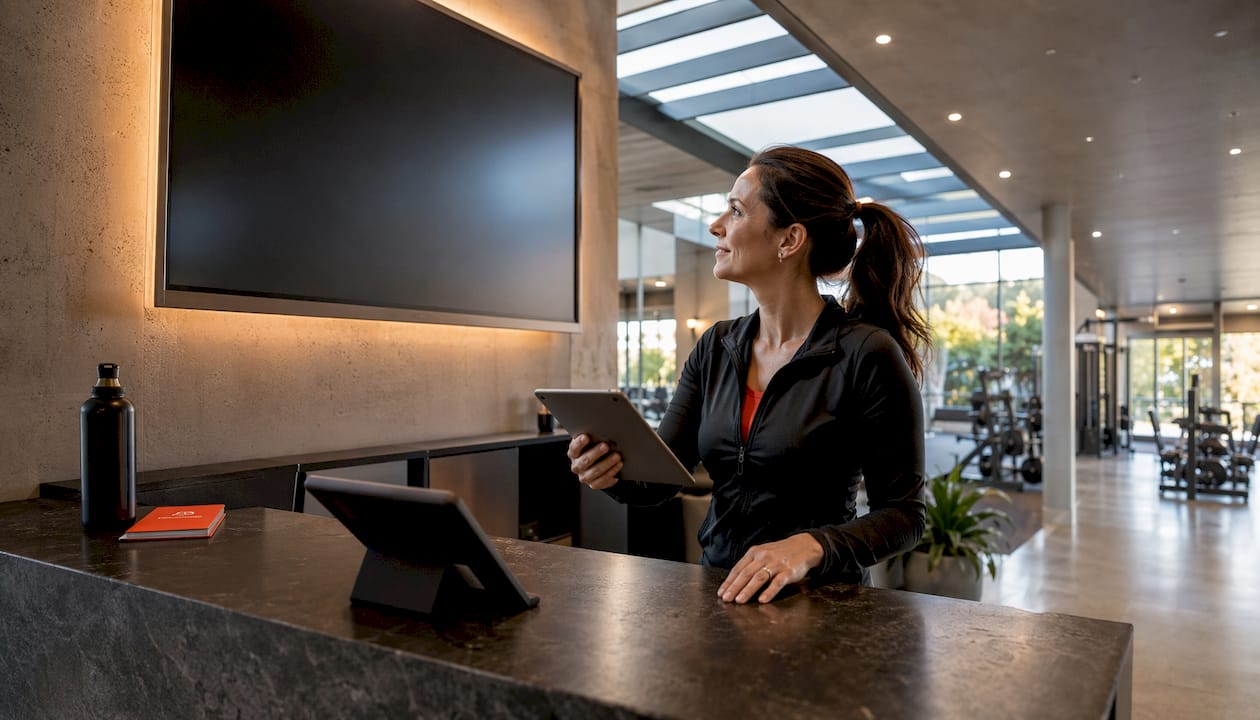
The role of digital signage in gym retention is more direct than most managers realize. Members don’t quit because they hate working out. They quit because they feel disconnected, uninformed, and uninspired. Dynamic screens placed throughout your facility change that equation by delivering real-time motivation, community recognition, and clear communication exactly when members need it most.
Here’s what that looks like in practice:
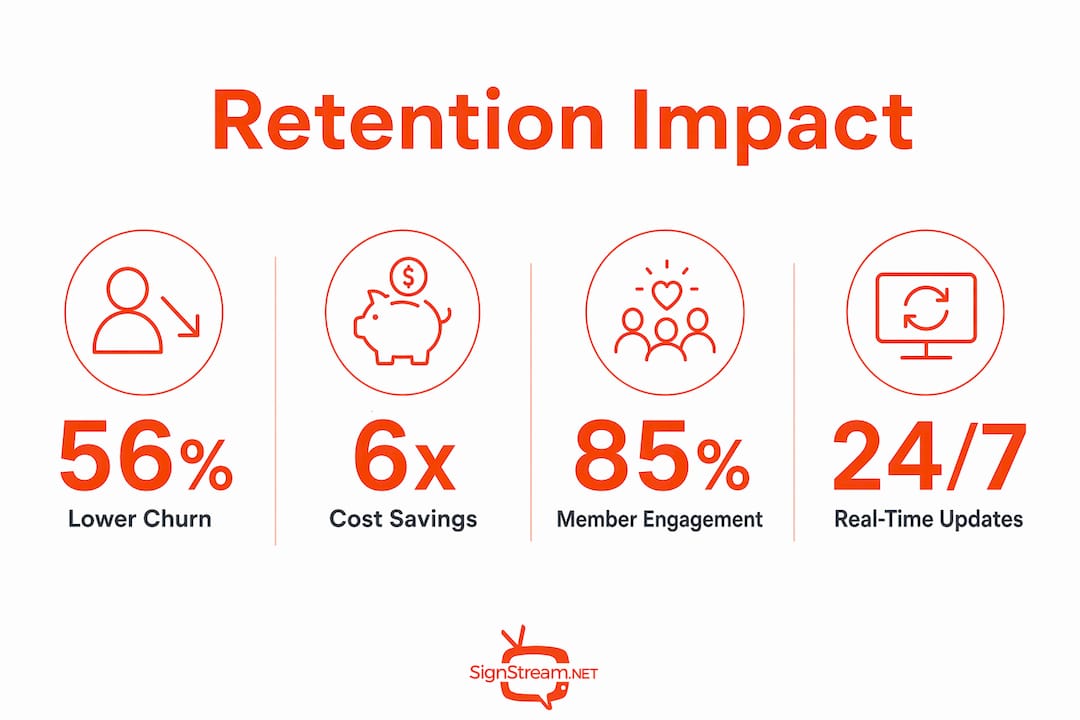
Reduced churn: Gyms face an average annual departure rate of about 28%. Digital signage addresses the gradual detachment that drives those exits and helps lower that rate.
Stronger engagement: Live class schedules, member spotlights, and motivational content keep members mentally connected to your facility between visits.
Operational efficiency: Screens handle routine announcements automatically, freeing your staff for higher-value interactions.
Measurable loyalty: When members feel seen and informed, they stay longer and spend more.
Acquiring a new member costs five to six times more than keeping an existing one. That single figure makes every dollar invested in retention technology worth scrutinizing carefully.
Table of Contents
How digital signage directly improves gym member retention
The digital display impact on gym loyalty comes down to one core mechanism: consistent, relevant communication at the moment a member is most receptive. Someone mid-cardio session, watching a countdown timer on screen, is primed to absorb a motivational message or a class promotion. Static posters can’t do that. A front-desk employee can’t be everywhere at once.
The benefits stack up across several dimensions:
Motivation and workout experience: Rotating fitness tips, challenge countdowns, and personal records displayed on screen give members a reason to push harder and come back tomorrow.
Timely communication: Real-time class schedule updates prevent the frustration of showing up for a canceled class, which is one of the most common triggers for cancellation.
Community and social proof: Member spotlights and achievement boards transform individual wins into shared celebrations, building the sense of belonging that budget gyms can’t replicate.
Personalized, dynamic content: Unlike a printed flyer, digital content can shift by time of day, audience segment, or current promotion without any printing cost.
Upsell opportunities: Screens in high-traffic zones promote personal training packages, nutrition programs, and retail products to members who are already engaged and on-site.
The combination of these factors doesn’t just reduce churn. It builds the kind of loyalty that turns members into advocates who bring friends through your door.
Content strategies that actually keep members engaged
Knowing you need digital signage is one thing. Knowing what to put on it is where most gyms fall short. The content mix matters as much as the hardware.

Motivational messaging and fitness challenges are your highest-frequency content. Short, punchy quotes from athletes, weekly step challenges, or a live leaderboard for a 30-day squat challenge give members something to look forward to on every visit. Pair this with personalized music for gym sessions and you create an atmosphere that feels curated rather than generic.
Live schedules and real-time updates belong on every screen near the entrance and class studios. Members should never have to ask a staff member what time spin class starts. When that information is always visible and always current, you remove a small friction point that, over months, adds up to a member who feels the gym runs smoothly.
Member success stories are underused by most facilities. A 60-second spotlight featuring a member’s before-and-after story, displayed during peak hours, does more for retention than a month of email newsletters. It signals to every other member: this place produces results.
Social media feeds and member-generated content pull your community online presence into the physical space. When members see their own Instagram posts on the gym’s screens, they share that experience with their followers. That’s organic reach you didn’t pay for.
QR codes for immediate engagement close the loop between passive viewing and active participation. Members can scan codes to join raffles, write Google reviews, or download your app while the message is fresh in their mind. The key is placing the QR code on screen at the exact moment the offer is most relevant.
Best practices for placing and running your gym’s screens
Getting the hardware and workflow right determines whether your signage investment pays off or collects dust.
Screen selection matters more than most managers expect. Consumer TVs fail in gym environments because of poor thermal management and inadequate brightness. Commercial-grade screens rated for 24/7 operation with 500–700 nits brightness handle the heat, humidity, and ambient light that would degrade a standard TV within months.
Placement should follow member behavior, not aesthetics. The lobby captures first and last impressions. Cardio zones offer the longest uninterrupted viewing time, making them ideal for longer content loops. Free weight areas and locker room entrances are prime spots for class promotions and community content. Each zone has a different audience mindset, so the content should reflect that.

Integration with your membership and scheduling systems is what separates a functional signage setup from a powerful one. When your screens pull live data from your booking platform, schedule changes appear automatically without anyone manually updating a slide. Platforms like Signstream allow instant multi-screen updates from any device, so a manager can push a last-minute class change from their phone and have it live on every screen in under a minute.
Content scheduling should match your member traffic patterns. Morning content can focus on energy and motivation. Midday screens might promote lunchtime express classes. Evening content can highlight recovery, nutrition, and tomorrow’s schedule. This kind of intelligent scheduling makes your screens feel relevant rather than repetitive.
Network stability is non-negotiable. A screen that goes dark or loops an error message during peak hours undermines the professional image you’re building. Invest in a dedicated network connection for your signage system and use a platform that supports remote monitoring so you know immediately if a screen goes offline.
Real results: what digital signage delivers in practice
The numbers from actual gym implementations tell a clear story. Elite sports clubs using Signstream’s platform have reported a 25% rise in class attendance after deploying dynamic digital signage. That’s not a marginal improvement. A 25% attendance increase translates directly to stronger habit formation, and members who attend more frequently are significantly less likely to cancel.
Metric | Before Digital Signage | After Digital Signage |
Class attendance rate | Baseline | +25% increase |
Member communication method | Staff-dependent | Automated, real-time screens |
Schedule change response time | Minutes to hours | Immediate, facility-wide |
Upsell visibility | Printed flyers | Dynamic, targeted promotions |
Community recognition | Occasional staff mention | Regular on-screen spotlights |
Key finding: Gyms that implement dynamic digital signage see measurable attendance improvements within weeks of deployment, with elite sports club clients reporting a notable rise in class attendance through Signstream’s platform.
The standout campaigns share a common thread: they make individual members feel like part of something larger. A monthly “Member of the Month” display, a live fundraising thermometer for a charity fitness challenge, or a countdown to a facility upgrade all create shared investment in the gym’s story. Members who feel invested don’t cancel.
Measuring whether your signage is actually working
Gut feeling isn’t a retention strategy. You need data to know whether your screens are driving the outcomes you’re paying for.
Screen impressions and dwell time tell you how many members are seeing your content and for how long. High impressions with low dwell time suggest content that isn’t holding attention.
QR code scan rates give you a direct conversion metric. If you run a promotion with a QR code and track scans, you know exactly how many members engaged with that specific message.
Class booking rates correlated with schedule displays show whether your real-time schedule content is driving sign-ups.
Membership renewal rates before and after campaigns provide the clearest picture of retention impact. Run a member spotlight series for 90 days and compare renewal rates to the same period the prior year.
Analytics dashboards built into modern signage platforms show screen impressions and interaction data that managers can use to refine campaigns and increase ROI. The goal is a continuous feedback loop: run content, measure response, adjust, and repeat. Gyms that treat their signage as a set-and-forget system miss most of the retention value.
How social media integration turns your screens into a referral engine
This is where digital signage benefits for fitness centers get genuinely interesting. Most gyms think of their screens and their social media presence as separate channels. The smarter approach is to merge them.
When members post gym photos under your branded hashtag and those posts appear live on your facility’s screens, two things happen simultaneously. First, the member who posted feels recognized, which deepens their emotional connection to your gym. Second, every other member in the room sees that post and the hashtag, which prompts them to participate. The result is a self-reinforcing referral engine that grows your social reach without additional ad spend.
Pro Tip: Set up a dedicated branded hashtag for your gym and display a live social feed on your lobby screen. Announce it during peak hours with a simple on-screen prompt: “Post your workout with #[YourGymTag] and see it here.” Members love seeing themselves on the big screen, and their followers see your gym.
Social proof works because it’s authentic. A member’s genuine post about hitting a personal record carries more persuasive weight than any ad you could run. Displaying that content in your physical space amplifies it to an audience that is already inside your facility and already considering whether to renew.
Legal and privacy considerations for gym digital signage
Using member photos, names, or personal achievements on your screens requires clear consent. This isn’t optional, and it’s worth getting right before you launch any member spotlight or social media integration campaign.
Written consent is the baseline. Your membership agreement should include explicit language authorizing the gym to display member content on in-facility screens and social media. If your current agreement doesn’t include this, update it and have existing members acknowledge the change.
User-generated content from social media carries its own considerations. When a member posts publicly under your hashtag, they’ve made that content public, but displaying it on your screens in a commercial context is a different use. A brief on-screen disclaimer noting that posts tagged with your hashtag may be featured in the facility covers this clearly.
Sensitive areas require stricter rules. Cameras and screens in locker rooms, changing areas, or restrooms are prohibited under state privacy laws across the US. Signage in these areas should be limited to static or non-interactive displays with no cameras or audience-measurement sensors.
Data collected through QR codes and analytics tools falls under your privacy policy. If your signage platform collects impression data or tracks interactions, that data handling should be disclosed. The TCF consent framework provides a useful reference for understanding consent categories around data collection and tracking, even in physical environments.
Cost, ROI, and what to budget for gym digital signage
The cost of digital signage for a gym ranges widely depending on screen count, hardware quality, and software platform. A realistic entry point for a mid-size facility is a few commercial screens, a content management platform, and installation. The ongoing cost is primarily the software subscription and occasional content production.
The ROI calculation is straightforward when you anchor it to retention economics. If retaining one member for an additional year generates $600–$1,200 in revenue (a reasonable range for US gym memberships), and your signage investment helps retain even a handful of additional members per month, the math works quickly. The value of keeping the right customers compounds over time as retained members refer others and purchase additional services.
Platforms like Signstream remove one of the traditional cost barriers by allowing deployment across unlimited screens at no extra charge per screen. That changes the unit economics significantly for multi-location operators or large facilities. You’re paying for the platform, not for each additional screen you add. The ad exchange marketplace built into Signstream also creates a secondary revenue stream: your screens can display cross-promotions from local businesses, turning a cost center into a partial revenue source. For a deeper look at how this plays out financially, the digital signage and club revenue guide covers the numbers in practical detail.
Content production cost is often overestimated. Modern signage platforms include templates that non-designers can use to produce professional-looking content in minutes. The bigger ongoing investment is strategic: someone on your team needs to own the content calendar and keep it fresh.
Signstream gives your gym screens that actually work for retention
Most gym managers know they need better member communication. Signstream is built specifically for that problem, and it’s designed so you don’t need a technical background or a dedicated IT team to run it.
With Signstream, you can update every screen in your facility instantly from your phone or laptop, push real-time class schedule changes, run member spotlights, and display live social media feeds. The platform deploys across unlimited screens at no extra charge, so scaling from one location to five doesn’t multiply your software costs. Elite sports clubs using Signstream have reported a notable rise in class attendance, a result that shows up in renewal rates and revenue. The built-in ad display network lets you cross-promote with local businesses and generate income from your screens, offsetting the platform cost. See how it works and get your screens doing real retention work from day one.
Key Takeaways
Digital signage is a highly cost-effective tool US gyms have for reducing the annual member departure rate, because it delivers motivation, communication, and community recognition at scale without adding staff.
Point | Details |
Annual churn is high | Gyms face an average annual departure rate of about 28%; dynamic screens directly address the detachment that drives it and help reduce this number. |
Attendance lifts are measurable | Elite sports club clients using Signstream report notable rises in class attendance after deployment. |
Retention beats acquisition | Keeping a member costs significantly less than acquiring a new one, making signage ROI straightforward to calculate. |
Social integration amplifies reach | Displaying branded hashtag posts on screens builds community and drives organic referrals without additional ad spend. |
Signstream scales without extra screen fees | Unlimited screen deployment at no extra charge makes Signstream a practical choice for growing or multi-location gyms. |
Recommended
Comments