

Make Place Based Ad Networks Measurable: Programmatic Steps for Marketers

A place-based ad network delivers digital ads on screens installed in physical venues, such as gyms, waiting rooms, transit stations, and retail checkout lines, where dwell time and location context make the message relevant. For marketers, that means measurable audience exposure tied to a specific setting rather than a broad geographic radius, and the fastest-growing versions now plug directly into programmatic pipelines governed by OAAA and Geopath measurement standards.
TL;DR:
Place-based ad networks target specific venue audiences, with high dwell times in environments like gyms, healthcare facilities, and transit stations, enabling behavior-focused messaging.
Measurement relies on foot traffic models, mobile location data, and direct actions like QR code scans, but accurate attribution requires syncing GPS logs with ad play for moving inventory.
Programmatic buying through private marketplaces offers control and certainty, with pricing based on venue dwell time and audience quality rather than total impressions.
Creative should be tailored to screen location and dwell time, favoring quick offers with prominent branding, large text, and simple calls to action like QR codes or short URLs.
Building your own place-based network with platforms like SignStream allows for unlimited control and monetization of in-house screens, reducing reliance on third-party inventory.
Table of Contents
What Sets a Place-Based Ad Network Apart From Other OOH?
A place-based ad network is a collection of digital screens deployed inside specific venue types, sold and measured as a distinct audience segment rather than a slice of general foot traffic. That distinction matters more than it sounds. Traditional out-of-home advertising sells reach across a broad geography, a billboard on a highway or a poster wall downtown, aimed at anyone who happens to pass by. Place-based networks sell context: a screen in a gym locker room reaches people mid-workout, and a screen above a pharmacy counter reaches people waiting on a prescription.
Mobile location-based ads, by contrast, follow a person’s device wherever it goes and serve ads on their phone. Place-based ads stay fixed to a venue and serve the room, not the individual. That difference changes everything about how you plan creative, measure results, and price the buy.
The industry uses several overlapping names for this category, and you’ll see all of them in RFPs and vendor decks:
Place-based advertising — the umbrella term used by trade groups like the OAAA
Digital out-of-home (DOOH) — technically accurate but broader, since it includes billboards and transit shelters too
Venue-specific networks — used when describing a single vertical, like healthcare waiting rooms or fitness clubs
Captive-audience networks — an older term still used for elevators and gas station pumps
Venue-level targeting wins over broad reach when the objective is behavioral, not just visibility. A gym screen promoting a new class format reaches people who are already primed to act on fitness messaging. A billboard reaches everyone equally, including people who will never set foot in a gym.
Which Venues and Screen Types Make Up These Networks?
Inventory in this category spans a wider range of environments than most media planners expect, and each venue type carries its own measurement quirks.
Common venue categories include:
Fitness and wellness — gyms, yoga studios, and health clubs, often with high repeat visitation from the same audience
Healthcare — waiting rooms, pharmacies, and urgent care lobbies, where dwell time frequently runs 15 minutes or longer
Transit — subway platforms, bus shelters, and airport terminals, where audiences are large but exposure per person is often brief
Retail and grocery — checkout lines, endcaps, and entryway screens, ideal for last-mile purchase influence
Gas stations — pump-top screens with short, forced dwell time during fueling
Elevators — a captive, screen-facing audience for 30 to 90 seconds per ride
Moving inventory — screens mounted on delivery vehicles, rideshare cars, or transit vehicles, which introduce a location variable that static screens don’t have
Stationary screens are simpler to measure because the location never changes. A screen bolted to a gym wall has one fixed set of coordinates, so exposure estimates rely on venue foot traffic and screen dwell zones. Moving inventory is harder. A screen mounted on a delivery van plays ads while the vehicle travels through multiple neighborhoods, so exposure has to be tied to GPS logs synced with the ad-play schedule rather than a single static address.
Screen placement drives both creative decisions and KPI selection. A pump-top screen with a five-second average glance calls for a single bold message and a QR code, not a 30-second brand story. A waiting room screen with a 20-minute average dwell time can carry a full narrative arc, rotating creative, and even secondary calls to action.
Pro Tip: Before locking a media plan, ask the venue operator for average dwell time by zone, not just total foot traffic. A location with huge daily visitor counts but 10-second average glances performs very differently than one with fewer visitors who linger.

How Do Geotargeting, Geofencing, and Proximity Differ?
Precision targeting is what separates a modern place-based ad network from a screen that simply plays a loop of ads to whoever walks by. Three terms get used almost interchangeably in sales decks, but they mean different things operationally.
Geotargeting filters by broad geography, such as a city, ZIP code, or radius around a venue. It’s useful for planning which markets to buy into, but it doesn’t validate whether anyone actually entered a location.
Geofencing draws a virtual boundary around a specific point, like a store entrance, and triggers an action, an impression count, a follow-up mobile ad, when a device crosses that boundary in real time.
Proximity targeting narrows further still, often using beacon or Wi-Fi signals inside a venue to detect presence within a few meters, useful for aisle-level or department-level relevance.
Foursquare has built much of the underlying infrastructure that makes geofencing reliable at scale. Its stop-detection technology and “Snap-to-Place” logic correct for GPS drift, the common problem where a phone’s location reading places someone in a parking lot instead of the store they actually entered. Point-of-interest (POI) datasets like these let networks validate that a visit really happened, rather than assuming it did because a phone passed within 200 meters.
Once targeting is defined, activation runs through a programmatic pipeline that looks a lot like digital display buying. Supply-side platforms (SSPs) connect venue inventory to demand-side platforms (DSPs), where buyers set targeting parameters and budgets. Deals typically run as private marketplaces (PMPs), where a buyer gets negotiated access to specific inventory at a set rate, or occasionally as programmatic guaranteed (PG) deals, which lock in fixed impression volumes in advance. Dynamic creative optimization can swap messaging based on time of day, weather, or venue type, all without a human touching the campaign after launch.
How Do You Measure Exposure and Attribution?
Measurement in this category has historically lagged behind digital display, mostly because “how many people saw this screen” is harder to prove than “how many people clicked this banner.” That gap is closing, but marketers should plan for modeled estimates, not exact counts.
Three data inputs typically combine to produce an audience estimate:
Modeled traffic data, often built from syndicated mobile location panels calibrated against venue-reported visitor counts
Mobile location data, used both for reach modeling and for post-exposure attribution when a device that saw an ad later visits a related location
QR code and NFC scan attribution, which offers a direct, countable action tied to a specific screen and timestamp
The OAAA has partnered with Ipsos on a pilot program designed to standardize impression, reach, and frequency metrics across OOH environments, aligning them more closely with how digital and TV audiences get measured. Geopath performs a parallel role, maintaining audited traffic counts venue operators and buyers both reference when negotiating rates. For moving inventory specifically, the OAAA’s DMOOH guidelines call for GPS data synced directly with ad-play logs. Without that sync, an operator could technically log an impression while the vehicle was parked in a garage with nobody around, overclaiming reach in the process.
A realistic measurement plan for a place-based campaign includes a few concrete elements: a viewability proxy based on dwell zone and screen angle, a holdout test comparing markets with and without the campaign, and a footfall correlation study checking whether visits to a target location rose during the flight window. None of these are perfect substitutes for a guaranteed impression count, but together they give a defensible read on performance.
What Buying Models and Pricing Structures Are Common?
Three buying paths dominate this space, and the right one depends on how much control you need versus how quickly you want to launch.
Direct buys with a single venue or network operator, negotiated rate and placement, typically the slowest to set up but the most customizable
Venue revenue share, where the screen operator and the venue split ad revenue, common in gyms, restaurants, and retail settings where the venue owns the hardware
Programmatic buying through PMPs, where a buyer gets negotiated access to specific inventory through an SSP, combining speed with some control over pricing and placement
Programmatic guaranteed (PG), which locks in fixed impression delivery at a set price, useful for buyers who need predictable forecasting
Private marketplaces have become the default transaction method in programmatic OOH, and that’s not an accident. OAAA reporting shows PMP deals remain the primary way programmatic OOH gets bought, because they let buyers keep brand-safety and placement controls that fully open auctions don’t offer. The tradeoff is forecasting: a PMP deal usually requires more lead time to negotiate than an open exchange buy, but it gives you far more certainty about where your ads will actually run.
Pricing tends to scale with expected dwell time and venue traffic quality rather than raw impression volume alone. A gas station pump network with millions of glances but five-second attention spans often prices lower per impression than a healthcare waiting room network with a fraction of the traffic but 15 times the dwell time.
What Creative Specs Work Best on Place-Based Screens?
Screen specs vary by venue, but most place-based networks standardize around 16:9 landscape or 9:16 vertical formats, with loop lengths between 8 and 15 seconds for high-traffic, low-dwell locations and up to 30 seconds where dwell time supports it. File sizes usually stay under 50MB for video assets to keep playback smooth across varied hardware.
Lead with the offer or brand name in the first two seconds; don’t build to a reveal
Use a QR code or short URL as the primary call to action, since NFC tap capability still isn’t universal across venue hardware
Time-limited offers (“today only,” “this week”) perform better than evergreen messaging on high-frequency screens
Keep text large and high-contrast; assume viewers are reading from six or more feet away, often in motion
Pro Tip: Test your creative on the actual screen hardware before launch, not just on a laptop preview. Ambient light in a gym or gas station washes out low-contrast colors that look fine on a monitor.
What Campaign Types and KPIs Work Best Here?
Objectives should shape both the venue selection and the metrics you track from day one.
QSR limited-time offer: run on retail and transit screens near store locations, track redemption codes and footfall lift during the flight window.
Retail flash sale: run on in-store and nearby transit screens, track QR scans and same-day POS lift against a holdout market.
Healthcare awareness campaign: run in waiting rooms with longer dwell time, track message recall through post-visit surveys rather than click-based metrics.
Gym membership drive: run inside fitness venues themselves, track sign-up attribution through a dedicated QR code and compare against baseline sign-up rates.
A short pilot works best with two or three test venues, a four-week flight, and a clear success threshold, such as a 10% lift in tracked redemptions, agreed on before launch rather than after.
How Does a Platform Like SignStream Fit Into This Model?
Screen networks live or die on how easily operators can update content and prove results, and that’s exactly where a platform like SignStream fits into the place-based model. SignStream lets venue operators push content changes to every screen instantly from any device, without additional fees based on the number of displays in the network.
Real-time content updates mean a gym can promote a class change or fill an empty session the same morning it happens
An unlimited screen structure lets a multi-location operator scale from one venue to dozens without new licensing costs
A built-in ad exchange marketplace lets venue owners cross-promote with nearby businesses and generate revenue from their own screens
Some clients have reported increases in class attendance after implementing dynamic signage tied to real-time scheduling.
For a marketer operationalizing this, the workflow looks straightforward: segment creative rotation by time of day and venue zone, attach a dynamic QR code to each offer for simple attribution, and check the analytics dashboard weekly to see which screens and messages are driving the most engagement.
When Should You Actually Use Place-Based Networks?
Place-based networks earn their spot in a media plan when the objective is behavioral and venue-specific, not just top-of-funnel awareness. A brand chasing broad reach is usually better served elsewhere; a brand trying to influence a decision made near the point of action, at a gym, a pharmacy, a checkout line, gets more out of this channel than almost any other.
Three priorities decide whether a launch succeeds: audit inventory dwell time before buying, build your measurement plan before the campaign starts rather than after, and test creative on real hardware. One more thing worth saying plainly: because this channel increasingly leans on location and mobile data for attribution, get consent and data handling right before you activate anything.
— DKS
Build and Monetize Your Own Place-Based Network With SignStream
SignStream gives you a different starting point than most of what this article just covered: instead of buying into someone else’s venue network, you build and control your own, with unlimited screens and no per-screen fees standing in the way of scaling it.
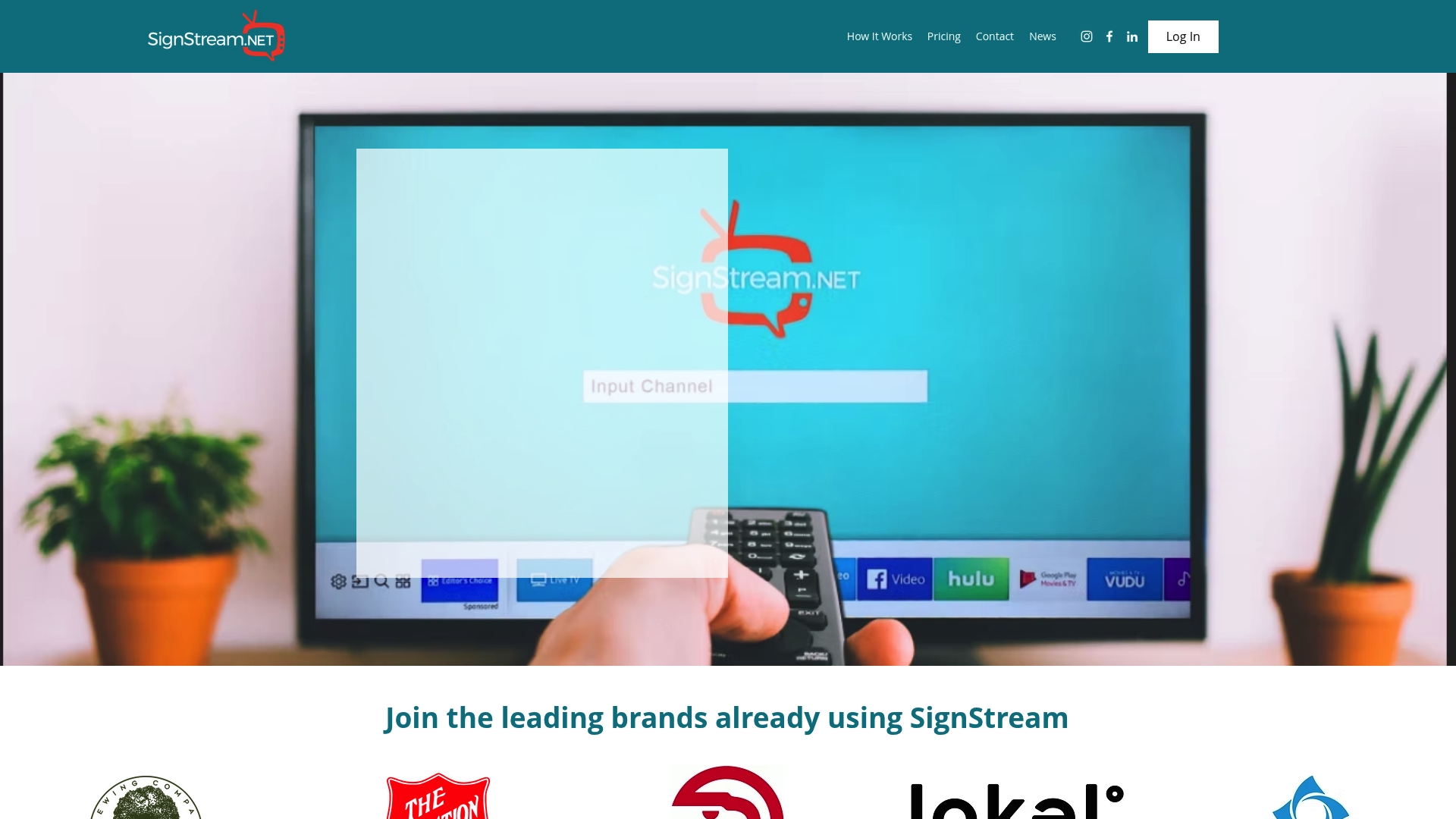
That matters because most place-based inventory belongs to a third-party operator who sets the price and the placement terms. SignStream flips that. You install screens in your own gym, restaurant, retail location, or office, update every one of them instantly from your phone or laptop, and then turn around and monetize that same screen space through the ad exchange marketplace, cross-promoting with nearby businesses or selling placements directly. Pricing runs $10 per month per channel for the SignStream Network plan, or $105 per month per channel for a fully Custom Channel, and the platform requires no technical expertise to run day to day. If you’d rather have the whole setup handled, SignStream’s team covers hardware installation, content design, and ongoing management too. Get a walkthrough of the platform and see current plan details on the pricing page to find the right fit for your venue.
FAQ
What Are Place-Based Ads?
Place-based ads are digital or static advertisements displayed on screens installed inside specific physical venues, like gyms, waiting rooms, or retail stores, where the setting itself makes the message relevant to whoever is present. They differ from general outdoor advertising because they target a defined audience context rather than broad passersby.
What Is the 3-3-3 Rule in Marketing?
The 3-3-3 rule generally refers to a content or messaging guideline where a message should be understandable within 3 seconds, hold attention for roughly 3 key points, and repeat across roughly 3 touchpoints for retention. Definitions vary by practitioner, so treat it as a rough creative heuristic rather than a fixed industry standard.
What Is an Example of an Ad Network in This Category?
A gym chain that installs screens across dozens of locations and sells placements to local businesses through a marketplace, such as SignStream’s ad exchange, functions as a place-based ad network. Larger examples include programmatic-enabled screen networks in transit hubs and retail chains that connect to SSPs like Place Exchange.
What Is the Best Ad Network for a Local Business?
The best network depends on whether you’re buying placements or building your own. For a business that wants to control and monetize its own screens rather than pay a third-party network, a platform like SignStream offers unlimited screen deployment and a built-in marketplace for cross-promotion.
How Do Place-Based Ads Work Technically?
Screens display scheduled or dynamic content tied to a specific venue, and exposure gets estimated through a combination of modeled foot traffic, mobile location data, and direct attribution tools like QR codes. Programmatic-enabled networks additionally connect to SSPs and DSPs, letting buyers activate campaigns through private marketplace deals rather than direct venue negotiations.
Recommended
Comments